Chinese painters have been climbing Yellow Mountain for a thousand years and finding the same thing: granite peaks emerging from cloud, pine trees growing from bare rock, and a landscape that consistently exceeds what the paintings suggest.
About Yellow Mountain
Huangshan entered Chinese artistic tradition through Tang dynasty poets and reached its greatest influence through the 17th-century Huangshan School of painting, whose ink-wash approaches shaped Chinese landscape art for three centuries. UNESCO World Heritage designation in 1990 recognizes both the natural and cultural significance.
What Yellow Mountain is
Huangshan, Yellow Mountain, in Anhui Province has been the subject of Chinese landscape painting and poetry for over a thousand years, and the reason is visible from any of its three main peaks: granite towers emerging from cloud, twisted pine trees growing from apparently solid rock, and a sea of mist filling the valleys below. The mountain is a UNESCO World Heritage Site, designated for both natural and cultural significance, and the most visited mountain in China.
“The mountain is a UNESCO World Heritage Site, designated for both natural and cultural significance, and the most visited mountain in China.”
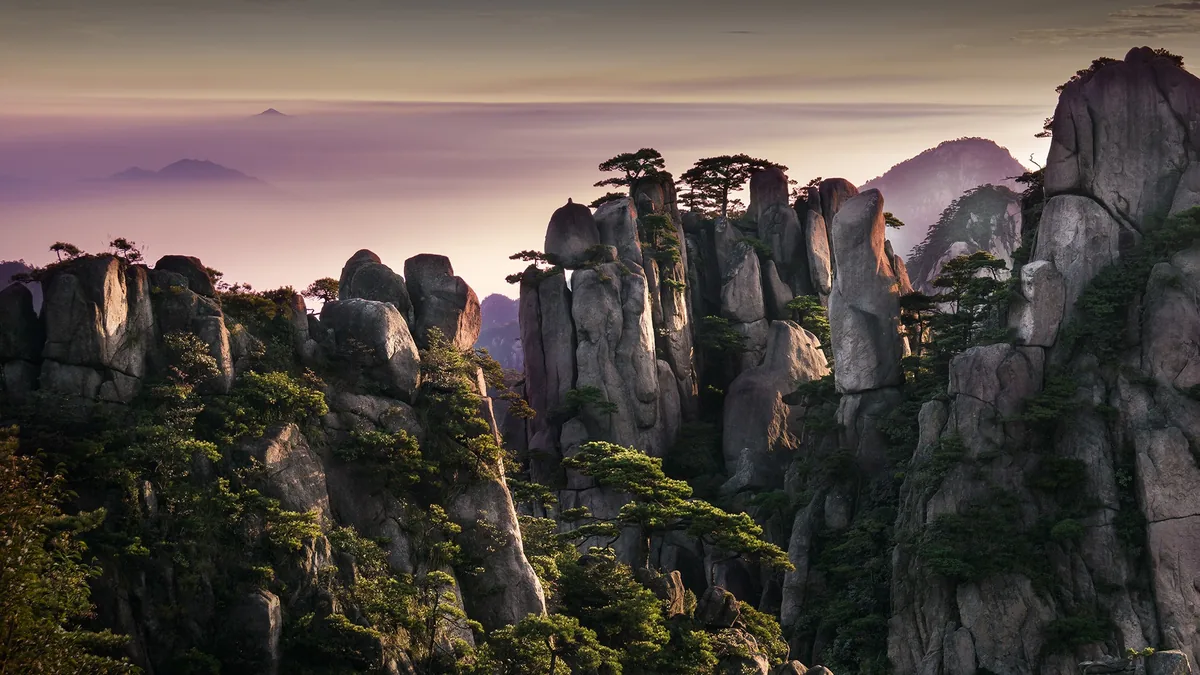
Yellow Mountain, China
How it got this way
Huangshan entered Chinese cultural consciousness through the Tang dynasty poets who climbed it and wrote about the experience, and reached its artistic peak through the Huangshan School of painting that developed in the seventeenth century, artists like Hongren and Shitao who used the mountain's specific formations as both subject and compositional principle, influencing Chinese ink painting for the following three centuries. The mountain's reputation in traditional culture means it carries a weight of expectation that other natural sites don't, and part of the experience is calibrating what you actually see against what centuries of art have suggested you should see.
Huangshan has three main summit areas , Lotus Flower Peak (1,864 meters), Bright Summit (1,860 meters), and Celestial Capital Peak, connected by stone steps and cable car routes. The sea of clouds that fills the valleys on still mornings after rain is the mountain's most celebrated phenomenon; it requires luck and patience but rewards both. The Welcoming Guest Pine, a gnarled formation growing horizontally from granite at the Jade Screen scenic area, is the mountain's most iconic tree and appears on more Chinese souvenirs than any other living organism.
Huangshan city (Tunxi) is connected to Shanghai (2.5 hours), Beijing (5 hours), and Guangzhou by high-speed rail. From the city, buses run to the mountain base; cable cars provide access to the upper plateau. Allow two days minimum for a meaningful visit.
“5 hours), Beijing (5 hours), and Guangzhou by high-speed rail.”
The Experience
Three connected summit areas above 1,800 meters, with cable car access and stone-step trails. The sea of clouds filling the valleys on calm mornings after rain is the mountain's most celebrated and weather-dependent feature.
Why It Matters
Huangshan is both a natural landscape of exceptional quality and the physical source of a major tradition in Chinese visual art, a rare case where the original and its representation have influenced each other across a millennium.
Why Visit
The mountain lives up to its artistic reputation in a way that famous landscapes often don't. Standing above the cloud line on a clear morning, with granite towers and pines in every direction, is an encounter with a landscape that formed part of Chinese aesthetic thought for centuries.
Insider Tips
- 1
Book a mountain summit hotel to be above the clouds at dawn, day-trippers miss the best light.
- 2
The western cable car accesses the most dramatic formations; the eastern cable car is faster for exit.
- 3
Check the weather forecast specifically for cloud inversion conditions, the tourist office and local weather apps track these.