“In 460 CE, a Northern Wei emperor commissioned colossal Buddhas whose faces were modeled on living emperors, a move that merged religious devotion with political legitimacy and produced 51,000 sculptures across 252 caves.”
About Yungang Grottoes
Carved from 460 CE under Northern Wei dynasty patronage, the Yungang Grottoes document the transmission of Buddhist art from Central Asia into China and its adaptation into a distinctly Chinese visual language. UNESCO World Heritage Site since 2001.
What Yungang Grottoes actually is
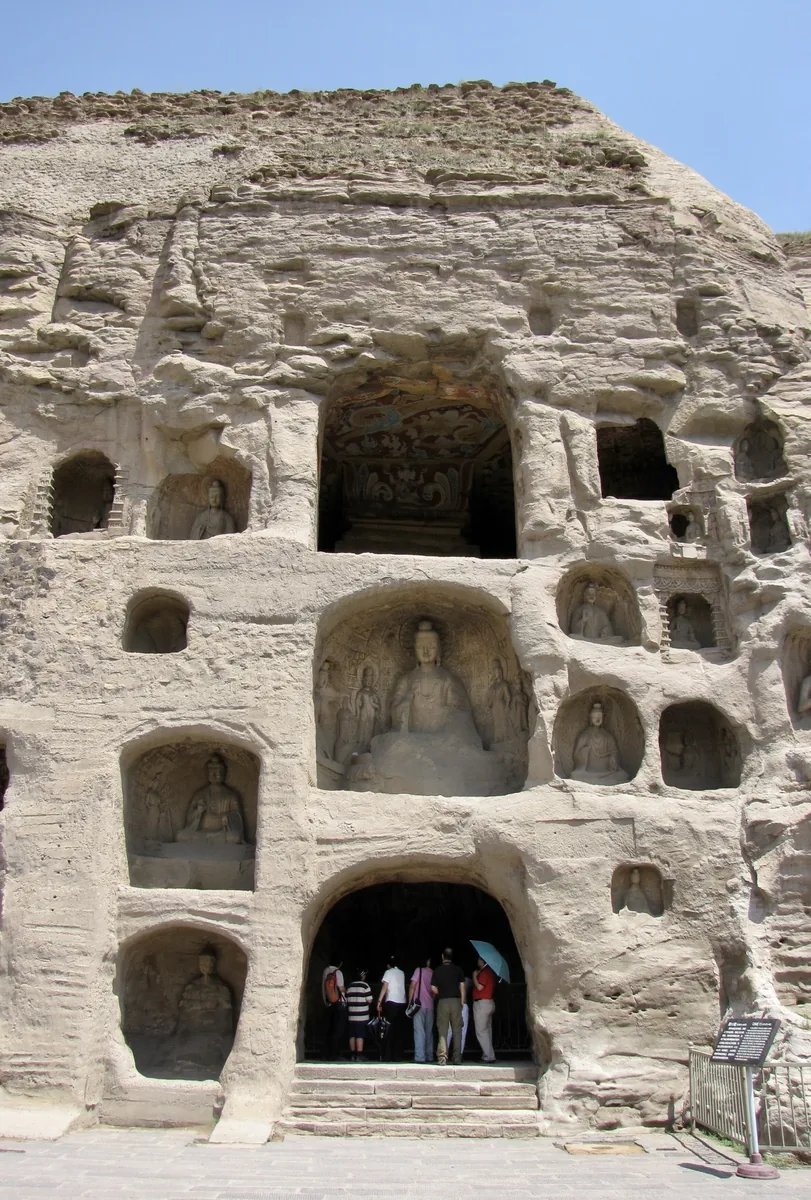
The Yungang Grottoes outside Datong in Shanxi Province contain 252 caves carved into a sandstone cliff during the fifth and sixth centuries CE under the patronage of the Northern Wei dynasty, the first great flowering of Buddhist rock carving in China. The caves hold over 51,000 Buddhist sculptures ranging from 2 centimeters to 17 meters in height, and represent the transmission point between Central Asian Buddhist art traditions and the distinctly Chinese style that would define subsequent centuries of religious sculpture.
Origins
The Northern Wei dynasty, a Xianbei people's state that had conquered northern China in 386 CE, needed to legitimize its rule over a Han Chinese population. Buddhism, newly arrived from Central Asia via the Silk Road, offered a cosmopolitan imperial religion that transcended ethnic identity. Emperor Wencheng commissioned the first major caves in 460 CE under the monk Tanyao; the early caves were designed to house colossal Buddha figures whose faces were modeled on the living emperors, fusing religious veneration with political legitimacy. The artistic style of the earliest caves shows strong Central Asian influence, figures with non-Chinese features, drapery conventions from Gandharan art, before shifting toward a more indigenous Chinese aesthetic in the later caves. The UNESCO listing came the grottoes a World Heritage Site in 2001.
The main cave cluster extends 1 kilometer along the cliff face. The five Tanyao Caves (Caves 16–20) contain the colossal seated Buddhas, Cave 20's 13.7-meter figure, now exposed to open air after its protective canopy collapsed, is the most reproduced image from the site. The middle caves (5 and 6) show the most intricate narrative relief carving, with multi-story towers of figures filling the cave walls.
Datong is connected to Beijing by high-speed rail (2.5 hours). The Yungang Grottoes are 16 kilometers west of Datong; tourist buses run from the city center.
The Experience
A 1-kilometer cliff face with 252 caves, from the five colossal Tanyao Buddhas to the intricately carved narrative reliefs of the middle caves, the stylistic shift from Central Asian to Chinese Buddhist art is visible across the sequence.
Why It Matters
Yungang represents the foundational moment of Chinese Buddhist sculpture, the point where Silk Road artistic traditions met a Chinese imperial context and began producing the forms that defined religious art across East Asia for the following millennium.
Why Visit
The Yungang Grottoes offer the specific experience of standing before art at the historical origin point of a major tradition, here, you can see the Central Asian elements (the faces, the drapery) before they were assimilated into what became recognizably Chinese Buddhist imagery.
✦ Insider Tips
- 1
Start at the eastern end and walk west to follow the chronological development of the carving styles.
- 2
Cave 20 is the most immediately impressive, the open-air seated Buddha repays extended looking.
- 3
The Datong city wall, recently restored, is worth combining with the grottoes on a two-day visit.