Eight hundred years of footsteps have polished the floors of this cathedral, but the stone lions at the gate still look as sharp and dangerous as the day they were carved in 1240.
About Cathedral of St. Lawrence
Master Radovan, the genius behind the portal, signed his work as 'the best of all in this art,' a rare moment of artistic ego in a time of anonymous craftsmen. The cathedral’s construction was a communal effort that survived the plague and various Venetian-Hungarian wars. The bell tower alone took over 200 years to finish, which explains the fascinating shift in style from its simple Romanesque foundations to the ornate Renaissance finish. It was designated a UNESCO site in 1997 as part of the historic core of Trogir, recognized as one of the best-preserved examples of a Romanesque-Gothic town in Central Europe.
Cathedral of St. Lawrence
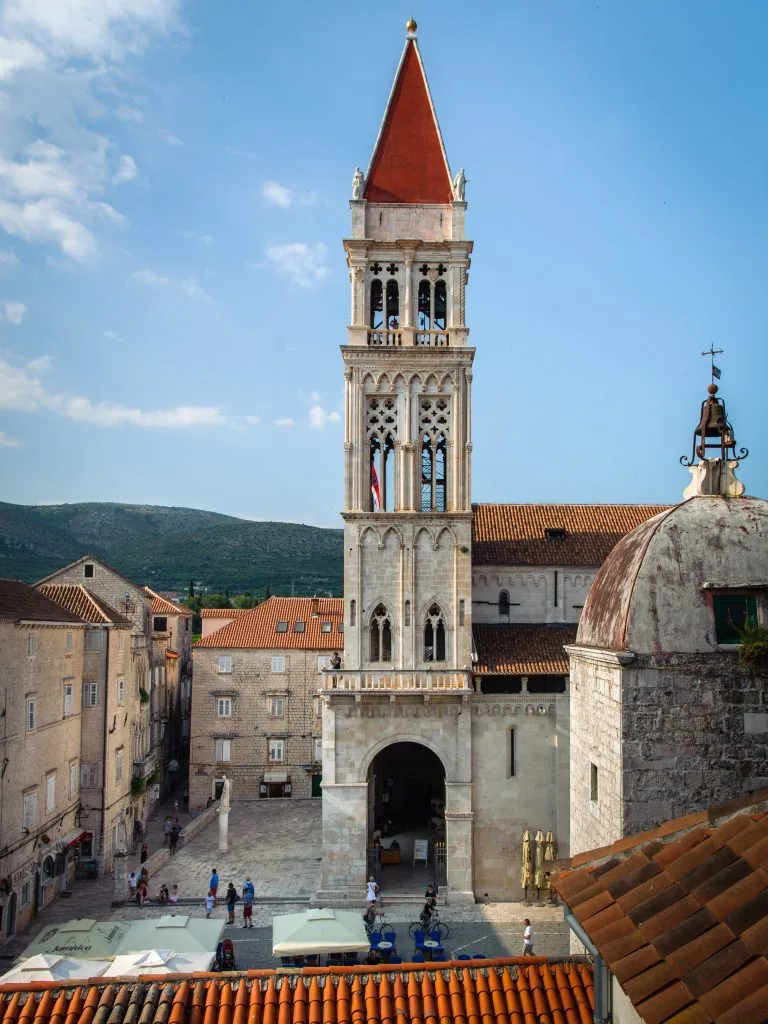
In central the stone-island city of Trogir, the Cathedral of St. Lawrence is still a textbook of architectural history, rising through four centuries of changing styles. Its bell tower is a distinct vertical timeline, where the solid Romanesque base gives way to Gothic arches and finally a Renaissance cap. The centerpiece of the cathedral, and arguably the finest piece of sculpture in the country, is the Radovan Portal, a 13th-century stone entrance so densely carved that it seems to pulse with medieval life. Inside, the air smells of old incense and cold limestone, and the light is filtered through high, narrow windows that create a sense of deep, protective shadow. It is the spiritual anchor of a town that has remained almost entirely within its medieval walls, a place where every stone has a name and a history.
Origins
Construction began in 1213 on the site of an ancient Christian basilica that had been destroyed by Saracen invaders. The building process moved with the slow, deliberate pace of the medieval world, only reaching completion in the 17th century. This extended timeline allowed the cathedral to absorb the best of every era; Master Radovan carved the portal in 1240, while the Chapel of Blessed John of Trogir, a Renaissance masterpiece, was added later by Nikola Firentinac. The cathedral was the pride of the Trogir commune, a statement of their wealth and artistic independence from the nearby powers of Venice and Split. Despite various sieges and the passage of empires, the cathedral’s interior remains one of the most intact and harmonious ecclesiastical spaces in the Mediterranean.
Inside
Approaching the main entrance, The way the two stone lions of the Radovan Portal seem to glare at the passing crowds, supporting the weight of Adam and Eve on their backs. The carving is so intricate that The individual folds of a shepherd’s cloak and the curious expressions on the faces of the zodiac figures. Inside the nave, The sound of the city noise disappearing, replaced by the heavy silence of the vaulted ceiling. What registers is the texture of the choir stalls, carved from dark wood with a precision that mimics the stonework outside. Something like a sense of absolute stillness in the Chapel of Blessed John, where the marble angels look as if they might take flight in the dim light. People generally look up at the altar, but you should notice the uneven, polished surface of the floor stones, worn down by eight hundred years of parishioners. The vibration of the great bells climbing the wooden stairs of the tower, a climb that is narrow and claustrophobic until you reach the open-air summit. Immediately, the way the red roofs of Trogir look like a jigsaw puzzle against the blue of the sea. At the top is salty and fresh, a sharp contrast to the cool, static atmosphere of the crypt below. The cathedral is the focal point of the main square in Trogir. Since the old town is a pedestrian-only island, you must cross the small bridge from the mainland and walk five minutes through the narrow alleys to the center.
The Experience
The light inside is dim, catching the gold of the altarpiece and the white marble of the statues in brief flashes. First, the way the acoustics of the stone chamber make even a whisper feel like a shout. A sense of history that is almost overwhelming, standing in a space that has been the center of life for dozens of generations. The piece that stays with you is standing in the Radovan Portal and realizing that the scenes of daily life carved in 1240, the hunting, the cooking, the farming, are still recognizable to any modern observer.
Why It Matters
The Cathedral of St. Lawrence is the most significant architectural work in Trogir and one of the most important in Croatia. The Radovan Portal is a world-class masterpiece of Romanesque sculpture. Historically, the cathedral represents the continuity of Christian life in Dalmatia and the artistic heights achievable by a small Mediterranean commune.
Why Visit
Check out this cathedral for the portal alone. It is a rare chance to see medieval art that is both monumental and deeply human. While the cathedrals in Split and Šibenik are larger, Trogir offers an intimacy and a concentration of high-quality sculpture that is unmatched in the region. It is the perfect place to see the evolution of European art in a single building.
✦ Photo Gallery
Best Season
🌤 September is the best time to visit, as the summer crowds have thinned and the soft afternoon light is perfect for seeing the details of the Radovan Portal without the harsh glare of July.
Quick Facts
Best time to visit
September is the best time to visit, as the summer crowds have thinned and the soft afternoon light is perfect for seeing the details of the Radovan Portal without the harsh glare of July.
Getting there
In Trogir, Croatia; reach Trogir first, then continue to the site.
Location
Trogir, Croatia
Type
attraction
Insider Tips
- 1
Bring a small flashlight to see the details of the carvings in the darker corners of the portal.
- 2
The climb up the bell tower is steep and the final ladder is not for those with vertigo, but the view is the best in town.
- 3
Look for the 'humorous' details in Radovan’s carvings, like the small animals and the varied expressions of the figures.
- 4
Visit the treasury museum attached to the cathedral to see the incredible collection of medieval textiles and silverware.
- 5
Try to visit during a choral rehearsal or mass to hear the incredible acoustics of the stone nave in action.