“Twenty-five meters high and six meters thick, these stones once protected a republic so wealthy it paid off empires to leave its gates alone.”
About Old City Walls
The construction was a continuous labor of love and survival spanning from the 12th to the 17th centuries. Builders used a unique mortar mixed with goat milk and egg whites to ensure the limestone blocks bonded with legendary strength. The Republic of Ragusa was a master of diplomacy, but the walls provided the hard power that backed up their soft words. Key additions like the Revelin Fortress were built in haste as the Turkish threat grew, yet they possess a terrifying beauty that remains unchanged since the day the last stone was laid. They stand today as the most complete medieval defensive system in Europe.
What Old City Walls actually is
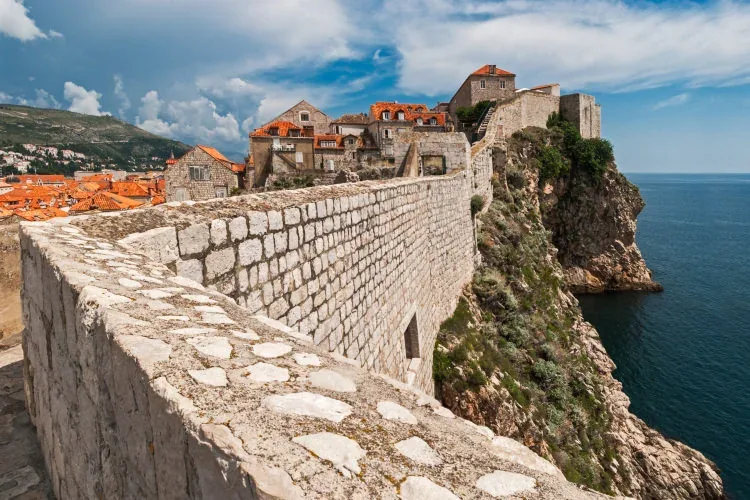
Nearly two kilometers of unbroken white limestone coil around Dubrovnik like a sleeping dragon, separating the shimmering Adriatic from a labyrinth of terracotta roofs. These fortifications do not merely surround the city; they define its character as a place that survived by wit, wealth, and walls. Walking the full circuit offers a shifting perspective of the Dalmatian coast, where the turquoise water crashes against the base of the Minceta Tower and the scent of salt air mingles smelling of wood-fired ovens from the kitchens below. The sheer scale of the masonry feels insurmountable, yet the details are remarkably delicate, from the narrow arrow slits to the gracefully carved gargoyles that have watched the sea for half a millennium.
Nearly two kilometers of unbroken white limestone coil around Dubrovnik like a sleeping dragon, separating the shimmering Adriatic from a labyrinth of terracotta roofs.
Background
Ragusa, the ancient name for Dubrovnik, began building these defenses in the 12th century, but the looming threat of the Ottoman Empire spurred a massive architectural overhaul in the 1400s. Unlike many European cities that relied on foreign mercenaries, the people of Ragusa poured their own maritime wealth into these stones, hiring great minds like Michelozzo di Bartolomeo to perfect their geometry. The walls were never breached by force during their prime. They were designed to withstand not only cannons but also the violent tremors of the 1667 earthquake that flattened most of the city. Even the scars from the 1991 siege are still visible if you know where to look, serving as a silent born from the walls' modern role as a shield for the city's living soul.
Visiting Old City Walls
Ascending the steep stone stairs at Pile Gate, the immediate transition from the packed Stradun to an array of wind and wide horizons. The limestone is polished to a glass-like sheen by millions of footsteps, reflecting the fierce Adriatic sun. The laundry flapping on lines strung between centuries-old windows, a reminder that people still live their private lives within this fortress. What registers is the deep booming sound of the swells hitting the maritime walls of St. John’s Fortress, a rhythmic vibration felt in your chest. Opening with the way the light changes moving from the landward side, shaded by the mountains, to the seaward side where the glare of the water is almost blinding. Almost all visitors focus on the horizon, but you should notice the vegetable gardens tucked into the ruins of old bastions. You come across a grit of sea salt on your skin by the time you reach the maritime museum, realizing that these walls are as much a product of the ocean as the land.
Enter the circuit via the main entrance
Enter the circuit via the main entrance at Pile Gate for the most dramatic climb, or use the quieter entrance near St. Luke’s Church in the east. The walk is best started at 8:00 AM before the heat of the day settles into the stone and the cruise crowds fill the narrow passages.
Enter the circuit via the main entrance at Pile Gate for the most dramatic climb, or use the quieter entrance near St.
The Experience
Around the highest point of the Minceta Tower is thin and tastes of ozone and wild rosemary. Something like a strange sense of vertigo not from the height, but from the realization of how tiny the city below actually is. What emerges is the way the orange roof tiles vary in shade, with the newer, brighter ones marking the houses rebuilt after the 1990s conflict. The detail that stays with you is looking down into a hidden courtyard where an elderly woman is tending to a single lemon tree, oblivious to the world passing by above her head. The opening note is the way the swallows dive through the machicolations, claiming the fortresses as their own nesting grounds.
Why It Matters
The walls are the physical manifestation of the concept of 'Libertas,' the motto of the old Republic. They represent a rare historical moment where trade and culture were prioritized over conquest. Beyond their military utility, they are a masterpiece of medieval urban planning that has preserved a Renaissance city in amber for the modern world.
Why Visit
Walk these stones because no photo can convey the physical weight of the history here. While the city below can feel like a crowded stage set, the ramparts offer a bird's-eye view of a living community and a chance to feel the raw power of the Adriatic wind against a barrier that has never bowed.
✦ Insider Tips
- 1
Purchase your ticket online in advance or use the Dubrovnik Pass to skip the queue at the Pile Gate stairs.
- 2
The walls are a one-way circuit; always walk counter-clockwise to avoid the frustration of swimming against the human tide.
- 3
Look for 'Buža Bar' outside the walls; there are tiny holes in the stone where you can exit for a drink on the cliffs.
- 4
Carry a full water bottle as the prices at the few cafes on top of the walls are significantly inflated.
- 5
Wear rubber-soled shoes, as the ancient limestone can be remarkably slick even when perfectly dry.