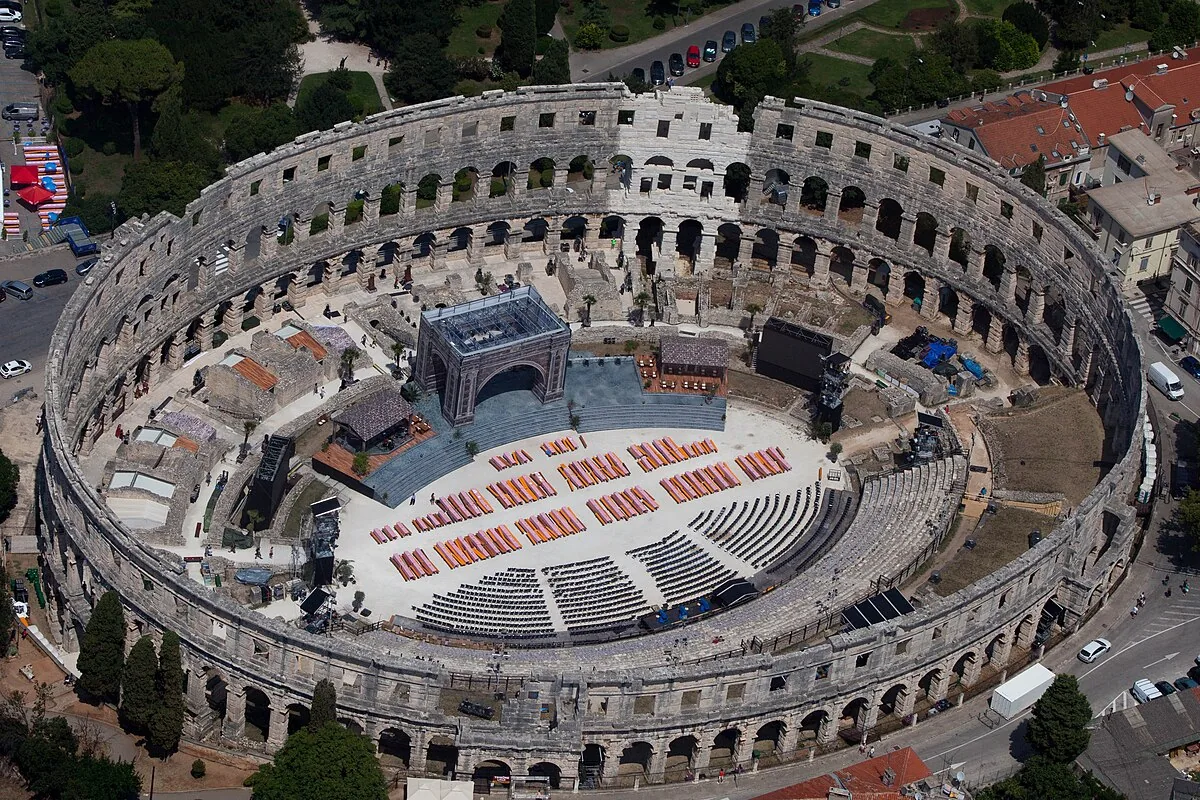
While the Roman Colosseum is a broken masterpiece, Pula's Arena stands so complete that it still hosts movie nights and concerts under its original 1st-century arches.
About Pula Arena
Built during the same period as its more famous cousin in Rome, the Arena was a statement of Pula's importance as a Roman colony. Its construction was a feat of logistics, requiring thousands of tons of stone to be moved by sea. The four towers are a unique feature, originally containing cisterns that provided scented water to be sprayed over the audience. In the 15th century, the Venetians considered dismantling it and moving it to Venice, but the cost was fortunately deemed too high. It remains one of the six largest surviving Roman arenas in the world.
Pula Arena
A perfect circle of Istrian stone rises above the harbor of Pula, a monument to the Roman obsession with spectacle and order. The Pula Arena is the only remaining Roman amphitheater to have all four side towers and all three architectural orders entirely preserved. Built from local limestone that glows with a pale, ghostly light at dusk, the Arena was once the site of bloody gladiatorial combat for 20,000 spectators. Today, it is an open-air cinema and concert hall, its ancient arches framing the modern masts of yachts in the Adriatic. The structure is remarkably intact, lacking the skeletal, broken look of the Colosseum in Rome. Inside, the space the oval feels still and smelling of sun-baked rock and wild herbs growing between the stone seats.
The past
Legend says the Arena was built by fairies in a single night, but history credits Emperor Augustus and later Vespasian in the 1st century AD. It was constructed using stone from the nearby Vinkuran quarry, which is still in use today. During the Middle Ages, the Knights of Malta used the interior for tournaments, and locals often scavenged the site for building materials, though fortunately, the outer walls remained too massive to easily dismantle. In the 19th century, the Arena was restored under the orders of General Marmont during the Napoleonic era, and it has remained the civic pride of Istria ever since. It has survived world wars and the fall of empires, transitioning from a place of death to a place of cultural celebration.
Walking through the arched entrance,
Walking through the arched entrance, The sheer verticality of the three-story walls. The limestone is rough and warm to the touch, pitted by two thousand years of salt air. The detail that registers is the way the light passes through the upper arches, casting long, rhythmic shadows across the gravel floor of the arena. Leading is the sound of your own footsteps crunching on the stone, an echo that would have been drowned out by the roar of thousands in the Roman era. The sudden drop in temperature as you descend into the underground tunnels, where the gladiators and wild animals once waited. You register the faint, musty smell of the earth in these lower chambers, which now house an exhibition on ancient olive oil and wine production. People generally stay in the center, but you should notice the intricate drainage systems carved into the floor, an echo of the Roman genius for infrastructure. There is a sense of continuity seeing the modern stage being set up for a film festival, realizing that the Arena’s purpose has always been to bring people together for a shared experience. What you catch first is the way the white stone turns a deep honey-orange just before the sun dips below the horizon.
The Arena is the centerpiece
The Arena is the centerpiece of Pula and is located just a few hundred meters from the main bus station and the ferry port. It is impossible to miss, as it towers over the northern end of the city center.
The Experience
The quiet of the Arena at midday is a heavy, tactile thing. The gravity of the massive blocks above you as you stand in the vaulted corridors. You register the way the wind from the harbor whistles through the upper windows, a sound that feels like a distant sigh. The tiny wildflowers clinging to life in the cracks of the stone seats, their bright colors a stark contrast to the monochrome masonry. What lingers with you is standing in the center of the oval and realizing that the same sky seen by Roman centurions is now framed by the same limestone curves.
Why It Matters
Pula Arena is the most significant Roman monument in Croatia and a primary symbol of Istria’s Latin heritage. It is an architectural bridge between the Roman world and the modern Mediterranean, proving that even the most brutal spaces can be repurposed for beauty and art over time.
Why Visit
Visit Pula for the Arena because it offers a level of intimacy that larger ruins lack. You can touch the stone, explore the underground passages without a massive crowd, and see a monument that feels like a living part of the city rather than a fenced-off relic.
✦ Photo Gallery
Best Season
🌤 July and August are the months for the Pula Film Festival and major concerts, but September offers the best light and the quietest atmosphere for true exploration.
Quick Facts
Best time to visit
July and August are the months for the Pula Film Festival and major concerts, but September offers the best light and the quietest atmosphere for true exploration.
Getting there
In Pula, Croatia; reach Pula first, then continue to the site.
What's nearby
Euphrasian Basilica is also close by.
Location
Pula, Croatia
Type
attraction
Coordinates
44.8730°, 13.8500°
Insider Tips
- 1
Visit the underground chambers first; they contain a fascinating collection of Roman amphorae used for transporting Istrian olive oil.
- 2
If you don't want to pay for a ticket, walk the perimeter path; the walls are low enough in some sections to see the entire interior.
- 3
Check the schedule for 'Spectacvla Antiqva' during the summer to see a historically accurate gladiator fight inside the Arena.
- 4
Wear a hat and sunscreen; the white limestone reflects the sun intensely and there is almost no shade within the center of the oval.
- 5
The best photo angle is from the park on the harbor side, where you can get the Arena and the sea in a single frame.