Water here does not merely flow; it builds its own stone staircases out of moss and minerals, creating a landscape that is technically alive and constantly growing.
About Plitvice Lakes National Park
For centuries, this was a wild borderland between the Habsburg and Ottoman empires. The first hotels were built in the late 1800s, attracting royalty who sought the 'healing' properties of the mountain air. Scientists have studied these waters since the 1920s, discovering that the specific mosses found here are the essential architects of the waterfalls. The park’s survival through the conflicts of the 20th century is considered a minor miracle, and today it serves as a global model for balancing mass tourism with fragile ecological preservation.
About Plitvice Lakes
Sixteen terraced lakes spill into one another across a limestone canyon, creating a liquid staircase that seems to defy the laws of landscape. Plitvice Lakes is an array of constant motion, where the water changes color from emerald to azure depending on the mineral content and the angle of the sun. The park is a geological marvel built on tufa, a delicate, porous rock created by the interaction of water, algae, and moss. The walk across the wooden boardwalks that hover inches above the rushing currents, you are surrounded by an interplay of falling water that ranges from a delicate trickle to the thunderous roar of the Veliki Slap. The space is oxygen-rich and cool, scented with damp earth and the sharp, clean smell of ancient beech forests.
“Sixteen terraced lakes spill into one another across a limestone canyon, creating a liquid staircase that seems to defy the laws of landscape.”
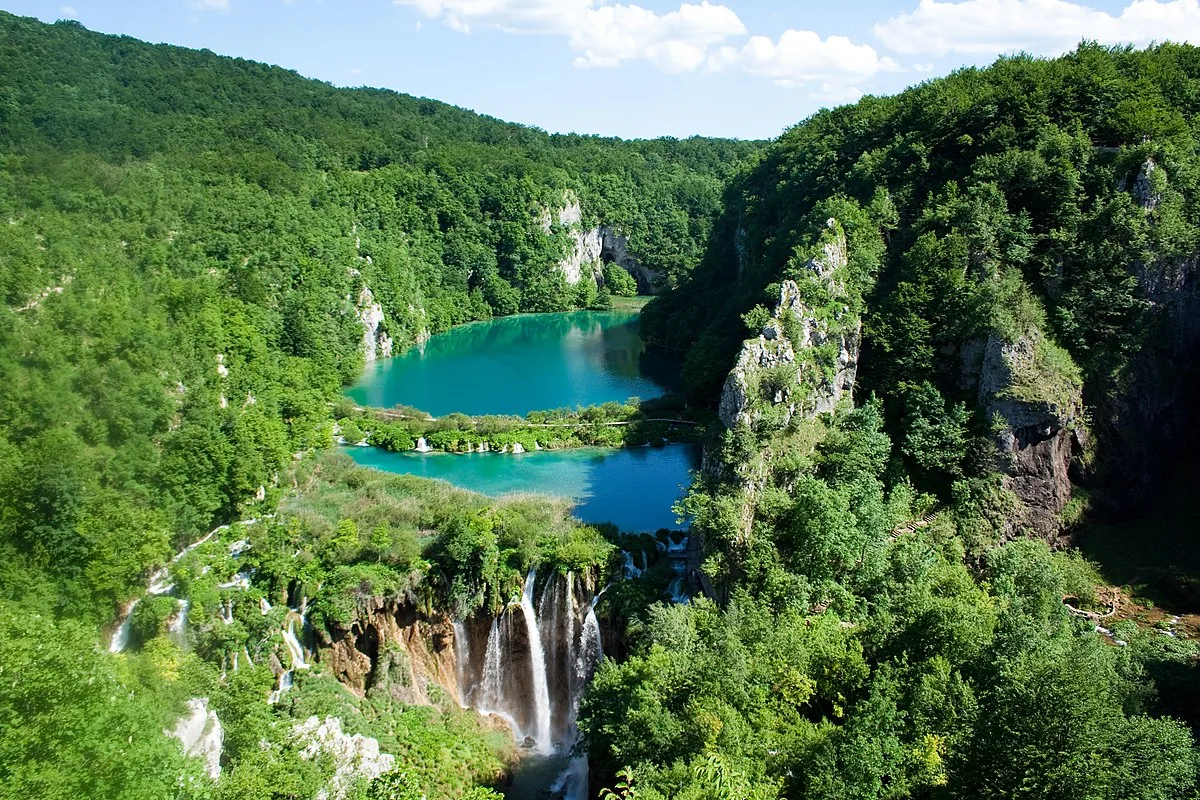
Plitvice Lakes National Park, Croatia
Stepping onto the wooden slats of the Lower
Lakes trail, The spray of a dozen minor waterfalls on your face. The room is several degrees cooler here than at the park entrance. Pay attention to the way the trout hover motionless in the crystal-clear water, their shadows cast sharply on the white lake bed below. Opening with the deep, vibrant green of the moss that blankets every fallen branch, acting as a natural sponge for the constant moisture. You get the vibration of the ground near the Big Waterfall, a low-frequency hum that resonates in your skull. What registers is the sound of the wind through the tall reeds at the edge of Lake Kozjak, a soft hissing that contrasts with the heavy splash of the cascades. People generally rush to the highest viewpoints, but you should notice the tiny, intricate patterns of the tufa deposits forming on a single leaf caught in a stream. The gravity of the sheer scale of the wilderness as the electric boat glides across the silent center of the largest lake. First, the way the light filters through the dense canopy, creating emerald cathedrals in the forest clearings.
Location and access
The park is located in the mountainous Lika region, roughly halfway between Zagreb and Zadar. Buses from either city take about two to three hours. Those who come arrive via Entrance 1 for the famous canyon views or Entrance 2 for a more immersive forest experience.
Why it matters
The geography of Plitvice was formed over millennia as the Korana River carved through the karst mountains, but the lakes as we see them are a result of a rare chemical dance. The tufa barriers grow about one centimeter per year, meaning the landscape is literally a living organism that changes shape over time. This region was once known as the 'Devil's Garden' because of its impenetrable forests and treacherous terrain. It became Croatia’s first national park in 1949 and gained UNESCO status in 1979. During the Croatian War of Independence in the early 1990s, the park was the site of the first armed clash, but fortunately, the delicate ecosystems and waterfalls were largely spared from destruction, allowing the 'Green Heart' of the country to heal.
The Experience
The mist in the morning turns the canyon into a scene from a prehistoric era, where you half-expect to see something ancient emerge from the ferns. You come across a smooth, damp wood of the handrails under your palms as you navigate the narrowest sections of the boardwalk. The first thing you register is the way the water sounds different at each lake, sometimes a high-pitched tinkling, other times a heavy, rhythmic thud. The smell of wet pine and cold stone that stays with you long after you leave. The moment that stays with you is reaching the 'hidden' cave stairs where the roar of the falls becomes a deafening, white-noise embrace.
Why It Matters
Plitvice is the ultimate expression of the karst topography that defines the Balkan peninsula. It is a world-class example of a tufa-depositing system, a process that is rare on a global scale. Culturally, it is a point of immense pride for Croatians, representing the raw, untamed beauty of their hinterland.
Why Visit
Go to Plitvice because it is one of the few places on earth that looks exactly like the over-saturated postcards. It offers a sensory immersion that feels like walking through a high-definition dream, providing a profound reset for anyone weary of the concrete and noise of modern life.
Insider Tips
- 1
Arrive at the gate at 7:00 AM sharp; by 10:00 AM, the narrow boardwalks become congested with tour groups, making photography difficult.
- 2
The 'Program K' is the longest hiking route but offers the most seclusion and covers both the upper and lower lake systems.
- 3
Wear waterproof shoes with good traction, as the wooden boardwalks are perpetually damp and can be slippery in the shaded areas.
- 4
Take the panoramic shuttle train to the highest point and walk back down to save your knees from the steep inclines.
- 5
Bring a polarising filter for your camera to cut through the water's surface glare and capture the true depth of the emerald pools.