“One man’s obsession with stone and struggle resulted in this seaside palace, a home he built for himself but ultimately gave to the world when he could no longer live in his homeland.”
About Ivan Meštrović Gallery
Meštrović oversaw every detail of the building’s construction, from the choice of local limestone to the orientation of the windows to ensure optimal lighting for his works. The gallery showcases the arc of his career, from his early Secessionist influences to his later, more religious and monumental style. After his move to the US to teach at Notre Dame, he continued to coordinate with curators in Split to ensure the collection was presented as he envisioned. The site survived the conflicts of the 1990s and has since undergone a meticulous renovation that restored the original luster of the Brač stone and the surrounding botanical arrangements.
What Ivan Meštrović Gallery in Croatia is
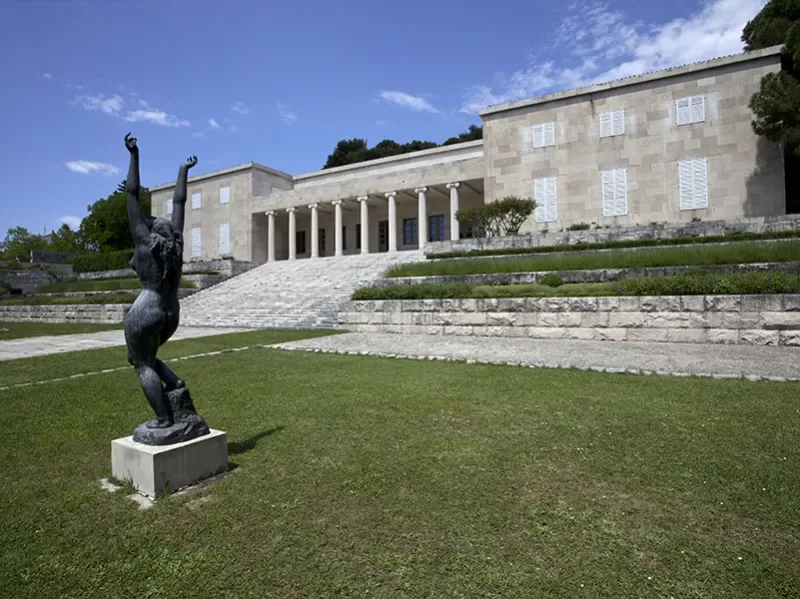
Beneath the pine-clad slopes of Marjan Hill in Split, a neoclassical villa of white Brač stone works as a temple to the human form. The Ivan Meštrović Gallery was designed by the sculptor himself, not merely as a museum, but as a summer residence and a monumental workspace. The architecture is a study in grand proportions, featuring a dramatic peristyle of ionic columns that frame the shimmering Adriatic. Inside, the spaces are cool and vast, housing the masterpieces of the man Rodin called 'the greatest phenomenon among sculptors.' The air is still and carries a trace of the surrounding Mediterranean gardens, lavender, cypress, and salt. Every room is a choreographed dialogue between heavy bronze, delicate wood, and the shifting coastal light that breathes life into the static figures.
Beneath the pine-clad slopes of Marjan Hill in Split, a neoclassical villa of white Brač stone works as a temple to the human form.
this grand villa, 1931
Ivan Meštrović began construction on this grand villa in 1931, intending it to be his permanent legacy in his homeland. As a global celebrity who had exhibited in the world’s major capitals, he used his personal wealth to create a sanctuary for his art and family. However, the turbulence of the 20th century intervened; Meštrović was imprisoned by the Ustaše during World War II and eventually moved to the United States, never returning to live in the palace he built. In 1952, he gifted the villa and hundreds of his works to the Croatian people, a final gesture of devotion from an artist in exile. The gallery remains shaped by his obsession with the spiritual and political destiny of the Balkan people, expressed through the muscularity of his bronze and the raw emotion of his marble.
Walking through the high-ceilinged entrance hall , The way the light from the floor-to-ceiling windows illuminates the tension in a bronze muscle or the sorrow in a wooden face. The setting is several degrees cooler than the packed Riva outside, providing a silent sanctuary for contemplation. The first thing you register is the texture of the 'History of the Croats' sculpture, the seated woman holding a heavy stone book with a gravity that feels biblical. In the central hall, The sound of the wind through the pines outside, a soft white noise that enhances the stillness of the sculptures. The scale of his ambition moving into the garden, where larger-than-life figures struggle against unseen forces under the open sky. Most who visit stay inside, but you should notice the way the shadows of the olive trees play across the outdoor bronze works, changing their expressions as the sun moves. The physical weight of the art, a sense of gravitas that few modern galleries can replicate. Starting with the way the white marble of the building itself seems to glow against the deep blue of the sea, creating a perfect frame for the dramatic, often tortured figures of his imagination. The gallery is located on the southern side of the Marjan peninsula. It is a pleasant twenty-minute walk from the Split city center along the coast, or a short ride on the number 12 bus from the Riva.
The Experience
The silence in the 'Job' room is tactile, where the bronze figure of the biblical sufferer conveys a level of physical agony that is almost difficult to watch. First, the way the light hits the polished wood of his religious reliefs, making the grain look like flowing water. A sense of absolute calm in the garden, looking back at the house and realizing it is as much a sculpture as anything it contains. The element that stays with you is standing between the columns of the porch and seeing the horizon of the Adriatic perfectly mirrored in the stillness of the gallery's atmosphere.
The silence in the 'Job' room is tactile, where the bronze figure of the biblical sufferer conveys a level of physical agony that is almost difficult to watch.
Why It Matters
The Ivan Meštrović Gallery is the most important monographic museum in Croatia. It preserves the legacy of an artist who was central to the national identity of the region in the early 20th century. Artistically, it is one of the few places in Europe where you can see the direct continuation of the grand classical sculpture tradition into the modern era.
Why Visit
See this gallery to escape the noise of Diocletian's Palace and see the soul of modern Croatia expressed in bronze. It is a rare opportunity to see how an artist of global stature chose to frame his own life’s work. The combination of world-class sculpture and the serene Mediterranean setting makes it one of the most sophisticated cultural stops in the Adriatic.
✦ Insider Tips
- 1
Purchase a joint ticket that includes the nearby Meštrović's Crikvine-Kaštelet to see his incredible wooden New Testament reliefs.
- 2
The garden is one of the best spots in Split for quiet reflection; bring a book and spend an hour among the sculptures.
- 3
Look for the smaller, more intimate sketches and models in the side rooms to see the artist’s process before he committed to stone.
- 4
Visit in the late afternoon when the sun hits the western facade, turning the white stone a brilliant, warm gold.
- 5
The number 12 bus is the most reliable way back to the center if you find the coastal walk too hot in the afternoon.