“More of a palace for the dead than a graveyard, this ivy-clad sanctuary is the only place in the Balkans where every faith has shared the same front porch for over a century.”
About Mirogoj Cemetery
The site was a private country estate before Bollé turned it into a civic masterpiece. He designed the arcades first, intending them to be a protective wall against the outside world, and they remain the most iconic part of the cemetery. Throughout the 20th century, Mirogoj became the default site for national mourning, hosting the funerals of presidents and cultural icons alike. Despite the various political regimes that have governed Zagreb, the cemetery's multiconfessional status has never been challenged, making it a rare symbol of tolerance and shared identity in a region often defined by its divisions.
About Mirogoj Cemetery
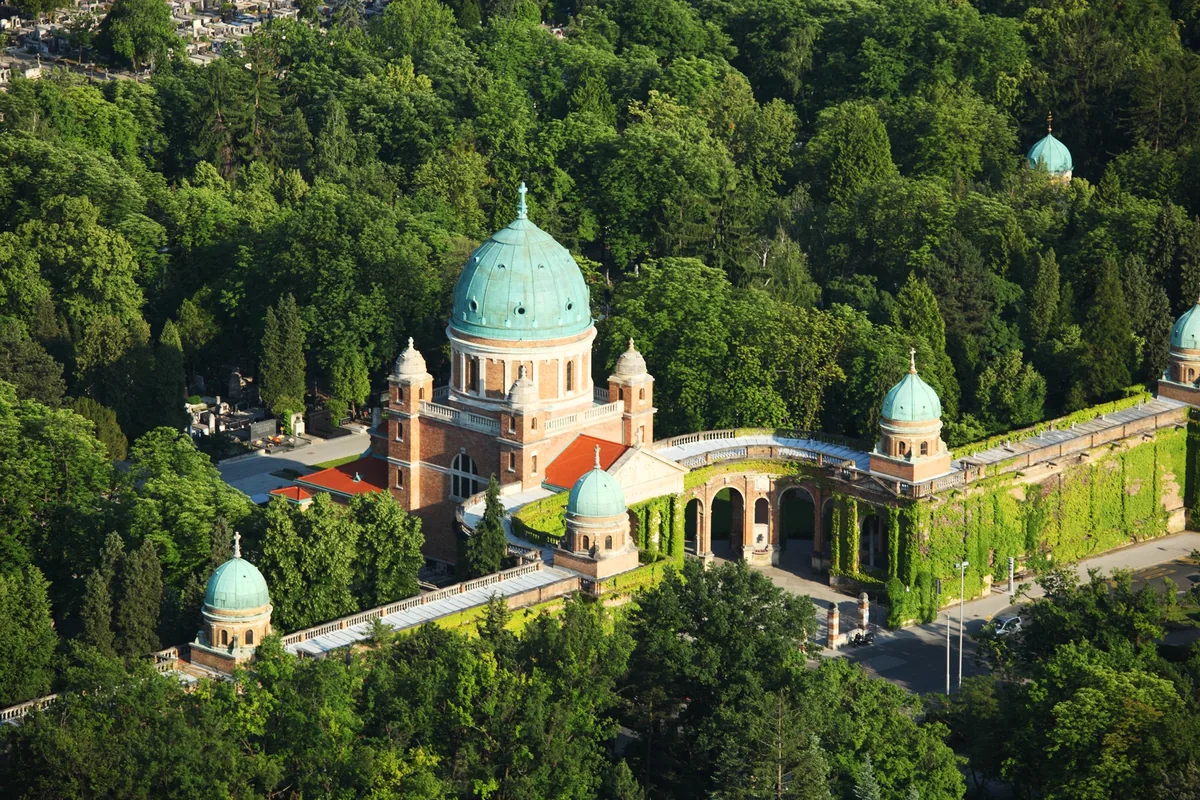
Beyond a monumental wall of ivy-covered brick arches, Mirogoj Cemetery is a silent, leafy city where Zagreb’s history is written in stone and bronze. This is not a place of morbid gloom, but a grand park of memory, designed as a multiconfessional space where Catholics, Orthodox Christians, Jews, and Muslims rest side by side. The centerpiece is the long, green-domed arcade that stretches nearly five hundred meters, its vaulted walkways providing a dramatic frame for the monuments of the city’s elite. The surroundings here is cool and still, smelling of damp moss, old stone, and the hundreds of beeswax candles that flicker in the red glass lanterns. It is a masterpiece of landscape architecture that manages to be both intimidatingly grand and deeply personal.
Beyond a monumental wall of ivy-covered brick arches, Mirogoj Cemetery is a silent, leafy city where Zagreb’s history is written in stone and bronze.
Hermann Bollé, the same architect who gave St.
Mark’s Church its colorful roof, began work on Mirogoj in 1876. He envisioned a 'pantheon' for the city, moving away from the crowded, chaotic churchyards of the past. The land was originally owned by Ljudevit Gaj, a leader of the Croatian national revival, and Bollé transformed the estate into a structured masterpiece of the Neo-Renaissance style. The construction of the arcades took over thirty years, surviving the Great Earthquake of 1880 which destroyed much of the city center. Mirogoj was revolutionary for its time, as it was owned by the city rather than a church, ensuring that every citizen, regardless of their faith, could be buried with dignity in the same beautiful space. It remains the most important resting place in Croatia, holding the remains of poets, politicians, and ordinary families whose stories are etched into the marble.
Visiting Mirogoj Cemetery
Walking under the heavy brick arches of the arcades, The sound of your own footsteps echoing off the stone floor, a sharp contrast to the soft crunch of gravel on the inner paths. The light is filtered through thick layers of ivy that drape over the columns like velvet curtains, turning the afternoon sun into a soft, emerald glow. The incredible variety of the sculptures, angels with weeping faces, lions guarding heavy iron doors, and modern bronze reliefs that look like frozen ripples in water. The first thing you register is the smell of wet earth and the sharp, clean scent of the pine trees that line the main avenues. You get a sense of absolute calm as you wander into the deeper, less-visited sections, where the older graves are slowly being reclaimed by nature. Just about everyone stay in the central arcades, but you should notice the small, humble headstones in the outer fields, which often have the most moving personal tributes. A mark of the continuity of the city seeing families tending to graves with fresh flowers and small lanterns, a tradition that keeps the cemetery feeling like a living part of the community. The opening note is the way the light catches the copper domes at sunset, turning them into beacons of pale green against the dark forest of Medvednica mountain.
Mirogoj is located on the northern edge
Mirogoj is located on the northern edge of the city. Take the 106 bus from Kaptol (next to the Cathedral), a ten-minute ride that drops you directly at the main entrance gates.
Take the 106 bus from Kaptol (next to the Cathedral), a ten-minute ride that drops you directly at the main entrance gates.
The Experience
The silence here is tactile, broken only by the occasional caw of a crow or the distant hum of a bus. What grabs you is the way the light changes as you move between the open fields and the shaded arcades, shifting from bright and airy to intimate and solemn. Something like a sense of history that is more accessible than in any museum, as every name on a headstone is a piece of the Zagreb puzzle. The element that stays with you is seeing the 'sea' of red lanterns lit on All Saints' Day, a sight that turns the cemetery into a glowing, rhythmic field of light.
Why It Matters
Mirogoj is one of the most beautiful cemeteries in Europe, comparable to Père Lachaise in Paris or Highgate in London. Culturally, it is the most important repository of Croatian collective memory. Architecturally, it is the finest example of Neo-Renaissance landscape design in the country, proving that a cemetery can be a vital piece of urban public space that enriches the lives of the living.
Why Visit
Visit Mirogoj to see the soul of Zagreb in a setting of perfect peace. It is the best place to understand the city's complex, multicultural past without the noise of the center. It offers a masterclass in 19th-century aesthetics and a chance to walk through a living forest of art and history that is as beautiful as any gallery.
✦ Insider Tips
- 1
The cemetery is vast; pick up a map at the main gate if you want to find the graves of specific figures like Dražen Petrović or Franjo Tuđman.
- 2
Visit in the early morning when the dew is still on the ivy and the mist clings to the domes for the most ethereal photos.
- 3
The 106 bus is frequent and reliable, but walking back down toward the city center through the leafy Medveščak neighborhood is a lovely 30-minute stroll.
- 4
Photography is generally welcomed, but remain respectful of families who may be visiting graves or attending services.
- 5
Look for the Jewish section in the northern part of the cemetery; it contains some of the most moving and architecturally unique monuments on the grounds.