Thirty-five underwater pipes turn every passing wave into a haunting, melancholic chord, making the Adriatic Sea the world's largest and most unpredictable street performer.
About Sea Organ
Zadar was once a major Venetian stronghold, but its maritime identity was severed by modern urban planning. The Sea Organ was designed to heal this rift. Architect Nikola Bašić worked with engineers and musical experts to ensure the pipes were tuned to five different tones, based on traditional Dalmatian klapa singing. The project won the European Prize for Urban Public Space in 2006, proving that modern architecture can be as evocative as ancient ruins. It has since become the symbol of Zadar’s cultural rebirth in the post-war era.
What Sea Organ actually is
The Adriatic Sea plays its own symphony through a series of broad marble steps at the tip of the Zadar peninsula. The Sea Organ (Morske Orgulje) is a radical piece of architectural art that uses the energy of the waves to push air through thirty-five underwater pipes, creating a haunting, ever-changing melody. There are no speakers and no electricity; the music is entirely dependent on the rhythm of the water and the force of the wind. The white stone stairs look like a minimalist sculpture, inviting people to sit and listen to the 'breath' of the ocean. The air is thick with sea spray and the sound is a deep, resonant hum that feels more like a heartbeat than a musical instrument.
“The Adriatic Sea plays its own symphony through a series of broad marble steps at the tip of the Zadar peninsula.”
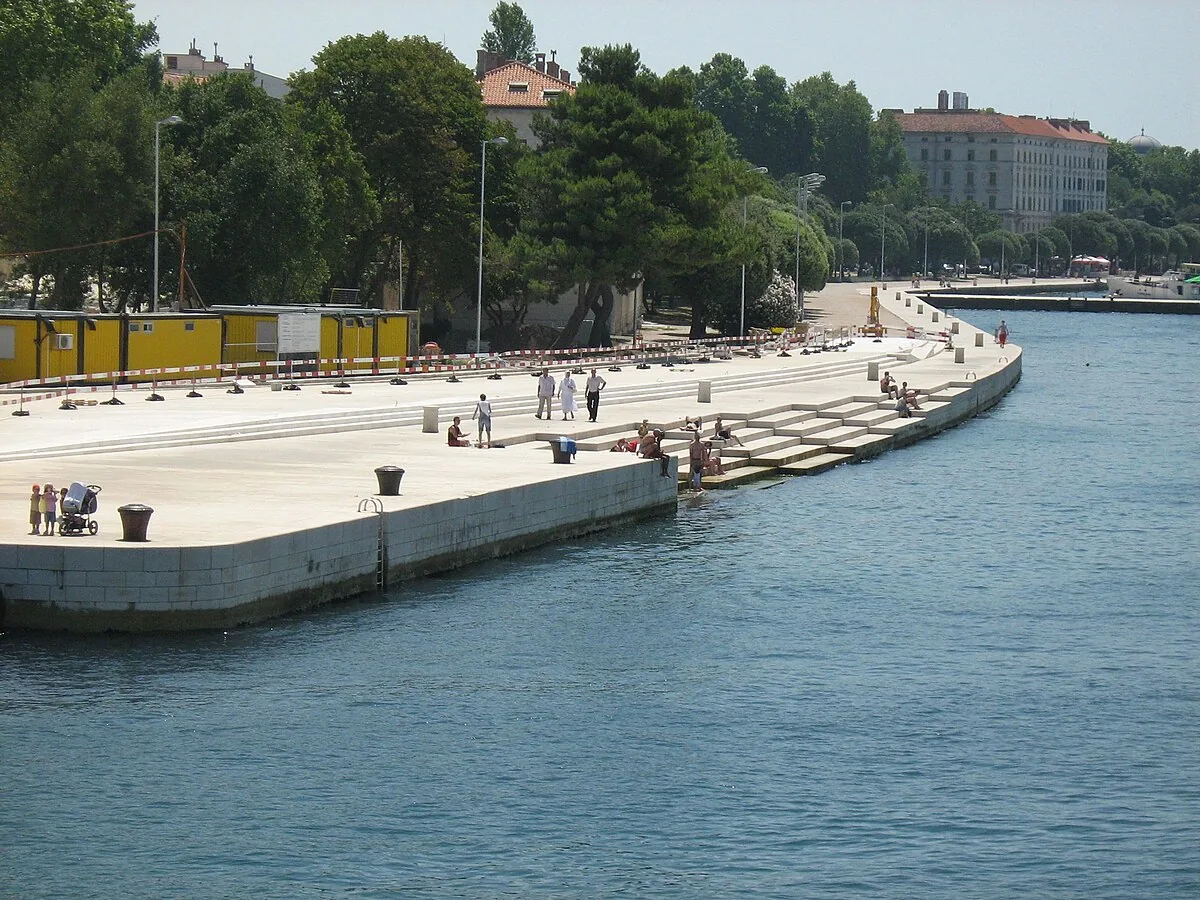
Sea Organ, Croatia
Zadar’s waterfront was a bleak, concrete
Zadar’s waterfront was a bleak, concrete wasteland for decades following the heavy bombing of World War II. In 2005, architect Nikola Bašić was commissioned to redesign the promenade, and he envisioned a way to reconnect the city with the sea through sound. Inspired by the 'hydraulis' of ancient Greece, he hid the organ pipes beneath the marble steps, with whistle openings along the sidewalk that allow the sound to escape. The project was an instant global sensation, transforming a forgotten corner of the city into its most beloved gathering place. Just a few steps away, Bašić also created the 'Greeting to the Sun,' a solar-powered light installation that complements the auditory experience of the Organ with a visual dance of colors after dark.
Sitting on the cold marble as the sun begins to set, the low-frequency vibrations of the organ pipes through the stone and into your bones. On all sides, the air is cool and smells of salt and ozone. First you see the way the music changes when a large ferry passes by, the wake creating a sudden, discordant crescendo of notes. First, the sound of the whistles, sometimes a low, melancholic moan, other times a bright, rhythmic chirping. An echo of the spray of the water on your shins when a particularly strong wave hits the lower steps. What lands is the way the crowd falls silent, the usual tourist chatter replaced by a communal state of listening. People generally look at the horizon, but you should notice the small circular holes in the pavement where the sound actually emerges. Something like a strange sense of calm, as the music has no beginning and no end, perfectly matching the infinite horizon of the sea. Starting with the way the light from the nearby light installation begins to pulse just as the Organ’s music reaches its evening peak.
The Sea Organ is located at the far
The Sea Organ is located at the far western end of Zadar’s Old Town peninsula. It is a ten-minute walk from the Roman Forum and the Church of St. Donatus. The area is completely pedestrianized and easily accessible to anyone wandering the Zadar Riva.
“The Sea Organ is located at the far western end of Zadar’s Old Town peninsula.”
The Experience
The Organ is at its most powerful during a 'Jugo' wind, when the heavy swells force air through the pipes with a primal, mourning quality. The power of the nature in the volume of the sound. The first thing you register is the way the dogs in the area often tilt their heads, confused by the subterranean music. Immediately, the smell of the pine trees that line the promenade, mixing with the sharp scent of the sea. What remains with you is watching the sunset, which Alfred Hitchcock famously called the best in the world, while the sea sings its own unpredictable accompaniment.
Why It Matters
The Sea Organ is a landmark for the 21st century, demonstrating how art can turn a utilitarian space into a spiritual one. It celebrates the relationship between humans and the environment without being invasive. It has made Zadar a destination for those seeking a more contemplative and sensory experience of the Mediterranean.
Why Visit
Visit Zadar for the Organ because it is a place where you can actually 'hear' the landscape. It is the perfect antidote to the noisy, crowded streets of other coastal cities, a place where the only thing you have to do is sit down, be quiet, and listen to the ocean breathe.
Insider Tips
- 1
The best time to visit is an hour before sunset; stay until the 'Greeting to the Sun' light show begins right next to the organ.
- 2
The lower steps can be wet and slippery; sit on the middle tiers to stay dry while still feeling the vibrations.
- 3
If you want a private concert, visit at 2:00 AM on a weeknight when the promenade is empty and the sound of the water is the only thing audible.
- 4
Look for the small brass whistles embedded in the stone to see the actual mechanism that creates the sound.
- 5
Don't record it on your phone; the low frequencies are almost impossible for mobile microphones to capture accurately.