Days after Niagara Falls first flickered to life, this Croatian cascade was already powering an entire city, proving that beauty and industry have always been intertwined in these mountains.
About Skradinski Buk
The watermills at Skradinski Buk were the economic engine of the region for generations, with some mills dating back to the medieval era. They are built from the same local stone as the riverbed, making them look like natural outcroppings. The hydroelectric plant, 'Jaruga,' was a pioneer of the alternating current system and is still operational in a modernized form nearby. The park was established in 1985, and since then, the focus has shifted from industrial use to the preservation of the tufa barriers, which can be easily destroyed by human contact or changes in water chemistry.
Skradinski Buk in Croatia
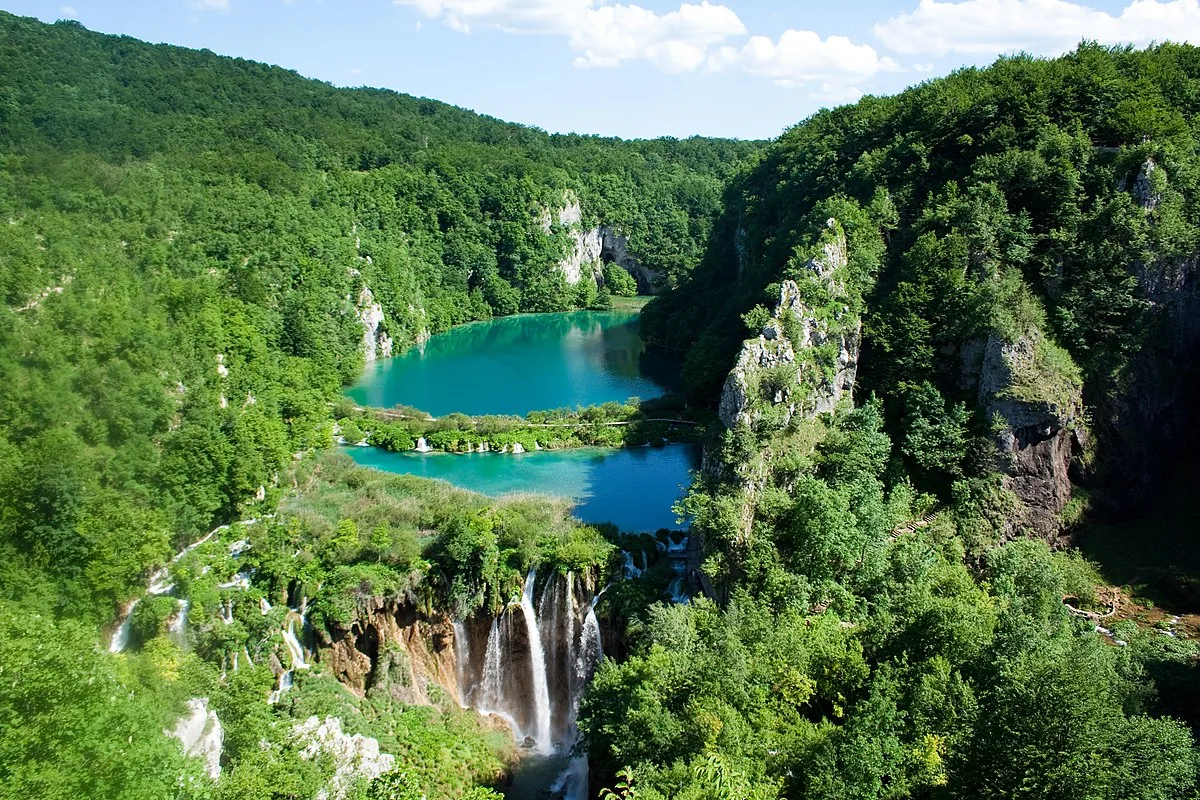
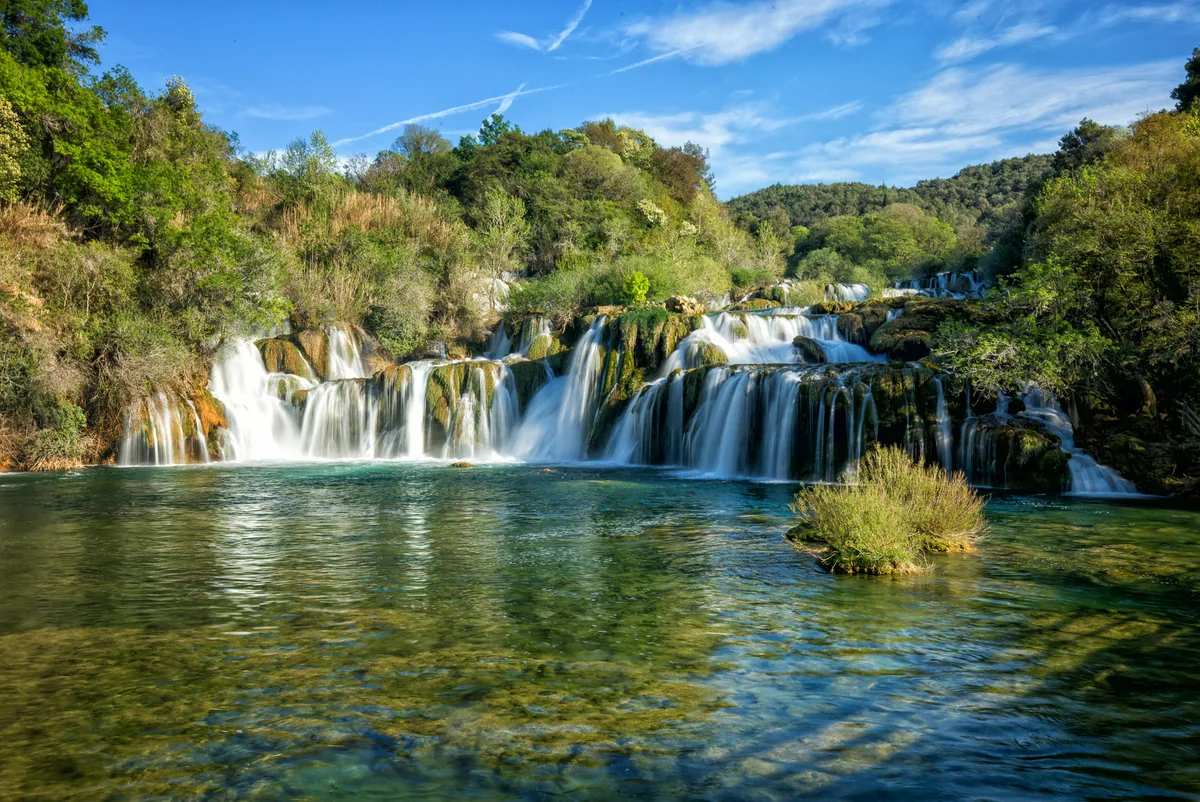
At the point where the Krka River meets the Adriatic sea air, seventeen waterfalls cascade over a series of travertine barriers to create Skradinski Buk, the longest and most dramatic waterfall system in the Balkans. The water falls over a total height of 45 meters, crashing into a massive emerald pool that was once a legendary swimming spot but is now protected as a fragile ecosystem. The air is perpetually misty and cool, scented with the sharp, clean smell of rushing river water and crushed mint. Wooden boardwalks snake through a flooded forest, where the river flows directly under your feet, creating a experience of being suspended over a moving world. The sound is a constant, low-frequency rumble that vibrates through the wooden slats and into your soles.
The falls are the result
The falls are the result of the same 'tufa' process found at Plitvice, where calcium carbonate from the water settles on moss and algae to create living stone barriers. Century after century, this raw power was harnessed by local people who built a series of watermills to grind wheat and wash wool using the river's force. In 1895, Skradinski Buk became the site of one of the world's first hydroelectric power plants, designed by Tesla-inspired engineers to provide the city of Šibenik with electricity just days after Niagara Falls was lit. The remains of this industrial history are still visible among the trees, blending with the natural landscape. Today, as part of Krka National Park, the falls are a protected sanctuary for rare birds, reptiles, and the specific river flora that allows the tufa to keep growing.
Crossing the long wooden bridge that spans the base of the falls, The way the mist coats your skin in a fine, cool film. The room is thick with the roar of the water, a sound so loud it makes conversation impossible near the main drop. The thing you pick up on is the vibrant, almost neon green of the moss where the water flows fastest, a color that seems to glow in the shaded parts of the canyon. The opening note is the tiny fish darting against the current in the shallow pools, their silver scales flashing in the sun. The humidity of the forest climbing the stone steps toward the upper viewpoints, where the river splits into dozens of smaller, quieter streams. What hits is the smell of woodsmoke from the old mill buildings, where local women still demonstrate traditional weaving techniques. The majority stay at the bottom pool, but you should notice the 'death' of the river as it slows down and becomes a quiet, reed-filled estuary just past the final falls. Something like a sense of timelessness watching the water move, realizing that the river has been carving this path through the karst plateau for thousands of years. The way the light catches the spray at mid-morning, creating rainbows that shimmer in the gorge. The most scenic way to arrive is by boat from the town of Skradin, a 20-minute journey up the river canyon that is included in the park ticket. Alternatively, you can take a bus from the Lozovac entrance and walk down the forest path to the top of the falls.
The Experience
Sound comes first: the watermills, a rhythmic, wooden thumping, provides a steady heartbeat to the upper section of the park. You register the way the water feels much colder than the sea, a trace of its mountain origins. A mark of the spray on your sunglasses as you lean over the railings of the main viewpoint, a refreshing shock in the July heat. First, the smell of dried lavender and rosemary for sale in the small stone kiosks. The moment that stays with you is standing on the quiet boardwalk in the middle of the flooded forest, where the river is only an inch deep and moves in absolute silence over the roots.
Why It Matters
Skradinski Buk is a living laboratory of geological and industrial history. It represents the perfect synergy between a rare natural process, tufa formation, and the human ingenuity that learned to use the river without destroying it. It remains one of the most biodiverse river ecosystems in Europe, home to several endemic fish species found nowhere else.
Why Visit
Visit Skradinski Buk to see a 'vertical' forest where the river is as much a part of the canopy as the trees. While Plitvice is about the lakes, Krka is about the power of the river. It offers a more interactive experience, where you can explore old mills, see power plants, and take a boat through a limestone canyon all in one afternoon.
✦ Photo Gallery
Best Season
🌤 April and May are the best months, as the snowmelt from the mountains makes the falls thunderously loud and the surrounding forest is a vivid, fresh green.
Quick Facts
Best time to visit
April and May are the best months, as the snowmelt from the mountains makes the falls thunderously loud and the surrounding forest is a vivid, fresh green.
Getting there
In Krka, Croatia; reach Krka first, then continue to the site.
Location
Krka, Croatia
Type
attraction
Insider Tips
- 1
Take the boat from Skradin; it’s a far more dramatic and relaxing entrance than the bus from Lozovac.
- 2
The trail is a loop; walk it clockwise to get the steepest climbs out of the way early and end with the view of the big falls.
- 3
Visit the ethnographic village near the top to see the original 'washing machines', natural stone whirlpools used to clean wool.
- 4
Bring a light waterproof jacket, even in summer, as the spray from the main falls can soak you in minutes if the wind is right.
- 5
Look for the endemic Krka trout in the crystal-clear pools; they have distinctive red spots and are very sensitive to water quality.