“A single bolt of lightning once blew the roof off this citadel, yet it remains the reason the people of Hvar exist today instead of becoming a footnote in Ottoman history.”
About Spanish Fortress
Long before the Venetians laid a single brick, an ancient Illyrian hillfort occupied this peak, sensing the strategic value of the high ground. The medieval walls we see now were financed by a tax on every bag of salt leaving the harbor, a commodity as precious as gold in the 1300s. Spanish architects arrived in the 16th century to modernize the bastions, adding the characteristic flared bases designed to deflect cannonballs. It served as a vital lookout point against pirates and imperial rivals for centuries before the Austrian military finally abandoned the barracks in the mid-1800s.
What Spanish Fortress in Croatia is
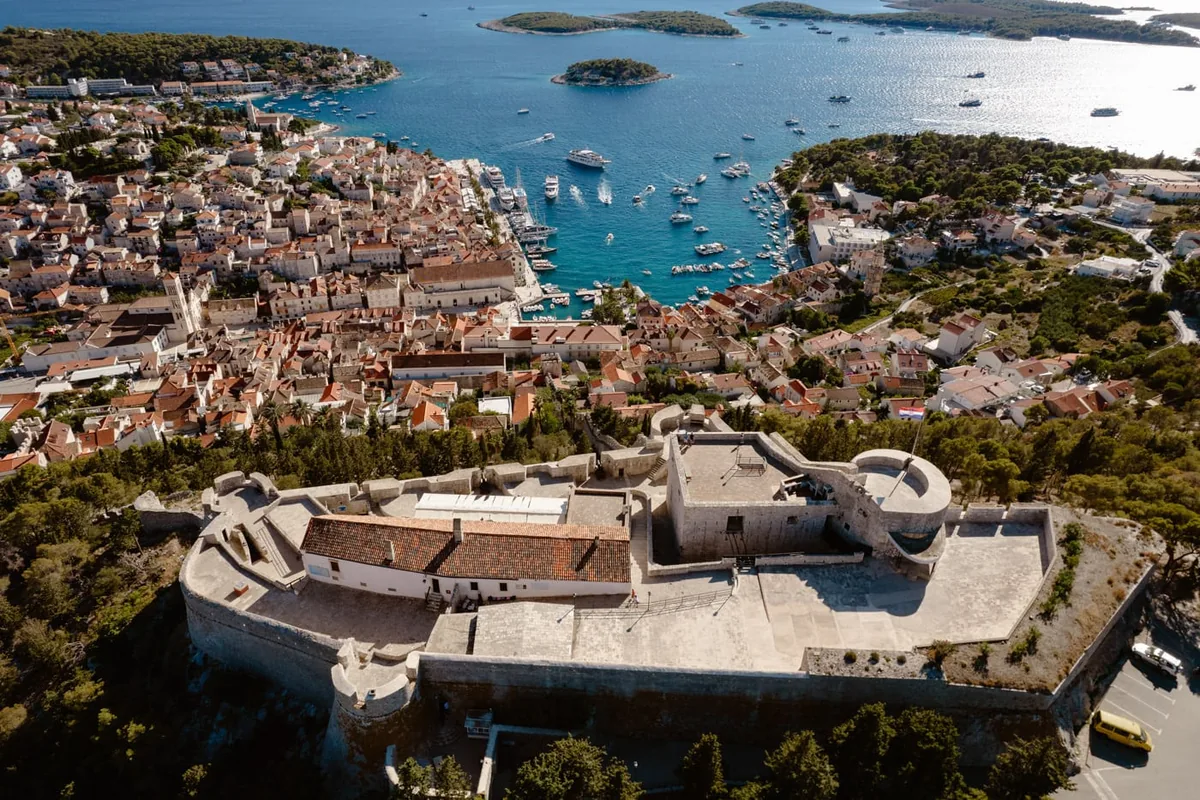
High above the lavender-scented island of Hvar, the limestone battlements of Tvrdjava Fortica loom like a jagged crown. People typically call it the Spanish Fortress, a name that echoes the 16th-century engineers who lent their expertise to its formidable design. The climb up the zigzagging stone path from the harbor, the air grows thinner and sharper, smelling of wild rosemary and heat-baked pine. The fortress is a silent sentinel over the Pakleni Islands, a cluster of emerald dots scattered across the turquoise Adriatic. Its walls are thick enough to swallow the sound of the modern world, offering a stillness that has persisted since the days of sails and swords.
High above the lavender-scented island of Hvar, the limestone battlements of Tvrdjava Fortica loom like a jagged crown.
on this site, 1282
Venetian authorities began serious construction on this site in 1282, but the current structure owes its life to the gold of the Hvar salt trade and Spanish military ingenuity. In 1571, the fortress proved its worth when the entire population of the town crowded within its walls to escape the pillaging fleet of the Ottoman admiral Uluz Ali. Every home in Hvar was burned that day, but the people survived behind these ramparts. Tragedy struck again in 1579 when lightning ignited the gunpowder magazine, a blast so powerful it shattered sections of the masonry and forced decades of reconstruction. By the 19th century, under Austrian rule, the military utility of the fort faded, and it began its slow transition into the evocative ruin that watches over the town today.
Running your hands along the rough, sun-warmed blocks of the outer bastion, The grain of a mountain moved by hand. The wind up here has a specific whistle as it whips through the narrow arrow slits, a sound that masks the distant thrum of yachts in the harbor below. What registers is the way the light hits the red-tiled roofs of the old town, making them look like a spilled tray of terracotta under your feet. The descent into the damp, lightless dungeons provides a visceral shock to the system, where the air is stagnant and smells of cold earth and old iron. The heavy chains still bolted to the stone walls, a stark reminder that this was a place of discipline as much as defense. People generally take their photos and leave, but you should notice the small succulents growing in the cracks of the stone, surviving on nothing but sea mist and grit. The scale of the Mediterranean horizon as the sun dips low, turning the water into beaten silver and the fortress walls into a deep, bruised gold.
The most rewarding route begins
The most rewarding route begins at the northern edge of the main square in Hvar Town. Follow the 'Fortica' signs up through the terraced gardens and the old city gate, a climb that takes roughly twenty minutes of steady effort.
The most rewarding route begins at the northern edge of the main square in Hvar Town.
The Experience
The silence in the central courtyard is heavy, broken only by the occasional cry of a seagull. First, the way the light filters through the iron grates, casting long, geometric shadows across the dusty floor. Something like a sense of absolute isolation from the party-centric energy of the docks below. The piece that stays with you is standing on the highest rampart when the evening church bells begin to ring; the sound rises up the hill and seems to vibrate through the very stones you are standing on.
Why It Matters
The Spanish Fortress is the physical embodiment of Hvar's resilience. It represents the intersection of Mediterranean salt wealth and the desperate need for security in an era of constant maritime warfare. Beyond its military history, it is a masterclass in adapting limestone architecture to a rugged, vertical landscape.
Why Visit
This fortress to see Hvar for what it truly is: a historic stronghold rather than just a beach destination. The view from the bastions provides the only perspective that explains why this town was built in this specific bay, offering a visual map of the islands that no digital screen can replicate.
✦ Insider Tips
- 1
Bring a small flashlight to explore the darker corners of the prison cells where the natural light doesn't reach.
- 2
The tiny cafe inside the walls serves a surprisingly good espresso; drink it on the eastern terrace for the best morning shade.
- 3
Look for the ancient stone cisterns near the entrance which were the only source of water during the great siege of 1571.
- 4
Enter through the garden path rather than the road to see the historic Mediterranean flora carefully maintained by the local municipality.
- 5
The ticket office often accepts only cash or local cards, so have some euros ready before you make the long climb up.