Seventy-one stone heads watch you from the outer walls, a silent crowd of 15th-century ghosts guarding a cathedral held together by nothing but the genius of gravity.
About St. James Cathedral
Juraj Dalmatinac was a visionary who rejected the traditional wooden roofing of the time, fearing fire and decay. He spent his life carving the limestone slabs that fit together like a giant 3D puzzle, a technique that was centuries ahead of its time. The project was so expensive that the local bishop had to frequently plead with Venice for more funding. By the time it was finished in 1536, the architectural style had shifted from the pointed arches of the North to the rounded, human-centric forms of the Italian Renaissance, making it a unique hybrid of two eras. It was rightfully added to the UNESCO list in 2000 as a masterpiece of structural stone masonry.
What St. James Cathedral is
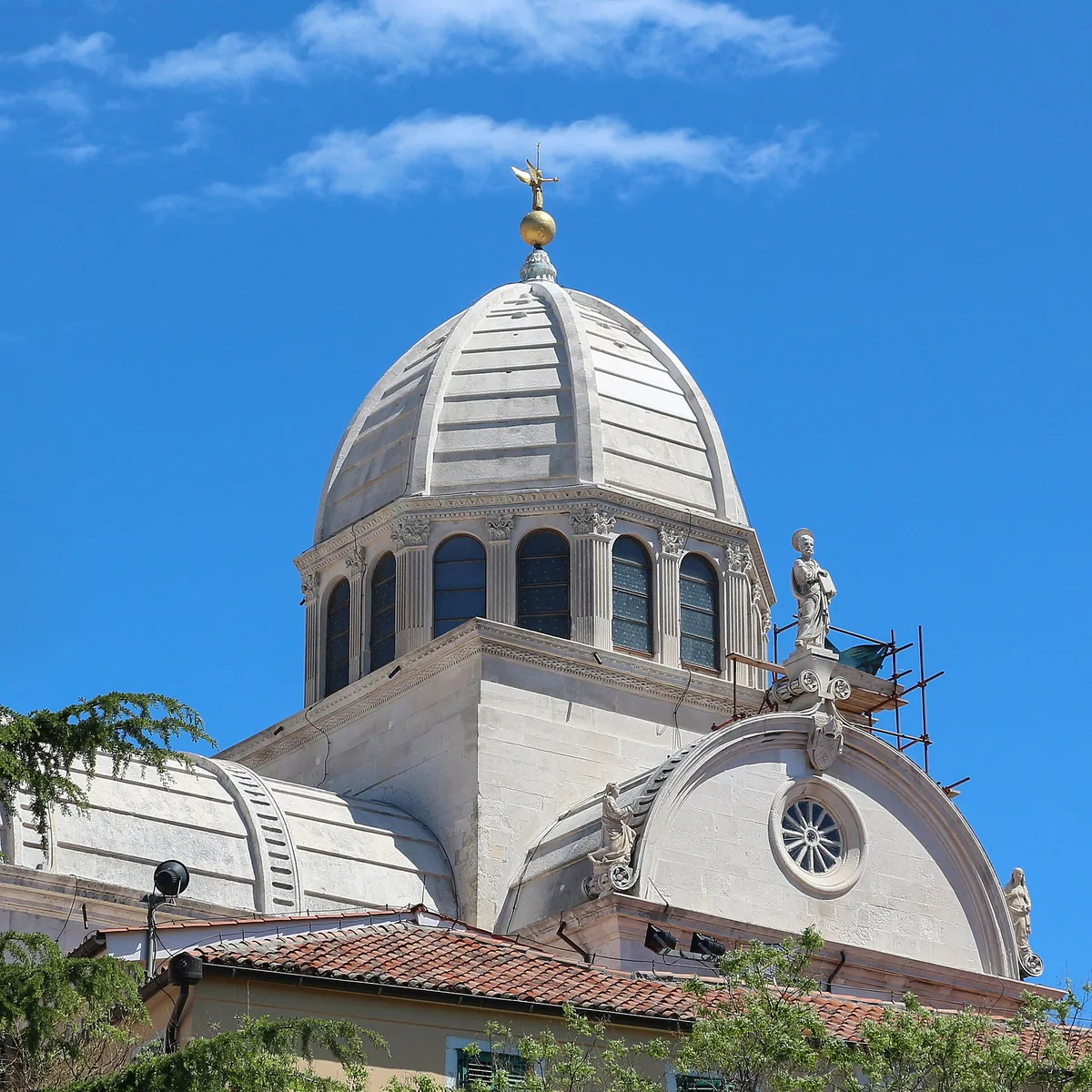
Built entirely of stone without a single brick, wooden beam, or ounce of mortar to hold its roof together, the Cathedral of St. James in Šibenik is a structural miracle of the Renaissance. This towering limestone and marble edifice looms over the harbor, a monochromatic masterpiece that seems to have been carved from a single mountain. The most famous feature is the exterior frieze of 71 unique stone heads, each a realistic portrait of a 15th-century citizen, ranging from grumpy merchants to tired sailors. The air around the cathedral is salty and often carries the sound of the 'Bura' wind whistling through the narrow stone gaps. Inside, the space is soaring and cold, dominated by the immense weight of the stone dome that hangs overhead like a frozen cloud.
“Built entirely of stone without a single brick, wooden beam, or ounce of mortar to hold its roof together, the Cathedral of St.”
St. James Cathedral, Croatia
Construction began in 1431 and spanned over
Construction began in 1431 and spanned over a century, involving three distinct phases of architectural evolution from Gothic to Renaissance. The most significant figure was Juraj Dalmatinac, a master architect who devised an ingenious interlocking system of stone slabs that allowed the walls and roof to be self-supporting. He was followed by Nikola Firentinac, who completed the massive dome using the same mortar-free technique. The cathedral was built during a time of constant threat from the sea and the mainland, serving as a spiritual anchor for a city that was a vital Venetian port. In 1991, during the Croatian War of Independence, the dome was hit by several shells, but thanks to its unique interlocking design, it did not collapse, and the damage was meticulously repaired by 1997.
Walking the perimeter of the cathedral , The way the light highlights the individual expressions on the stone heads, each one a window into the 15th-century soul. The environment smells of sun-warmed stone and the deep, clean scent of the Adriatic. The 'Lion's Gate' on the northern side, where two stone beasts guard the entrance with weary, ancient eyes. Straight off, the way the interior light changes as it passes through the thick, pale stone of the dome, creating a diffused, otherworldly glow that no glass window could replicate. A sense of immense pressure when standing directly under the dome, realizing that tons of rock are held in place by nothing but geometry and gravity. What lands is the sound of your own voice dropping to a whisper as the acoustics of the stone chamber amplify the slightest movement. The majority look at the altar, but you should notice the intricate baptistery tucked away in a corner, a riot of stone carvings that looks more like lace than rock. Part of the coolness of the marble steps as you exit, the heat of the Dalmatian sun providing a sharp contrast to the cathedral's internal chill. Instantly, the way the white stone turns a brilliant, blinding white at noon, making the building appear to glow from within. The cathedral is the centerpiece of Šibenik’s waterfront. It is a ten-minute walk from the main bus station through the pedestrianized old town. The building is best approached from the harbor side to fully appreciate its vertical scale against the surrounding hills.
The Experience
The morning light hits the western facade and makes the stone look like it's made of soft ivory. A sense of peace in the baptistery, where the carvings of angels and vines are so delicate you have to touch them to believe they aren't wood. What hits is the way the salt air has slightly pitted the lower stones, a slow-motion battle between the sea and the sanctuary. First, the smell of beeswax candles and the cool, damp scent of the stone floor. What sticks with you is looking up at the interior of the dome and seeing the lines where the slabs meet, realizing that the whole thing is just perfectly balanced rocks.
Why It Matters
St. James is the only cathedral in Europe constructed entirely of stone using a unique interlocking system. It represents the pinnacle of Dalmatian Renaissance art and the transition from medieval collective labor to the individual genius of architects like Juraj Dalmatinac. It is a symbol of Šibenik's independence and its ability to withstand both time and war.
Why Visit
See this cathedral to see how architecture can transcend its materials. While other churches are built, this one was 'assembled' like a piece of high-end furniture on a monumental scale. It is the best place in Croatia to see the faces of the Renaissance, quite literally, in the frieze of heads, and to feel the terrifying beauty of pure geometry.
Insider Tips
- 1
The baptistery is the most beautiful part of the interior; don't leave without finding the small door to its right.
- 2
Stand at the harbor side of the cathedral to see how the roof slabs overlap like scales on a fish, shedding water without needing lead or tiles.
- 3
Check the schedule for the 'International Children's Festival' in late June, when the square in front of the cathedral becomes a massive theater.
- 4
Wear polarized sunglasses to look at the exterior at noon, as the white limestone reflection can be genuinely painful to the eyes.
- 5
Look for the 'Adam and Eve' sculptures near the main portal; they are some of the earliest examples of Renaissance anatomy in the region.