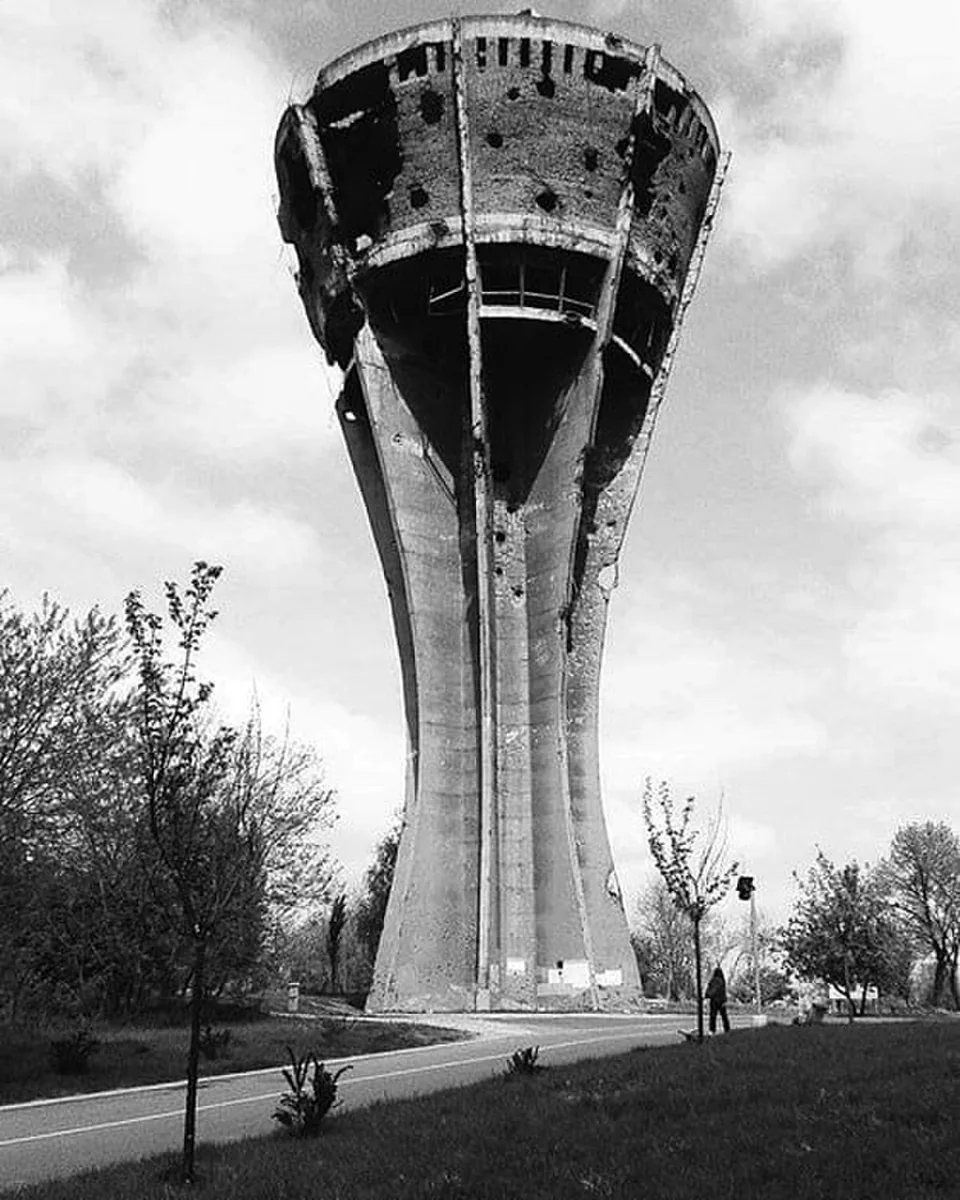
“Hit over six hundred times by heavy artillery, this concrete giant should have collapsed in 1991; instead, it became a jagged, indestructible symbol of a city's soul.”
About Vukovar Water Tower
The tower was part of a major Yugoslav-era modernization project, standing as a proud example of 1960s engineering. Its survival during the three-month siege is still studied by structural engineers, who credit the high-quality reinforced concrete and its circular design for its resilience. During the reintegration of the region in the late 1990s, the tower was the first thing returning refugees looked for on the horizon. The recent restoration, completed in 2020, was funded by thousands of individual donations from across Croatia and the diaspora, making it a true 'people's monument.'
What Vukovar Water Tower is
Standing on the banks of the Danube, the Vukovar Water Tower is a 50-meter-high concrete shell that refuses to fall. Its surface is pitted with over 600 artillery scars, a brutalist monument to a siege that nearly erased the city from the map in 1991. For years, it stood as a hollow ruin, but it has recently been transformed into a memorial that preserves every impact crater behind glass and steel. The climb up the interior staircase is a path through a vertical battlefield, ending at a panoramic terrace that offers a wide, silent view of the river and the plains of Slavonia. The tower is not a place of celebration, but a stark, silent witness to human endurance and the weight of history.
Standing on the banks of the Danube, the Vukovar Water Tower is a 50-meter-high concrete shell that refuses to fall.
Built in 1968, the tower
Built in 1968, the tower was originally one of the most modern structures in the region, a functional piece of infrastructure designed to provide water to the growing city. During the 1991 Battle of Vukovar, it became a primary target for artillery because it was the tallest point in the city and a symbol of resistance. Despite being hit hundreds of times, the structure's reinforced concrete core held firm, a fact that local residents saw as a miracle. For the duration of the siege, a small group of volunteers would climb to the top every night to replace the Croatian flag, an act of defiance that kept the city's morale alive. After the war, the decision was made not to repair the damage but to preserve it, turning the tower into a permanent reminder of the price of peace.
Ascending the modern glass elevator that runs up the center of the ruin, There is a strange sense of exposure looking directly into the jagged edges of the shell. The light inside is fragmented, pouring through the shell holes in long, dusty shafts. The way the modern steel walkways never quite touch the original concrete, creating a respectful distance between the present and the past. Audible here of the wind whistling through the hundreds of craters, a low, moaning sound that follows you all the way to the top. What lands is the texture of the concrete, rough, burnt, and peppered with shrapnel fragments that have become part of the building's DNA. A sense of the scale of the Danube below, a wide, slow-moving silver ribbon that seems indifferent to the tragedies on its banks. Most people are silenced by the 'Memorial Room' near the top, where the names of the defenders are etched in glass. The physical weight of the history stepping onto the roof and realize you are standing exactly where the flag was raised every night under fire. What draws the eye is the way the city has been rebuilt around the tower, the new red roofs a sharp contrast to the grey, scarred pillar. The experience is solemn and profoundly moving, leaving you with a deep respect for the resilience of the people who call this riverbank home.
The tower is located on the southern edge
The tower is located on the southern edge of Vukovar, about a 20-minute walk from the city center. It is clearly visible from almost anywhere in the city, making it easy to find by following the riverbank path.
The tower is located on the southern edge of Vukovar, about a 20-minute walk from the city center.
The Experience
Up at the top is surprisingly quiet, the height muffling the sounds of the modern city below. What lands is the way the glass walkways allow you to see all the way down into the dark, hollow base of the tower. A sense of absolute stillness as you look out over the 'Cross in the Danube' and the vast, flat horizon of the Pannonian plain. What stays with you is seeing the sunlight hit the jagged edges of a shell hole, turning a mark of destruction into a window of light. The smell of the river and the dry grass of the surrounding fields.
Why It Matters
The Vukovar Water Tower is the most important contemporary monument in Croatia. It bridges the gap between a functional past and a symbolic present, serving as a 'living ruin' that refuses to let the past be forgotten. Culturally, it is the heart of Croatian national identity, representing the struggle for independence and the slow, difficult process of reconstruction and reconciliation.
Why Visit
This tower to understand the recent history of the Balkans in a way that no textbook can convey. It is a visceral, three-dimensional encounter with the reality of war and the strength of the human spirit. It is the most powerful viewpoint in the country, not for the beauty of the landscape, but for the depth of the story it tells.
✦ Insider Tips
- 1
The museum uses an interactive app; make sure your phone is charged so you can listen to the stories of the people who climbed the tower during the war.
- 2
The walk from the center along the Danube is beautiful and helps put the tower’s height and location into context.
- 3
Avoid visiting on November 18th, the Day of Remembrance, unless you want to be part of a massive, city-wide commemorative procession.
- 4
Look for the original flag that was flown during the siege; it is preserved in a glass case inside the memorial area.