Two rock-cut temples built thirty-two centuries ago were moved block by block up a cliff in the 1960s to save them from a rising lake, and their astronomical alignment was preserved in the process.
About Abu Simbel
Carved by Ramesses II around 1265 BCE as religious monuments and political statements at the Nubian frontier, both temples were relocated 1964-1968 by a UNESCO-coordinated operation when the Aswan High Dam threatened to submerge them under Lake Nasser.
Abu Simbel stands near the southern border of Egypt, on the western shore of Lake Nasser, as far south as most visitors ever travel in the country. Two rock-cut temples were carved here under Ramesses II in the thirteenth century BCE, the Great Temple with its four colossal seated figures of the pharaoh, and the smaller Temple of Hathor dedicated to his queen Nefertari. Both structures were relocated in one of the largest archaeological engineering operations ever undertaken, moving them block by block up a cliff to save them from the rising waters of Lake Nasser after the Aswan High Dam was built.
“Abu Simbel stands near the southern border of Egypt, on the western shore of Lake Nasser, as far south as most visitors ever travel in the country.”
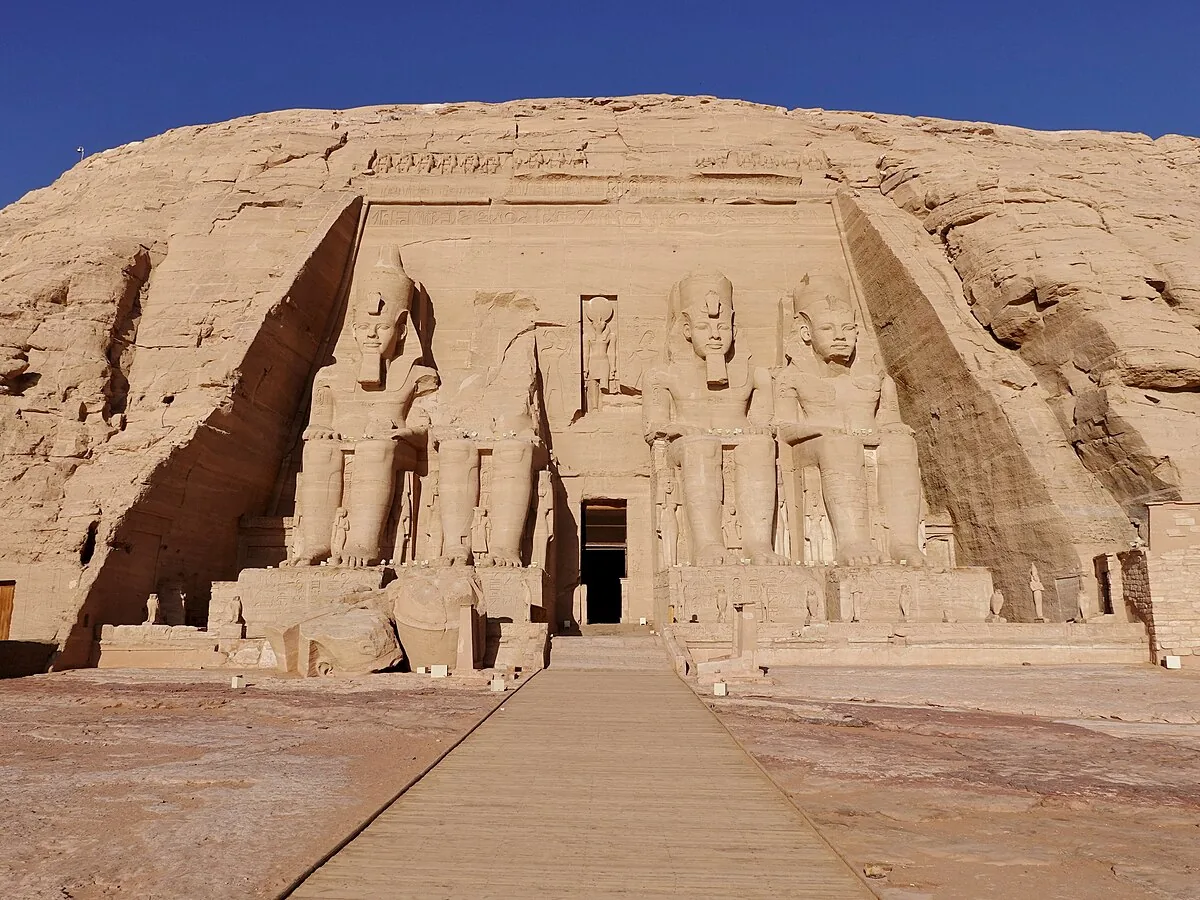
Abu Simbel, Egypt
Ramesses II reigned for sixty-six years and left monuments across Egypt on a scale no other pharaoh matched. Abu Simbel, built around 1265 BCE, served both religious and political purposes, a statement of Egyptian power at the Nubian frontier, and a temple aligned with astronomical precision so that twice a year, on February 22 and October 22, sunlight penetrates the inner sanctuary and illuminates three of the four seated statues within. The fourth figure, the god of darkness, remains unlit even on those days. The relocation between 1964 and 1968, coordinated by UNESCO, preserved this alignment with extraordinary accuracy.
The four colossal figures flanking the Great Temple's facade are each twenty meters tall, and the effect of approaching them across the open ground beside the lake is deliberately overwhelming. The interior corridors lead through hypostyle halls decorated with battle scenes from the Battle of Kadesh, Ramesses II's confrontation with the Hittites, and into the innermost sanctuary. The Temple of Hathor is smaller but has an intimacy the Great Temple lacks; the painted reliefs here are among the best-preserved at any Egyptian site. The solar alignment event in February and October draws crowds but is genuinely worth timing a visit around.
Abu Simbel is 280 kilometers south of Aswan.
Most people fly from Aswan or Cairo on the short domestic route; a daily convoy of tourist buses also departs Aswan at 4am for a road journey of about three and a half hours each way. The early departure allows a return to Aswan the same day.
“Most people fly from Aswan or Cairo on the short domestic route; a daily convoy of tourist buses also departs Aswan at 4am for a road journey of about three and a half hours each way.”
The Experience
Stand before the four twenty-meter colossal figures of the Great Temple's facade, move through battle-scene decorated halls into the inner sanctuary, and visit the smaller Temple of Hathor with its intimately detailed painted reliefs.
Why It Matters
One of Ramesses II's most ambitious monuments, and a landmark of modern archaeological engineering, the relocation of Abu Simbel remains one of UNESCO's defining preservation achievements.
Why Visit
The scale of the facade figures only becomes real when you're standing in front of them. The solar alignment event, when February or October light strikes the inner sanctuary statues, is among the most precisely engineered phenomena surviving from antiquity.
Insider Tips
- 1
The 4am bus convoy from Aswan is exhausting but cheaper than flying; the flight takes twenty minutes and is worth the cost for the extra time it buys at the site.
- 2
The Temple of Hathor receives far fewer visitors than the Great Temple, spend proportionally more time there.
- 3
The sound and light show at night requires an overnight stay in Abu Simbel village but provides a completely different perspective on the facade.