The only surviving Wonder of the Ancient World has been standing for four and a half thousand years at the edge of a modern city, and photographs have never captured its scale.
About Pyramids of Giza
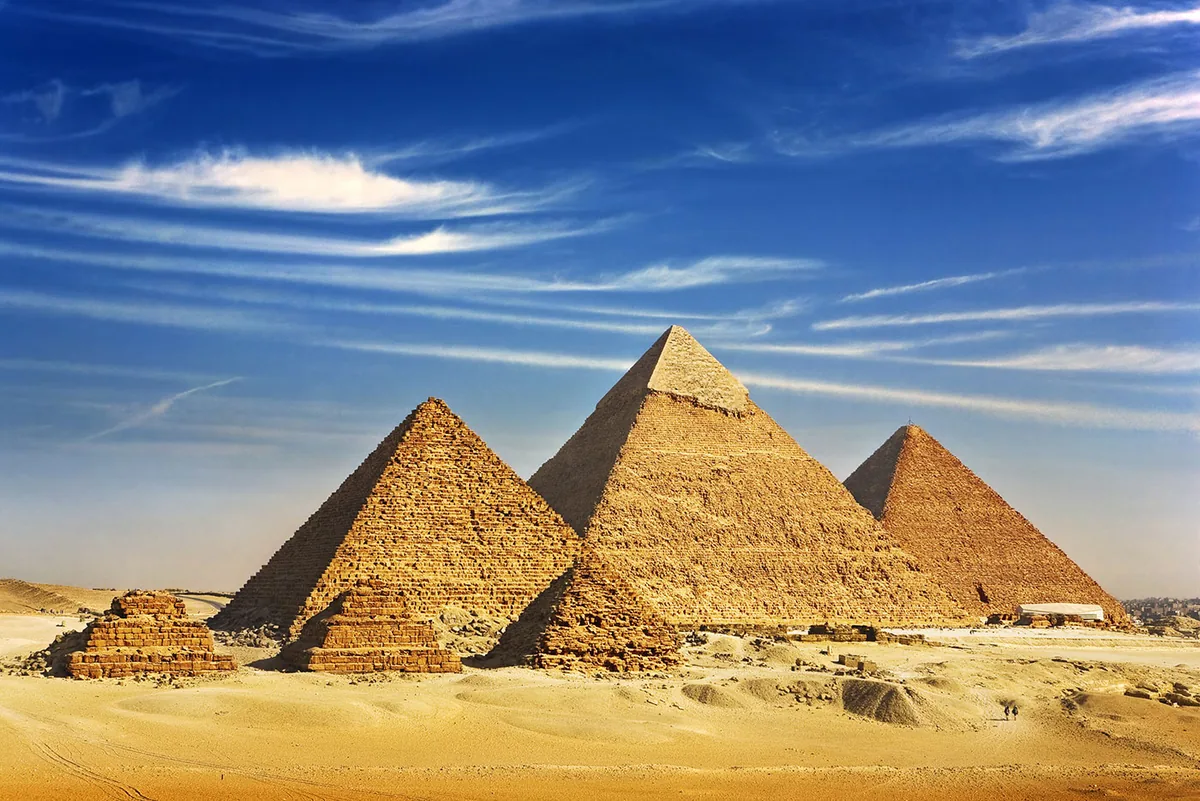
Built during Egypt's Fourth Dynasty between roughly 2560 and 2510 BCE as tombs for pharaohs Khufu, Khafre, and Menkaure, the pyramids were originally cased in polished white limestone. Most of that casing was stripped in the medieval period for other construction.
About Pyramids of Giza
The Giza plateau sits at the edge of Cairo, where the city's sprawl abruptly gives way to desert and three massive stone structures that have been standing for four and a half thousand years. The Great Pyramid of Khufu is the oldest of the Seven Wonders of the Ancient World and the only one still intact. The scale is something photographs consistently fail to convey, the base of Khufu's pyramid covers over five hectares, and the individual limestone blocks weigh an average of two and a half tonnes.
“The Giza plateau sits at the edge of Cairo, where the city's sprawl abruptly gives way to desert and three massive stone structures that have been standing for four and a half thousand years.”
Pyramids of Giza, Egypt
Origins
The three main pyramids were built during the Fourth Dynasty of the Old Kingdom, roughly between 2560 and 2510 BCE, as royal tombs for pharaohs Khufu, Khafre, and Menkaure. Each was originally cased in polished white Tura limestone that would have made them visible from a vast distance across the desert. Most of that casing was stripped for building material in the medieval period, Khafre's pyramid retains a section near the apex, which gives a sense of how all three would have appeared. The Great Sphinx, carved from a single limestone outcrop, guards the complex and is associated with Khafre, though the exact attribution remains debated among Egyptologists.
The plateau is larger than most visitors expect, and the three pyramids are widely spaced. Walking between them takes time. The interior of Khufu's pyramid can be entered through a narrow descending passage that leads to the burial chamber, it's physically demanding, claustrophobic, and worth every moment. Khafre's pyramid offers a similar interior experience with better preserved burial chambers. The Solar Boat Museum adjacent to the Great Pyramid displays the reconstructed cedar boat buried near Khufu, which remains one of the oldest intact wooden vessels in existence. The view of all three pyramids from the southern plateau, particularly at dawn before tour groups arrive, puts their scale and relationship to each other into proper proportion.
Giza is a suburb of greater Cairo, reachable by Cairo Metro to Giza station followed by a taxi or tuk-tuk to the plateau. The plateau opens at 7am; arriving at opening significantly reduces crowd density. Tickets for the plateau, pyramid interiors, and the Solar Boat Museum are sold separately.
“Giza is a suburb of greater Cairo, reachable by Cairo Metro to Giza station followed by a taxi or tuk-tuk to the plateau.”
The Experience
Enter the narrow descending passage of Khufu's pyramid to the burial chamber, walk the full plateau to understand the scale and spacing, see the reconstructed ancient cedar Solar Boat, and visit at dawn for the best view of all three structures together.
Why It Matters
The oldest and only surviving Wonder of the Ancient World, representing the peak of Old Kingdom engineering and the most recognizable archaeological site on earth.
Why Visit
No photograph or description prepares you for the actual size of these structures. The experience of standing at the base of Khufu's pyramid and looking up resets every expectation formed by images.
Insider Tips
- 1
Buy interior pyramid tickets separately, they sell out early and are not included in the general plateau entry.
- 2
The south plateau viewpoint gives the only angle where all three pyramids are visible simultaneously and in proportion.
- 3
Hiring a licensed Egyptologist guide through your hotel produces a qualitatively different visit than going independently.
- 4
The camel ride touts at the perimeter are persistent, a polite but firm refusal repeated once is more effective than engaging with the offer.