“For five centuries, Egypt's New Kingdom pharaohs cut their tombs into this remote desert valley, and the funerary art on those walls remains among the most intricate ever produced.”
About Valley of the Kings
New Kingdom pharaohs chose concealment over monuments after pyramid tombs proved vulnerable to looting. Despite guards and elaborate security measures, nearly all tombs were plundered in antiquity. Tutankhamun's tomb, found intact in 1922, was the extraordinary exception.
Valley of the Kings
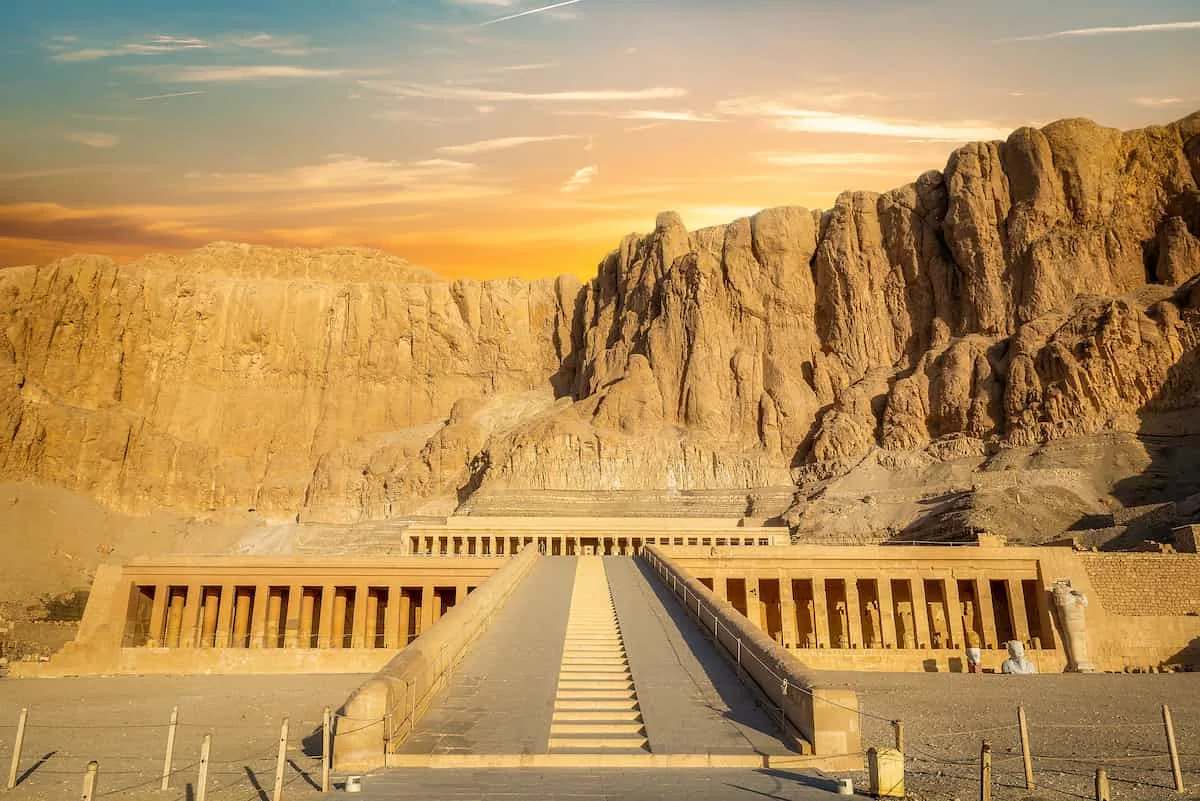
The Valley of the Kings lies on the west bank of the Nile across from Luxor, in a narrow desert valley flanked by limestone cliffs. For five centuries, from roughly 1550 to 1070 BCE, the pharaohs of Egypt's New Kingdom chose this remote location for their royal tombs, cutting deep into the bedrock and decorating the chambers with some of the most elaborate funerary art ever produced. More than sixty tombs have been discovered; new ones continue to be found.
The Valley of the Kings lies on the west bank of the Nile across from Luxor, in a narrow desert valley flanked by limestone cliffs.
The shift from pyramid tombs to rock-cut tombs in the New Kingdom reflected hard-won lessons about security. The pyramids of the Old and Middle Kingdoms had been systematically looted, and the New Kingdom pharaohs believed that concealment in a remote valley, watched over by a nearby pyramid-shaped peak, the Al-Qurn, and guarded by a permanent workforce, offered better protection. They were largely wrong: tomb robbery was rampant throughout antiquity, and nearly every royal burial was plundered in ancient times. The remarkable exception was Tutankhamun's tomb, discovered intact by Howard Carter in 1922, its contents, now in the Grand Egyptian Museum, represented less than a quarter of what a full pharaonic burial would have held.
The standard entry ticket covers three tombs chosen from a rotating selection. The tomb of Seti I, KV17, is the most elaborately decorated in the valley, though it requires a separate premium ticket. Tutankhamun's tomb is also separately ticketed; the mummy remains in situ. Ramesses VI's tomb is typically included in standard entry and has magnificent astronomical ceilings. Arrive before 8am to walk the first passage into the valley without tour groups filling the paths behind you. The desert silence and the quality of light in the early morning give the site a quality that midday visits lose entirely.
The valley is about seven kilometers from central Luxor on the west bank. Ferries cross the Nile from Luxor's east bank; from the west bank landing, taxis and minibuses serve the site. An electric tram runs from the valley entrance to the tomb area. The site opens at 6am.
The valley is about seven kilometers from central Luxor on the west bank.
The Experience
Move through rock-cut chambers decorated with detailed scenes from the Books of the Dead, visit the elaborately painted tomb of Seti I, and see Tutankhamun's mummy in situ in KV62. Arrive before 8am for the best atmosphere.
Why It Matters
The royal necropolis of Egypt's most powerful dynasty, containing over sixty tombs spanning five centuries of New Kingdom rule and some of the finest funerary art in the ancient world.
Why Visit
The interior of a painted royal tomb, standing in a chamber sealed for three thousand years, walls covered floor to ceiling in detailed religious narrative, is one of the most affecting experiences Egypt offers.
✦ Insider Tips
- 1
Buy the Seti I premium ticket in advance if possible, access is capped and it's the strongest single tomb in the valley.
- 2
The standard ticket covers three tombs; choose based on what's open that day rather than sticking to a fixed plan.
- 3
Photography is prohibited inside most tombs, the restriction is enforced and the fine is significant.
- 4
The small visitor center at the entrance provides orientation maps that help navigate between tomb entrances.