“Two pyramids built by Khufu's father record the trial-and-error that made Giza possible, including one pyramid where the builders changed the slope angle midway through construction.”
About Dahshur Necropolis
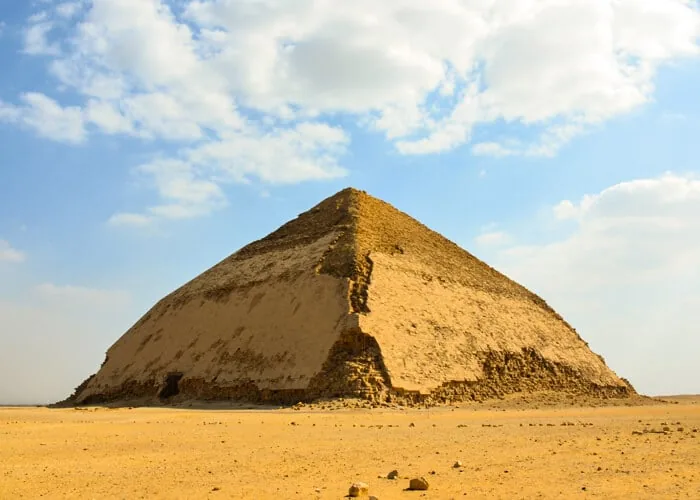
Pharaoh Sneferu built both the Bent Pyramid and the Red Pyramid around 2600 BCE during the Fourth Dynasty. The Bent Pyramid's mid-construction slope change reflects a structural problem discovered while building; the Red Pyramid applied the solution and produced Egypt's first true smooth-sided pyramid.
What Dahshur Necropolis actually is
Dahshur is a royal pyramid field about forty kilometers south of Cairo, containing two of Egypt's most architecturally significant pyramids: the Bent Pyramid and the Red Pyramid, both built by Pharaoh Sneferu in the Fourth Dynasty around 2600 BCE. Sneferu was the father of Khufu, who built the Great Pyramid at Giza, and Dahshur represents the experimental phase of pyramid construction, the architectural problem-solving that produced the refined form his son would perfect.
The Bent Pyramid takes its name from the change in slope angle visible midway up its face: the lower section rises at a fifty-four-degree angle, then abruptly shifts to forty-three degrees near the top. Egyptologists believe this reflects a structural problem discovered during construction, the steeper angle produced unacceptable internal stresses, and the builders adjusted mid-course. The result is a pyramid that is essentially a record of ancient engineering failure and correction. The Red Pyramid, built subsequently, applied the lessons of the Bent Pyramid and produced Egypt's first true smooth-sided pyramid, the direct architectural ancestor of the Giza structures.
Dahshur receives a fraction of Giza's visitors and retains an openness that makes exploring the site genuinely different. The Bent Pyramid's unusual profile is distinctive from a distance; the Red Pyramid can be entered through a descending passage that leads to three interconnected chambers, the air is thick with ammonia from bat colonies but the interior is worth the minor discomfort. The surrounding desert holds the ruins of several smaller pyramids from the Twelfth Dynasty Middle Kingdom period, largely reduced to rubble but interesting for the satellite structures and causeways still visible. The site feels like fieldwork rather than a tourist attraction.
Dahshur is about forty kilometers south of Cairo, most easily reached by taxi from the Giza plateau (approximately forty minutes) or from central Cairo (approximately one hour). The site is often combined with Saqqara and Memphis as a southern pyramid day trip.
Dahshur is about forty kilometers south of Cairo, most easily reached by taxi from the Giza plateau (approximately forty minutes) or from central Cairo (approximately one hour).
The Experience
Study the Bent Pyramid's distinctive double-angle profile from the desert floor, enter the Red Pyramid's descending passage into its three interconnected chambers, and walk the surrounding Middle Kingdom pyramid ruins for satellite structures and causeways.
Why It Matters
The architectural experiments at Dahshur, including a recorded mid-construction failure and correction, produced the engineering knowledge that made the Giza pyramids possible.
Why Visit
Dahshur has almost no crowds. The ability to walk freely around the Bent Pyramid, examine its exterior closely, and enter the Red Pyramid without queuing or time limits provides a completely different pyramid experience from Giza.
✦ Insider Tips
- 1
The Red Pyramid interior is open to entry, the descending passage is low and requires crouching, but the chambers at the end are surprisingly spacious.
- 2
Combine with Saqqara (fifteen minutes north) and Memphis for a full southern pyramid day, the three sites together cover Old Kingdom pyramid development comprehensively.
- 3
The Middle Kingdom satellite pyramids to the east of the Red Pyramid are worth the walk for the absence of visitors alone.