The largest religious complex ever built was under continuous construction for fifteen hundred years, and the Great Hypostyle Hall's 134 columns still bear traces of their original paint.
About Karnak Temple Complex
Construction began around 2000 BCE and continued through multiple dynasties. Karnak was the center of Amun worship and the wealthiest temple precinct in Egypt during the New Kingdom, its priestly class eventually wielding power that rivaled the pharaohs themselves.
What Karnak Temple Complex is
Karnak, on the east bank of the Nile at Luxor, is the largest religious complex ever built. Construction began in the Middle Kingdom period around 2000 BCE and continued for over fifteen hundred years, with successive pharaohs adding pylons, sanctuaries, obelisks, and halls. The result is a layered accumulation of architecture on a scale that no single building campaign could have produced, the precinct of Amun-Ra alone covers roughly two kilometers in circumference.
“Karnak, on the east bank of the Nile at Luxor, is the largest religious complex ever built.”
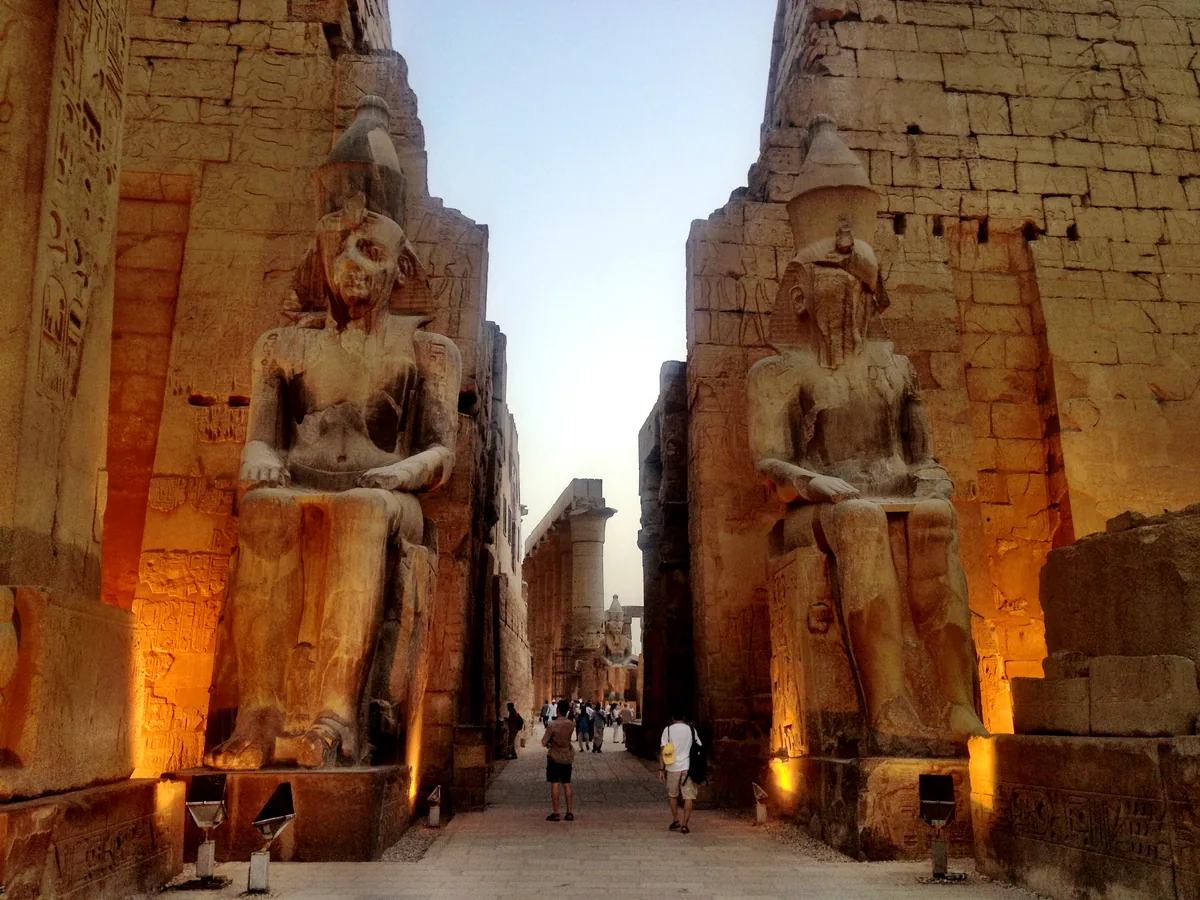
Karnak Temple Complex, Egypt
Karnak was the most important religious site in ancient Egypt for most of the New Kingdom period, when Thebes, modern Luxor, was the country's capital. The temple's primary deity was Amun, who merged with the sun god Ra to become Amun-Ra during the New Kingdom. The wealth and political power of the Amun priesthood, concentrated here, eventually became significant enough to rival that of the pharaohs themselves, a tension that contributed to Akhenaten's controversial attempt to shift Egyptian religion toward monotheism and move the capital away from Thebes. After Akhenaten's death, his successors systematically dismantled his reforms and poured resources back into Karnak.
The Great Hypostyle Hall is the structure that most visitors remember: 134 columns arranged in sixteen rows, the largest columns over twenty-three meters tall, covering an area of nearly five thousand square meters. The ceiling has long since collapsed, but standing among the columns, many still bearing their original paint, produces a spatial experience that is difficult to prepare for. The Avenue of Sphinxes connecting Karnak to Luxor Temple has been partially excavated and restored. The Sacred Lake, surrounded by the temple precinct, was used for ritual purification.
Karnak is on Luxor's east bank , about three kilometers north of Luxor Temple. A pleasant riverside walk or a short taxi ride connects the two. The site opens at 6am; early arrival is strongly recommended.
“Karnak is on Luxor's east bank , about three kilometers north of Luxor Temple.”
The Experience
Walk through the Great Hypostyle Hall's forest of painted columns, follow the partially restored Avenue of Sphinxes, circle the Sacred Lake, and spend time reading the wall reliefs that document fifteen centuries of royal patronage.
Why It Matters
The largest religious complex in human history, representing the accumulated devotion, and political investment, of over thirty pharaohs across fifteen hundred years.
Why Visit
The Hypostyle Hall is one of the most spatially overwhelming man-made environments on earth. No photograph, including wide-angle shots, captures what it feels like to stand between those columns.
Insider Tips
- 1
Arrive at the 6am opening, the Hypostyle Hall in early morning light, with minimal visitors, is a different experience from the midday crowds.
- 2
The site is large enough to require two to three hours minimum; plan accordingly.
- 3
A licensed guide is particularly valuable at Karnak for decoding the layered history visible in the different architectural styles.
- 4
The sound and light show at night runs three times weekly in English and provides a good narrative overview of the complex.