Cairo's oldest bazaar has been operating continuously since 1382, and one of its coffeehouses has been open since 1773.
About Khan el-Khalili
Founded as a Mamluk caravanserai in 1382 on the site of a Fatimid royal cemetery, Khan el-Khalili grew into Cairo's main commercial district through the Ottoman period. Specializations by trade, gold, spice, copper, perfume, developed in distinct lanes over centuries.
Khan el-Khalili is Cairo's oldest bazaar, a market district deep in Islamic Cairo that has been operating continuously since the fourteenth century. The market began as a caravanserai, a travelers' hostel and trading post, established by the Mamluk emir Djaharks el-Khalili in 1382, and it grew into the commercial heart of the city over the following centuries. The narrow lanes that make up the bazaar today cover a significant area and sell everything from gold and spice to mass-produced souvenirs.
“Khan el-Khalili is Cairo's oldest bazaar, a market district deep in Islamic Cairo that has been operating continuously since the fourteenth century.”
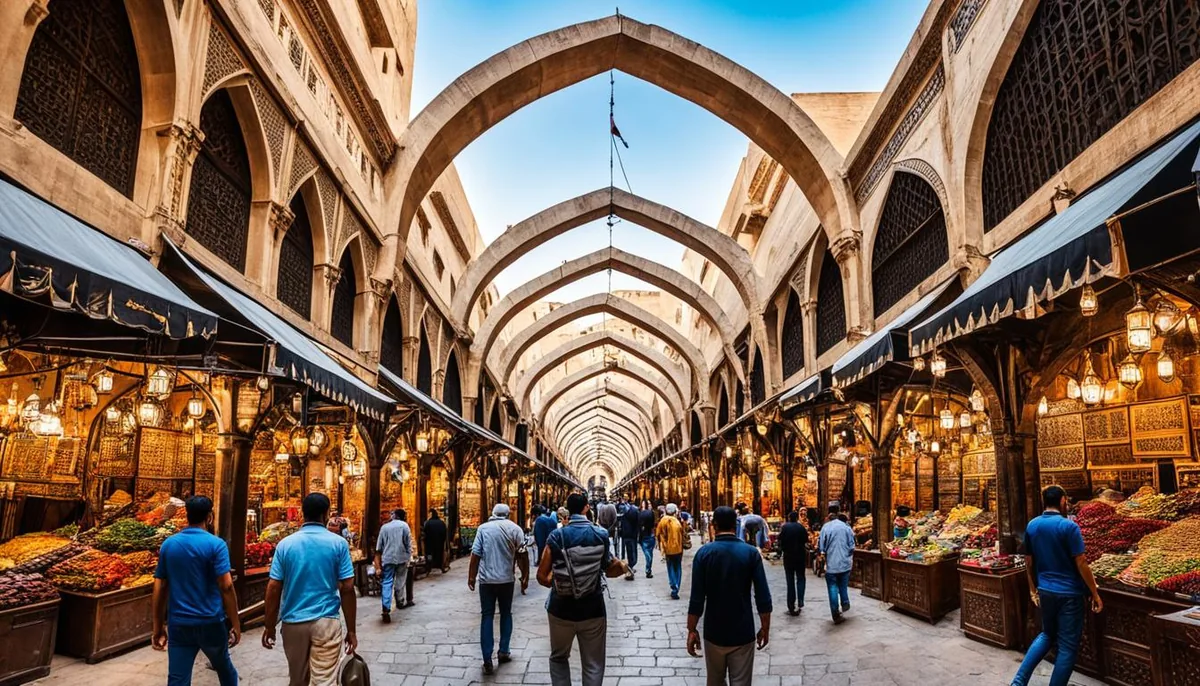
Khan el-Khalili, Egypt
The original caravanserai was built on the site of a Fatimid royal cemetery, which required the relocation of Fatimid tombs, a decision that generated significant religious controversy at the time. The khan became the center of Cairo's wholesale trade in the Ottoman period, when merchants from across the Islamic world used it as a base. Different sections of the bazaar specialized by trade: goldsmiths in one lane, spice sellers in another, perfume dealers, copper workers, textile traders. Some of these specializations persist today, though the tourist trade now dominates the most visible lanes.
The bazaar divides roughly into two zones: the tourist-facing outer lanes near Hussein Square, where souvenir shops and coffeehouse touts are thick, and the inner lanes where Cairenes shop for gold, spices, and household goods. The inner lanes are more interesting and less pressured. El-Fishawi coffeehouse, which has been open continuously since 1773, is the social anchor of the bazaar, a place for tea, shisha, and an hour of watching the lane traffic. The nearby mosque of Sayyidna al-Hussein and Al-Azhar Mosque make the surrounding district worth a full half-day.
Khan el-Khalili is in Islamic
Cairo, a twenty-minute taxi ride from central Cairo or the Egyptian Museum. The nearest metro is Al-Sayeda Zeinab, from which a fifteen-minute walk or short taxi reaches the bazaar.
“Cairo, a twenty-minute taxi ride from central Cairo or the Egyptian Museum.”
The Experience
Navigate from the tourist-heavy outer lanes to the inner market where locals shop for gold and spice, sit at El-Fishawi coffeehouse for tea and people-watching, and explore the adjacent mosques of Al-Azhar and Hussein.
Why It Matters
One of the oldest continuously operating markets in the Islamic world, representing six centuries of Cairo's commercial and social life.
Why Visit
The inner lanes of Khan el-Khalili, away from the souvenir shops, are still a functioning wholesale market where gold is weighed and spices sold by the kilo. That continuity with the fourteenth-century caravanserai is rare in any city.
Insider Tips
- 1
Walk past the first two hundred meters of souvenir stalls before buying anything, the inner lanes have better quality at lower prices.
- 2
Haggling is standard and expected; initial prices are typically two to three times the expected final price.
- 3
El-Fishawi is crowded but worth at least one tea, the ambiance is the point, not the beverage.
- 4
The spice market near the bazaar's northern end has medicinal herbs, loose tea, and dried flowers worth bringing home.