Priests made offerings at this island temple until the sixth century CE, a thousand years after most pharaonic sites were abandoned, before UNESCO dismantled and rebuilt it on a new island to save it from Lake Nasser.
About Philae Temple
The Temple of Isis operated continuously into the Byzantine period, the last functioning ancient Egyptian religious site. The original Philae Island was submerged after the Aswan Dam construction; UNESCO relocated the temple block by block to nearby Agilkia Island between 1972 and 1980.
The Temple of Isis at Philae sits on Agilkia Island in the Nile near Aswan, reached by a short motorboat crossing from the Aswan riverside. The temple was the last operational ancient Egyptian religious site, priests continued making offerings here until the sixth century CE, roughly a thousand years after most other pharaonic temples had been abandoned. The island is small, the temple complex fills most of it, and the Nile surrounds everything, a setting that makes Philae one of the most visually coherent Egyptian sites.
“The Temple of Isis at Philae sits on Agilkia Island in the Nile near Aswan, reached by a short motorboat crossing from the Aswan riverside.”
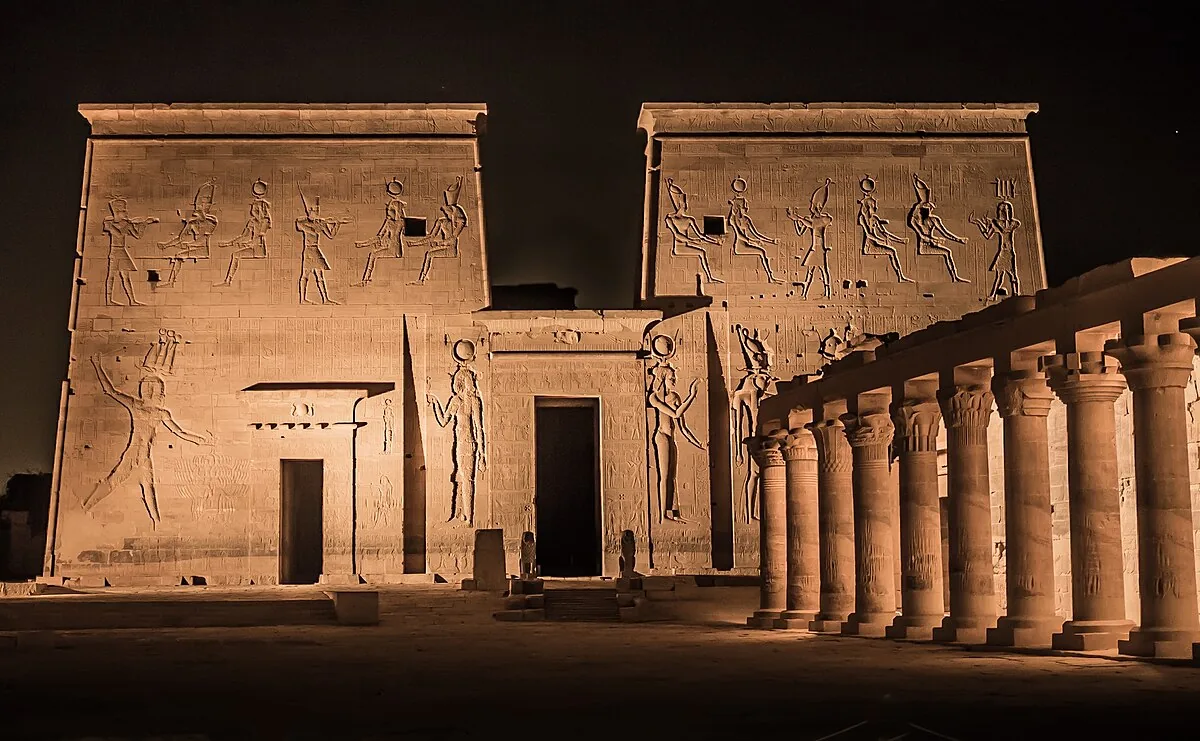
Philae Temple, Egypt
first Aswan Dam, 1902
The original Philae Island, where the temple stood for two millennia, was submerged by the rising water levels created by the first Aswan Dam in 1902. For decades, the temple was partially flooded for most of the year, visible only when the dam released water in summer. After the Aswan High Dam created Lake Nasser in the 1960s, complete submersion became permanent. Between 1972 and 1980, UNESCO coordinated the dismantling and reconstruction of the temple on the nearby Agilkia Island, which was reshaped to approximate the original Philae topography. The relocation preserved both the temple and the island's character.
The approach by motorboat across the water , with the pylon gates and colonnades visible from the river, provides context that arriving by land never could, the island setting was always integral to the experience. The main complex includes two pylons, a colonnaded courtyard, the hypostyle hall, and the innermost sanctuary of Isis. Relief carvings cover most surfaces in good detail. The Temple of Hathor, a smaller structure on the island's periphery, contains a famous carving of musicians in a scene unusually relaxed in tone for pharaonic art. A sound and light show runs on Tuesday, Thursday, and Saturday evenings.
Philae is reached from the Shellal motorboat dock, about ten kilometers south of Aswan. Taxis from Aswan take about twenty minutes; the motorboat crossing takes five minutes. Aswan is served by train from Luxor (approximately four hours) and by domestic flights from Cairo.
“Philae is reached from the Shellal motorboat dock, about ten kilometers south of Aswan.”
The Experience
Arrive by motorboat across the Nile for the approach the ancient worshippers used, walk through the two-pylon complex with its well-preserved relief carvings, visit the peripheral Temple of Hathor with its unusual musician carvings, and attend the evening sound and light show.
Why It Matters
The last ancient Egyptian temple in active religious use, relocated in one of UNESCO's most complex preservation operations, and the primary surviving monument to the worship of Isis.
Why Visit
Philae's island setting gives it an integrity that most relocated monuments lack. The motorboat approach across open water, the temple rising from the shoreline, is close to how ancient pilgrims would have experienced the site.
Insider Tips
- 1
Negotiate the motorboat fare before boarding, a fixed round-trip price is standard and avoids difficulties on return.
- 2
The sound and light show (Tuesday, Thursday, Saturday) is worth attending for the illumination of the pylons at night.
- 3
The Temple of Hathor at the island's far end is less visited but has some of the most interesting carvings on the site.