Wind erosion over millions of years carved a former seabed into chalk formations that glow white against the desert floor, and camping under the stars between them is unlike anywhere else in Egypt.
About White Desert National Park
The chalk formations are the remnants of an ancient inland sea that covered this region eighty million years ago. The harder chalk survived as softer sand eroded away, leaving columns and masses that fossils of marine creatures confirm were once underwater.
The White Desert National Park occupies a section of Egypt's Western Desert north of the Farafra Oasis, where millennia of wind erosion have carved chalk rock formations into shapes that read, in certain light, as sculptures: mushrooms, inselbergs, animals, abstract masses of brilliant white chalk rising from a flat desert floor. The contrast between the white chalk and the yellow-orange sand is most extreme at sunset and sunrise, when the formations take on pink and gold tones that shift with the light.
“The contrast between the white chalk and the yellow-orange sand is most extreme at sunset and sunrise, when the formations take on pink and gold tones that shift with the light.”
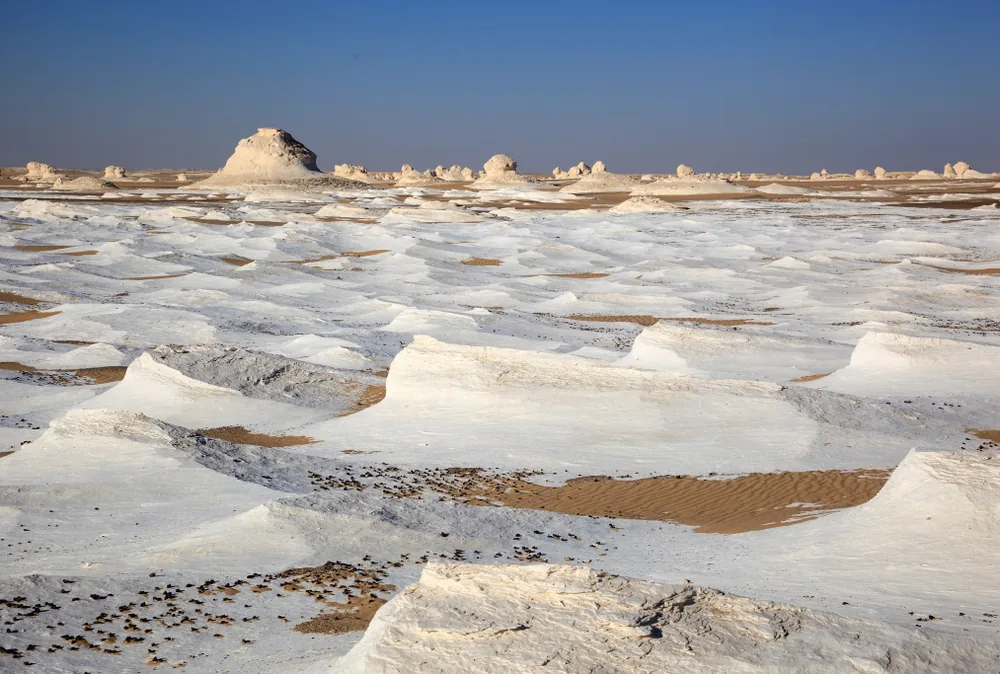
White Desert National Park, Egypt
The chalk formations were the seabed of an ancient inland sea that covered this part of North Africa approximately eighty million years ago. As the sea retreated and the Sahara developed, the softer sand layers eroded away, leaving the harder chalk columns and formations protruding from the desert floor. The national park designation, formalized in 2002, protects roughly three thousand square kilometers of this landscape. Fossils of ancient marine creatures, sea urchins, shells, are visible in the chalk, a mark of the environment that produced the formations.
The park is visited primarily on overnight camping trips organized from Bahariya Oasis, about four hours south of Cairo. The drive through the Black Desert, a volcanic landscape of dark basalt, before entering the white zone provides a useful contrast that makes the chalk formations more dramatic. Camping in the White Desert, sleeping under an exceptionally dark sky far from any city, is the primary reason to make the journey. The formations are best experienced on foot at first light, when the air is cool and the shadows long. Jeep tours stop at the main formation areas during the day, but the experience of walking alone between the chalk shapes in early morning is qualitatively different.
Bahariya Oasis is the base for White Desert visits, about 370 kilometers southwest of Cairo by road. Daily buses run from Turgoman station in Cairo; the journey takes four to five hours. From Bahariya, all White Desert access requires a 4WD vehicle, local operators in Bahariya organize overnight trips with camping equipment.
“Bahariya Oasis is the base for White Desert visits, about 370 kilometers southwest of Cairo by road.”
The Experience
Camp overnight among the chalk formations after passing through the contrasting Black Desert, walk the formations at first light in cool silence, and look for marine fossils in the chalk surfaces that record the ancient seabed origin.
Why It Matters
One of Egypt's most geologically distinctive landscapes, protecting a rare chalk formation environment that has no equivalent elsewhere in the country.
Why Visit
The White Desert's landscape is genuinely disorienting, the chalk formations read as otherworldly in a way that photographs don't adequately represent. The combination with desert camping and a dark sky makes it the most sensory-complete natural experience in Egypt.
Insider Tips
- 1
Book an overnight trip from Bahariya rather than a day tour, the formations at sunset and sunrise are incomparably better than at midday.
- 2
The Black Desert en route is worth stopping in, the contrast with what comes next is part of the experience.
- 3
Marine fossils are visible in the chalk without digging, look at the surface of formations at knee height.
- 4
All operators are required to be licensed for White Desert camping, verify licensing before booking in Bahariya.