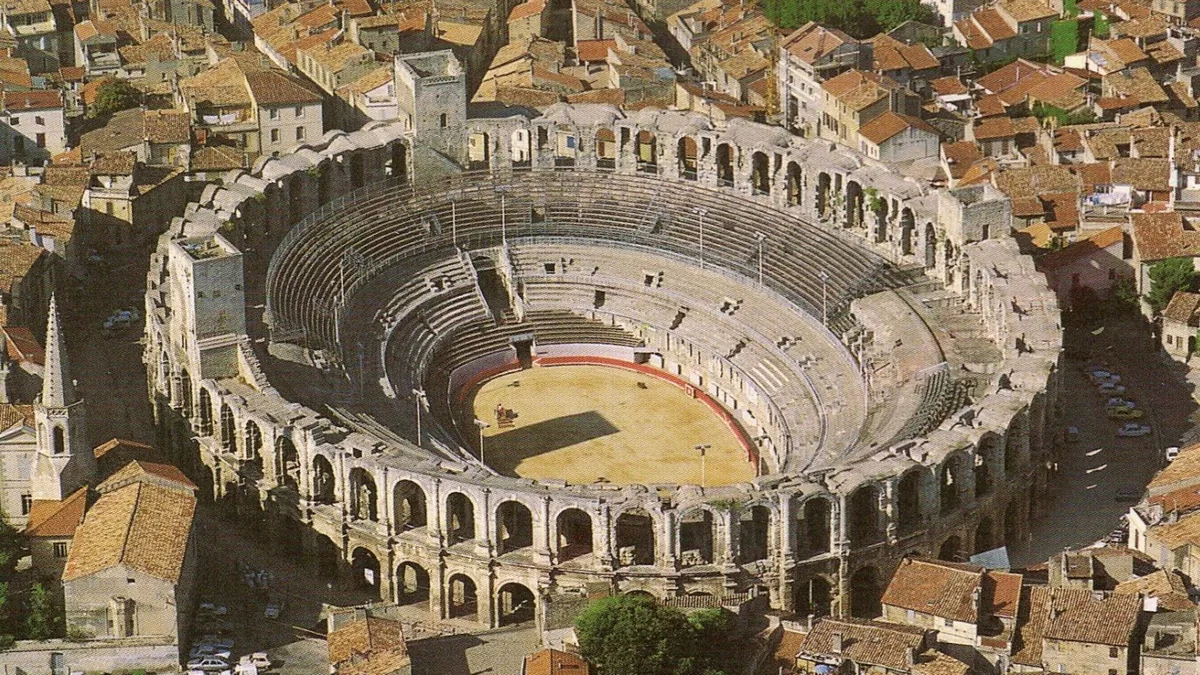
“A first-century Roman amphitheatre that once seated 20,000 spectators was converted into a residential village of 212 houses in the medieval period, then the houses were removed in the nineteenth century to restore the original seating, which is still used for bullfighting.”
About Arles Amphitheatre
Built at the height of Roman Arles's prosperity, the amphitheatre survived Rome's decline as a residential quarter with medieval towers built within its walls. Nineteenth-century restoration removed the houses and restored the seating; the Feria bullfighting tradition continues a medieval use of the space.
What Arles Amphitheatre actually is
The Roman amphitheatre at Arles, the Arènes d'Arles, was built in the first century CE and seated approximately 20,000 spectators. With the Roman theatre, the ancient forum, and the Alyscamps necropolis, the amphitheatre is part of a UNESCO-listed ensemble that makes Arles one of the most intact Roman cities in France. The amphitheatre is still in active use: bullfighting events called the Feria take place here multiple times each year, continuing a tradition that began in the medieval period when the structure was converted into a residential quarter of 212 houses.
The Roman amphitheatre at Arles, the Arènes d'Arles, was built in the first century CE and seated approximately 20,000 spectators.
Arles, ancient Arelate, was one of the most important cities of Roman Gaul, the capital of the western Roman Empire under Constantine and a major port on the Rhône. The amphitheatre was built during the height of Roman Arles's prosperity and used for gladiatorial combat, animal hunts, and public spectacles. After Rome's decline, the amphitheatre was converted to civilian use: the two surviving medieval towers, built within the structure to use its walls, date from this period, as do the foundations of the houses and church that occupied the interior until they were removed in the nineteenth century to restore the Roman seating. The Feria traditions that use the space today date to the same medieval period.
The amphitheatre is physically imposing from outside, two tiers of arcades, 60 arches per tier, covering an oval 136 by 107 metres. The interior seating, partially restored, allows the full circuit of the oval to be walked; the view from the top tier over Arles and the Alpilles hills beyond is one of the best elevated perspectives in the city. When Feria is running, typically in May, June, and September, the seating fills with 20,000 spectators as it did for the Romans. The medieval towers at the north end of the structure are the most visible evidence of the building's post-Roman transformation. Arles is on the main rail line between Marseille (about fifty minutes) and Nîmes (about thirty minutes). The amphitheatre is in the center of Arles's old town, a ten-minute walk from the train station.
The Experience
Walk the full oval of the restored Roman seating from the top tier for views over Arles and the Alpilles, examine the medieval towers built within the Roman structure, and attend a Feria event in May, June, or September if the calendar aligns.
Why It Matters
The best-preserved Roman amphitheatre in France and a UNESCO World Heritage component, a building that has been in continuous use for two thousand years, transitioning from gladiatorial combat to residential housing to bullfighting.
Why Visit
The Arles Feria is one of the few opportunities in France to experience a major public spectacle in an ancient amphitheatre the way it was designed to be used, with 20,000 people filling the original Roman seating. Even outside Feria, the view from the upper tier over the city is reward enough.
✦ Insider Tips
- 1
The top tier of the seating provides the best view over the city and the Alpilles; the climb is straightforward and the perspective repays it.
- 2
Combine the amphitheatre with the Roman theatre (five minutes' walk) and the Museon Arlaten ethnography museum on the same day.
- 3
The LUMA Arles contemporary arts complex, designed by Frank Gehry, is twenty minutes' walk and worth combining for a full day in the city.