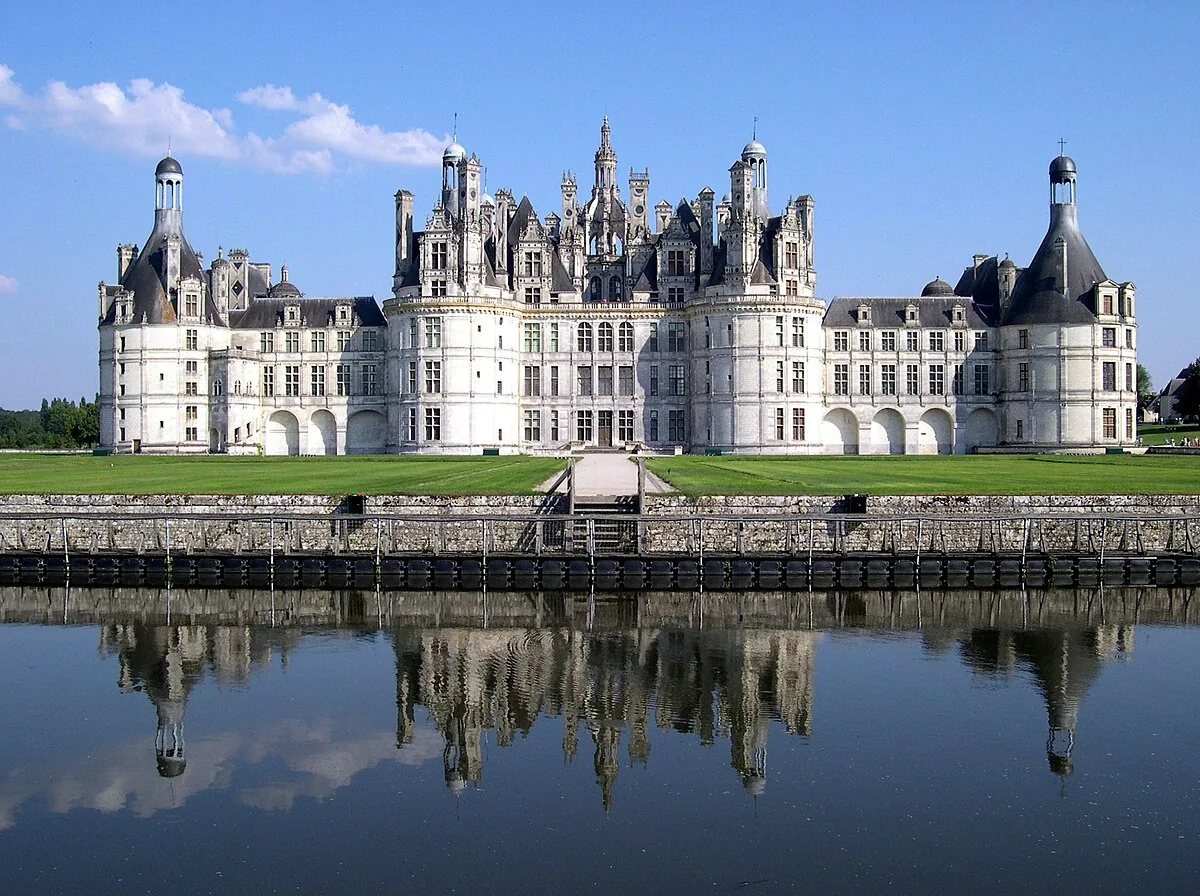
Francis I built 440 rooms, 365 fireplaces, and a roofline like a miniature city as a hunting lodge he visited only thirteen times, and the double helix staircase at its center, attributed to Leonardo da Vinci, allows two people to ascend simultaneously without ever meeting.
About Château de Chambord
Built from 1519 to demonstrate French supremacy over Italian Renaissance architecture, Chambord was never properly finished and never functioned as a sustained royal residence. Louis XIV visited for hunting parties; Molière premiered Le Bourgeois Gentilhomme here in 1670. The estate has been a national domain since the Revolution.
What Château de Chambord actually is
Château de Chambord is the largest château in the Loire Valley, a building of 440 rooms, 365 fireplaces, and a roofline of towers, turrets, chimneys, and dormers that reads at a distance as a miniature city. Built by Francis I from 1519 as a royal hunting lodge, it remained unfinished at his death and has spent more of its existence vacant than occupied. The design is conventionally attributed to influence from Leonardo da Vinci, who was living at Amboise as the king's guest when planning began, though the attribution of specific elements remains debated among architectural historians.
Francis I's ambition at Chambord was to create a château that would surpass anything built in Italy, a demonstration that the French Crown could absorb and exceed the Italian Renaissance that had dazzled French aristocrats during the Italian wars. The château was used as a hunting base only, it has no proper kitchen and was never intended for sustained royal residence, but the scale of construction consumed resources that strained the royal finances. The famous double helix staircase at the center of the building, by which two people can ascend simultaneously without meeting, is the architectural element most consistently attributed to Leonardo's design input. Louis XIV used Chambord for hunting parties and hosted the premiere of Molière's Le Bourgeois Gentilhomme here in 1670.
The double helix staircase at the center of the keep is the architectural experience most visitors come for, two intertwined helical ramps that share the same central column and light source but never intersect, allowing two people to ascend and descend without meeting. The rooftop terrace, reached by continuing up the staircase, presents the full complexity of the roofline at close range: dozens of chimneys, lantern towers, and dormers in a composition that seemed deliberately irrational. The surrounding estate, the largest walled forest in France at 5,440 hectares, has deer and Przewalski's horses that can be seen from observation platforms along the estate roads.
Chambord is in the Loire Valley, about 14 kilometres from Blois. Blois is served by frequent TGV and regional trains from Paris (about ninety minutes). From Blois, a shuttle bus serves Chambord in summer; a bicycle hire from Blois covers the flat Loire Valley road in under an hour.
The Experience
Climb the double helix staircase through its shared central column to the rooftop terrace, study the complex lantern and chimney roofline at close range, and walk or cycle the estate roads to see deer and Przewalski's horses in the walled forest.
Why It Matters
The largest château in the Loire Valley and one of the most architecturally ambitious buildings of the French Renaissance, a royal hunting lodge whose scale and decorative ambition far exceeded its modest practical function.
Why Visit
The double helix staircase is a spatial experience that diagrams don't adequately communicate, walking up while looking down through the shared light source and across to the other helix produces a vertiginous sense of spatial invention. The rooftop is where the scale of the building's ambition becomes fully legible.
✦ Photo Gallery
Best Season
🌤 April through October. The Loire Valley summer is pleasant; the estate wildlife is most active at dawn and dusk, which means early morning or evening visits to the estate roads. The château is illuminated at night in summer.
Quick Facts
Best time to visit
April through October. The Loire Valley summer is pleasant; the estate wildlife is most active at dawn and dusk, which means early morning or evening visits to the estate roads. The château is illuminated at night in summer.
Getting there
In Loire Valley, France; reach Loire Valley first, then continue to the site.
Location
Loire Valley, France
Type
attraction
Coordinates
47.6161°, 1.5172°
Insider Tips
- 1
The estate wildlife observation platforms are open from dawn; the deer are most visible in early morning and at dusk rather than midday.
- 2
The sound and light show in summer evenings uses the facade dramatically, the combination of illumination and narration gives the roofline its full theatrical effect.
- 3
The château has no kitchen and no restaurant within the main building, the estate has a cafe and picnic areas in the grounds.