“A double-walled medieval fortress city in Languedoc was headed for demolition in the nineteenth century until Viollet-le-Duc restored it, and the restoration became the defining debate in European architectural conservation about where restoration ends and invention begins.”
About Cité de Carcassonne
Fortified since the Gallo-Roman period, Carcassonne was associated with the Cathar heresy and the Albigensian Crusade in the thirteenth century. Viollet-le-Duc's 1853 restoration saved it from demolition while adding slate roofing, historically inappropriate for the region, that remains the subject of conservation debate.
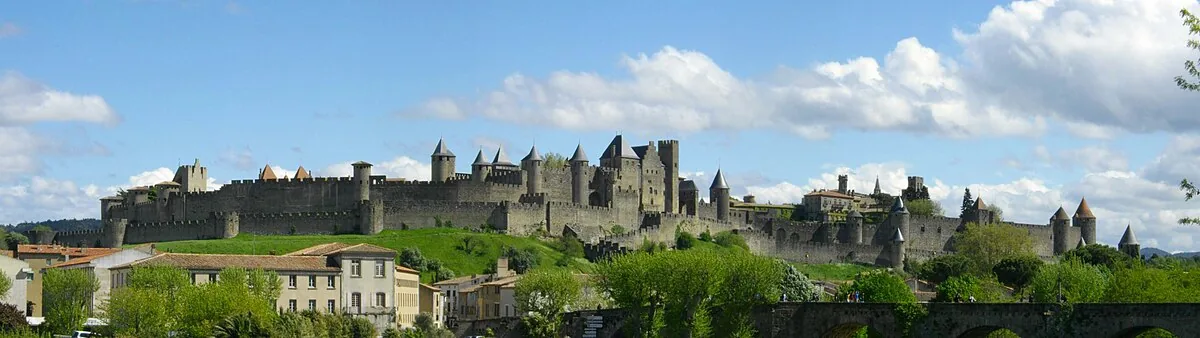
What Cité de Carcassonne actually is
Carcassonne's medieval walled city, the Cité, occupies a hilltop above the lower town and the Aude River in Languedoc, presenting a double ring of walls, 52 towers, and the Château Comtal in a fortification ensemble that, in its current appearance, is partly medieval and partly the work of nineteenth-century restoration. The UNESCO World Heritage Site designation recognizes both the genuine medieval fabric and the significance of Eugène Viollet-le-Duc's restoration, which became one of the defining examples of historicist architectural reconstruction in Europe.
Carcassonne has been fortified since the Gallo-Roman period; the visible stone towers began appearing in the twelfth century. The city was associated with the Cathar heresy in the thirteenth century, and the Albigensian Crusade launched against the Cathars resulted in siege and eventual French royal control. After the Treaty of the Pyrenees moved the French border south in 1659, Carcassonne's military significance diminished; by the nineteenth century, the Cité was substantially ruined and faced demolition. Viollet-le-Duc was commissioned to restore it in 1853. His work, which included the addition of slate roofing on the towers, later criticized as stylistically inappropriate for the Languedoc, saved the structure while also becoming the subject of the foundational debate in architectural conservation about the difference between restoration and invention.
The Cité is entered through two main gates and is occupied by a village of restaurants, shops, and hotels within the walls, it functions as a town rather than a monument. The Château Comtal in the interior requires a separate ticket and is one of the best-preserved secular medieval buildings in France. The lists, the passageway between the inner and outer walls, can be walked for the full circuit, about three kilometres. Evening visits when day visitors have left are when the Cité's medieval character is most apparent, the lights picking out the wall towers against the dark sky.
Carcassonne has a train station with direct TGV connections from Paris Gare de Lyon (under five hours) and regional services from Toulouse (55 minutes). The Cité is about two kilometres from the lower town train station, a walkable distance or a short taxi ride.
Carcassonne has a train station with direct TGV connections from Paris Gare de Lyon (under five hours) and regional services from Toulouse (55 minutes).
The Experience
Walk the three-kilometre inner and outer wall circuit through the lists, visit the Château Comtal with its separate ticket for the best-preserved secular medieval interior, explore the inhabited village within the walls, and return in the evening when the lit towers emerge from the dark.
Why It Matters
A UNESCO World Heritage Site representing both medieval military architecture at its most complete and the most influential example of nineteenth-century historicist restoration in Europe.
Why Visit
The evening visit, after the day-trippers leave, with the wall towers lit against the dark, is when the Cité functions as the medieval city it resembles rather than the tourist attraction it is during the day. The debate embedded in its very stones, between preservation and invention, gives the visit an intellectual dimension most visitors miss.
✦ Insider Tips
- 1
The evening light on the walls is worth the hotel cost of staying within the Cité, morning and evening, before and after day visitors, the character of the place changes completely.
- 2
The Château Comtal interior requires a separate ticket from the general Cité entry, buy it online to avoid queues.
- 3
The lists (between the inner and outer walls) can be walked for the full circuit; it takes about forty-five minutes at a comfortable pace.
- 4
The lower town (Bastide Saint-Louis) has better restaurants at lower prices than those within the Cité walls.