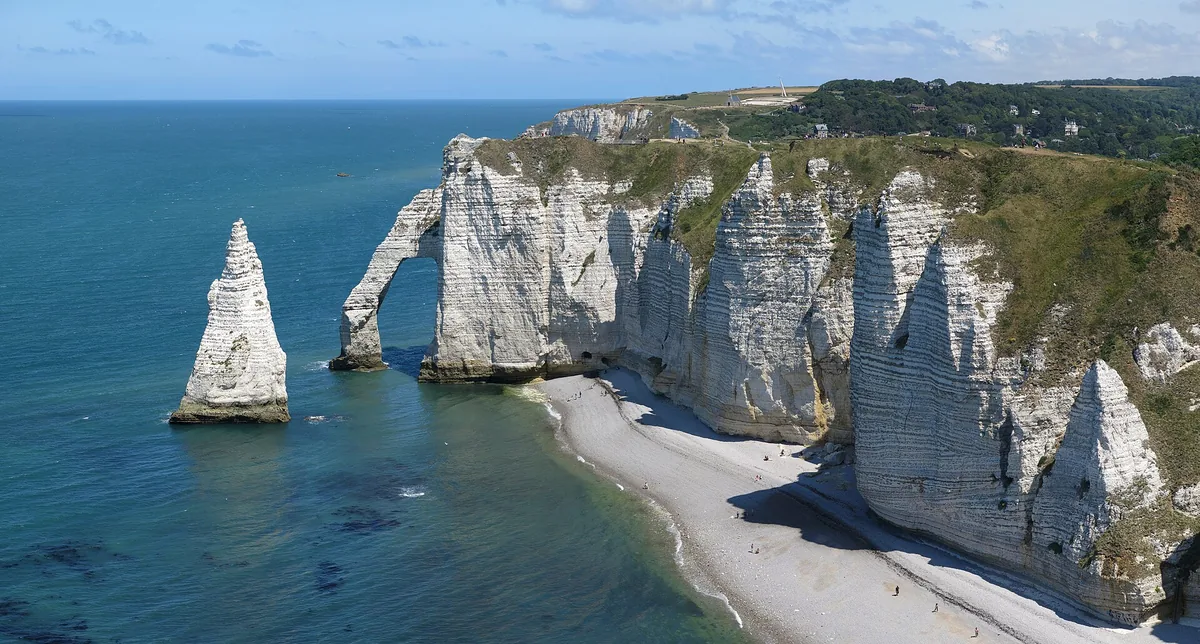
The chalk arches and offshore needle at Étretat were painted by Monet in over forty studies between 1883 and 1886, the same cliffs that Maurice Leblanc used as the setting for Arsène Lupin's secret underground lair.
About Falaise d'Aval
The same chalk geology as Dover's white cliffs, eroded into arches and needles by the English Channel, attracted Courbet, Monet, and the Impressionists in the nineteenth century. Monet's repeated studies of the Falaise d'Aval across different light conditions produced works now in major collections worldwide.
What Falaise d'Aval actually is
The Falaise d'Aval is a chalk cliff formation on the Normandy coast at Étretat, where the white cliffs have been eroded by the English Channel into arches, needles, and caves of striking geometric form. The needle rock, the Aiguille, stands offshore as a 70-metre pinnacle; the main arch, the Manneporte, is large enough for small boats to pass through. The cliffs have been painted by Gustave Courbet, Claude Monet, and dozens of other artists, and they attracted the Impressionist attention that made the Normandy coast one of the most painted landscapes in nineteenth-century France.
The chalk geology of the Normandy coast is the same formation that produces the White Cliffs of Dover across the English Channel, both are remnants of a Cretaceous-era seabed lifted above sea level. The differential erosion that produced the arches and needles at Étretat reflects variations in the chalk's hardness; softer zones eroded into caves that eventually collapsed into arches. Monet painted the Falaise d'Aval repeatedly between 1883 and 1886, working at different times of day to capture the changing light, the paintings that resulted are now distributed across major collections from Paris to Boston. Maurice Leblanc set the Arsène Lupin adventure stories partly in Étretat, inventing a fictional connection between the Aiguille and the underground tunnels of the cliff.
The Experience
Walk the clifftop path above the Falaise d'Aval for the view down to the Aiguille needle and the Manneporte arch, descend to the beach at low tide to walk beneath the arch itself, and continue to the Falaise d'Amont on the opposite side of the bay for the view back across Étretat.
Why It Matters
One of the defining landscapes of French Impressionism, the chalk arch formation at Étretat appears in Monet's work more than any other single natural feature in France.
Why Visit
The view from the clifftop path looking down to the Aiguille and the arch is the composition that Monet painted, standing at that vantage point, looking at the same light and the same chalk geometry, is a specific experience of what painting in the landscape means.
✦ Photo Gallery
Best Season
🌤 May through September. The cliff walk is exposed and windy year-round; summer light is best for the chalk's whiteness. Low tide allows beach access beneath the arch, check tide tables before descending.
Quick Facts
Best time to visit
May through September. The cliff walk is exposed and windy year-round; summer light is best for the chalk's whiteness. Low tide allows beach access beneath the arch, check tide tables before descending.
Getting there
In Étretat, France; reach Étretat first, then continue to the site.
Location
Étretat, France
Type
attraction
Insider Tips
- 1
Low tide is required to walk beneath the Manneporte arch on the beach, check tide tables and plan your visit accordingly.
- 2
The Falaise d'Amont (north cliff) gives the best view back over the town and the southern cliffs, cross the town to reach it.
- 3
The clifftop path is slippery when wet; proper footwear rather than sandals or flat-soled shoes is essential.
- 4
Étretat is crowded on summer weekends; weekday visits, particularly mornings, are significantly quieter.