A sixteenth-century syphilis hospital gave its name to Strasbourg's most photogenic quarter, where half-timbered tanner and miller houses crowd the Ill River channels in one of the Rhine plain's finest surviving medieval streetscapes.
About La Petite France
Strasbourg has been French, German, and French again across five centuries; La Petite France developed as the working-class tanner district outside the bourgeois core. The Colombages half-timbered vernacular represents the Rhine plain's architectural tradition in its densest surviving form.
La Petite France is a district at the western tip of the Grande Île, the historic island center of Strasbourg, where the Ill River divides into channels and the half-timbered houses of tanners, millers, and fishermen crowd close to the water. The neighborhood takes its name from a sixteenth-century hospital that treated syphilis, a disease known at the time in German as 'Franzosenkrankheit,' the French disease, though the association with that etymology is rarely front-of-mind for the visitors who photograph it. Strasbourg's Grande Île is a UNESCO World Heritage Site, with La Petite France as its most visually distinctive quarter.
“Strasbourg's Grande Île is a UNESCO World Heritage Site, with La Petite France as its most visually distinctive quarter.”
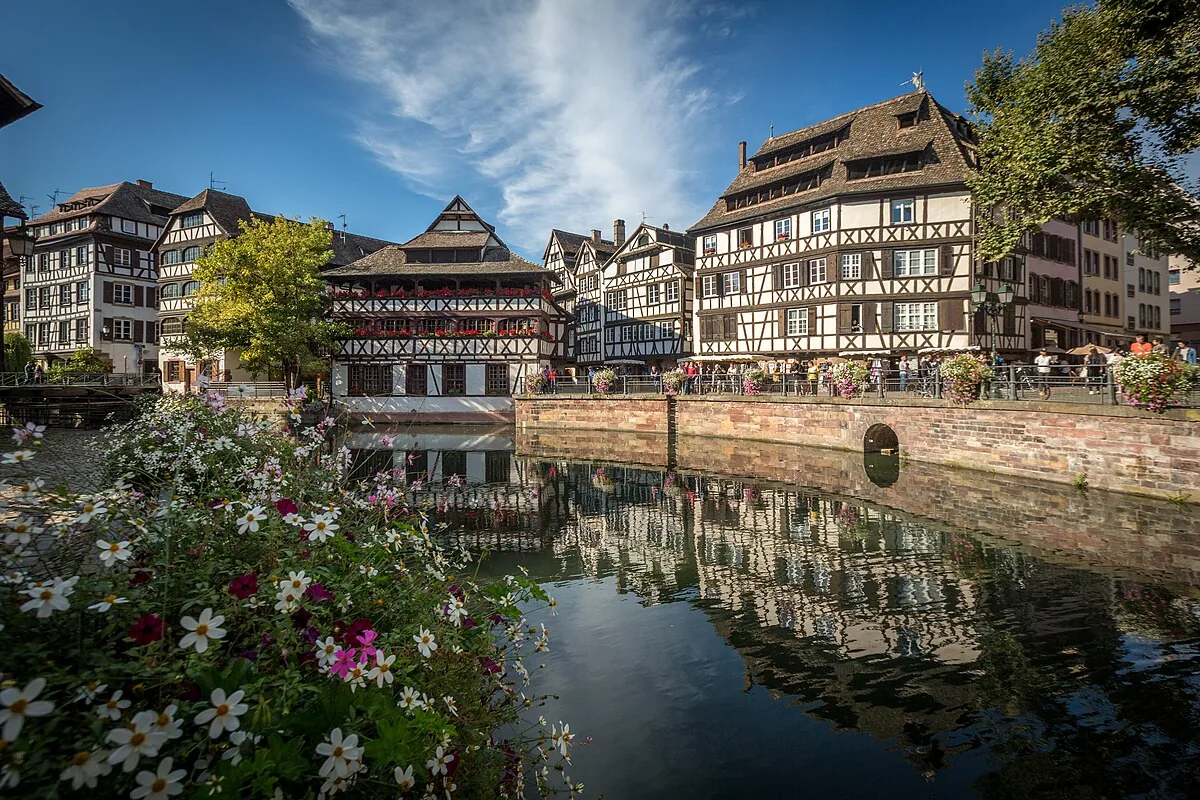
La Petite France, France
Strasbourg's position on the Rhine made it one of the most contested cities in Europe, German until 1681, French until 1871, German until 1918, French since 1945. La Petite France developed as the working-class tanner and miller district outside the bourgeois core of the medieval city, built along the river channels that powered the watermills and provided water for tanning. The half-timbered houses, Colombages, visible today represent the vernacular architecture of the Rhine plain in its most dense surviving concentration. The neighborhood's transformation into a heritage and tourist quarter has been complete for decades; the working trades left long ago, but the buildings remain.
The district's character is best understood from the covered bridges, the Ponts Couverts, which are actually no longer covered but whose four medieval towers still stand at the intersection of the Ill channels, offering views both into La Petite France and out toward the Barrage Vauban. The Barrage Vauban, a seventeenth-century fortified dam with a rooftop terrace, gives the best elevated view over the half-timbered rooflines. The narrow lanes of the district itself are dense with restaurants, wine bars, and pastry shops; the flammekueche, Alsatian flatbread, is the standard local dish, worth finding at a traditional winstub rather than a tourist-facing restaurant.
Strasbourg has a TGV station connected directly to Paris (1h45), Frankfurt, and Brussels. La Petite France is in the city center, a fifteen-minute walk from the train station or a short tram ride on lines A, D, or E to the Grand'Rue stop.
“Strasbourg has a TGV station connected directly to Paris (1h45), Frankfurt, and Brussels.”
The Experience
Walk the La Petite France lanes from the Ponts Couverts medieval towers, climb the Barrage Vauban rooftop terrace for the elevated view over the rooflines, and eat flammekueche at a traditional winstub rather than a tourist-facing restaurant.
Why It Matters
The most visually distinctive quarter of Strasbourg's UNESCO-listed Grande Île, the finest concentration of half-timbered Rhine plain vernacular architecture in France.
Why Visit
The Barrage Vauban rooftop terrace is consistently overlooked in favor of the street-level district view, the elevation over the Colombages rooflines with the spire of Strasbourg Cathedral in the background is one of the better urban views in Alsace.
Insider Tips
- 1
A traditional winstub serving flammekueche is identifiable by a pine branch hung above the door, a local custom indicating authentic Alsatian wine service.
- 2
Strasbourg Cathedral is fifteen minutes' walk from La Petite France, the south facade portal sculpture is among the finest in France.
- 3
The Christmas market in December fills the city's historic squares; accommodation books out months ahead during this period.