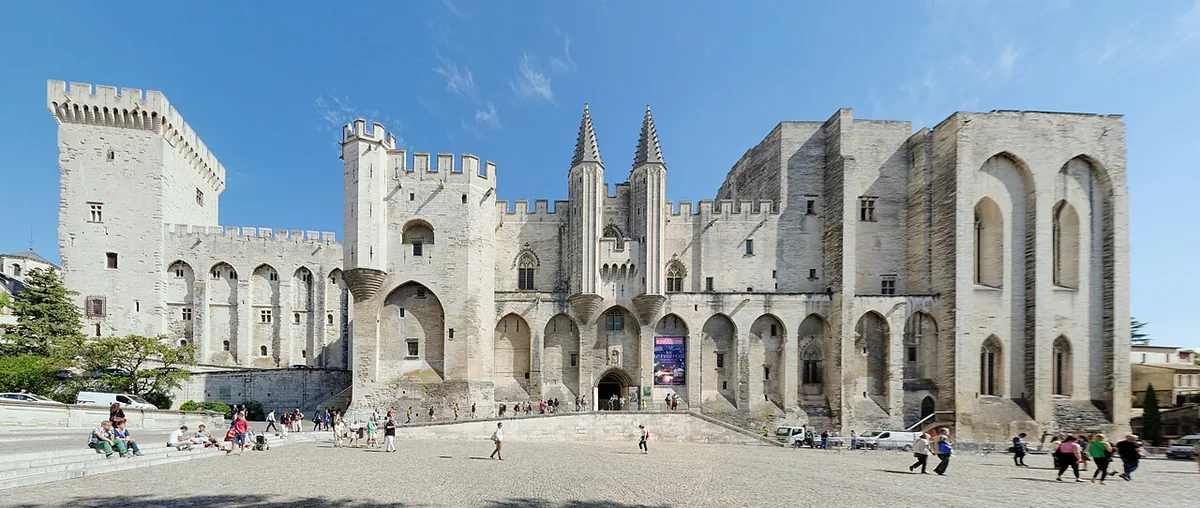
“The largest Gothic building in the world was the seat of seven popes during the period when the papacy abandoned Rome for southern France, and the Avignon Theatre Festival stages its central productions in the papal courtyard each July.”
About Palais des Papes
Pope Clement V relocated the papacy to Avignon in 1309 under French Crown pressure; seven popes and two antipopes reigned here until 1377. The palace was built in two campaigns, austere under Benedict XII, lavish under Clement VI, and used as a barracks in the nineteenth century, losing most of its original decoration.
What Palais des Papes actually is
The Palais des Papes in Avignon is the largest Gothic building in the world and the center of the Western Schism, the period from 1309 to 1377 when the papacy relocated from Rome to this city in the south of France. Seven popes and two antipopes reigned from Avignon, and the palace they built in successive campaigns reflects both the spiritual ambitions and the secular power of an institution that was, for several decades, the most influential in the Western world.
Commissioned by Pope Clement
Pope Clement V moved the papacy to Avignon in 1309 partly due to political pressure from the French Crown and partly because Rome's factional violence made it ungovernable. The Avignon popes were all French; their court attracted artists, scholars, and diplomats from across Europe, making Avignon one of the most culturally sophisticated cities of the fourteenth century. The palace was built in two main campaigns: the Old Palace under Benedict XII, austere and fortress-like, and the New Palace under Clement VI, more lavish in its decoration and conception. The return to Rome in 1377 under Gregory XI effectively ended the Avignon period, though the schism continued with rival antipopes claiming Avignon until 1417.
The scale of the palace is the primary physical experience, the Clementine Chapel alone is 52 metres long and rises to a barrel-vaulted ceiling that dwarfs most Gothic churches. The Great Audience Hall, also by Clement VI, has thirteenth-century fresco cycles of prophets by the painter Matteo Giovannetti; these are the most significant medieval frescoes in France outside of Paris. The palace was used as a barracks and prison for much of the nineteenth century, and the stripping of its medieval furniture and decoration was extensive, the interior is more bare than it would have been in papal occupation. The Avignon Theatre Festival each July uses the palace's main courtyard as its central stage.
Avignon is on the TGV line from Paris
(2h40 from Gare de Lyon) and is a regional hub for Provence. The Palais des Papes is in the center of Avignon's walled city, a five-minute walk from the TGV station at Avignon Centre.
(2h40 from Gare de Lyon) and is a regional hub for Provence.
The Experience
Stand in the 52-metre Clementine Chapel under its barrel vault, study Matteo Giovannetti's fourteenth-century fresco cycles in the Great Audience Hall, and attend the Avignon Theatre Festival's main courtyard performances in July if timing allows.
Why It Matters
The largest Gothic structure in the world and the physical center of the Western Schism, the seventy-year period when the papacy functioned from Avignon rather than Rome.
Why Visit
The scale of the papal apartments is genuinely disorienting, the Clementine Chapel at 52 metres long and the Grand Tinel banqueting hall at nearly the same length make the palace feel less like a building than a small city. The Giovannetti frescoes in the Great Audience Hall are the best medieval painting in the French provinces.
✦ Insider Tips
- 1
The audio guide is the clearest way to follow the two architectural phases and their political context.
- 2
The Giovannetti frescoes in the Grand Tinel and Great Audience Hall are the most significant art in the palace, allocate time accordingly.
- 3
The Festival d'Avignon in July uses the palace courtyard for major productions, booking ahead is essential if attending.
- 4
The Pont d'Avignon (the famous half-bridge) is five minutes' walk from the palace, combine for a half-day in the historic center.