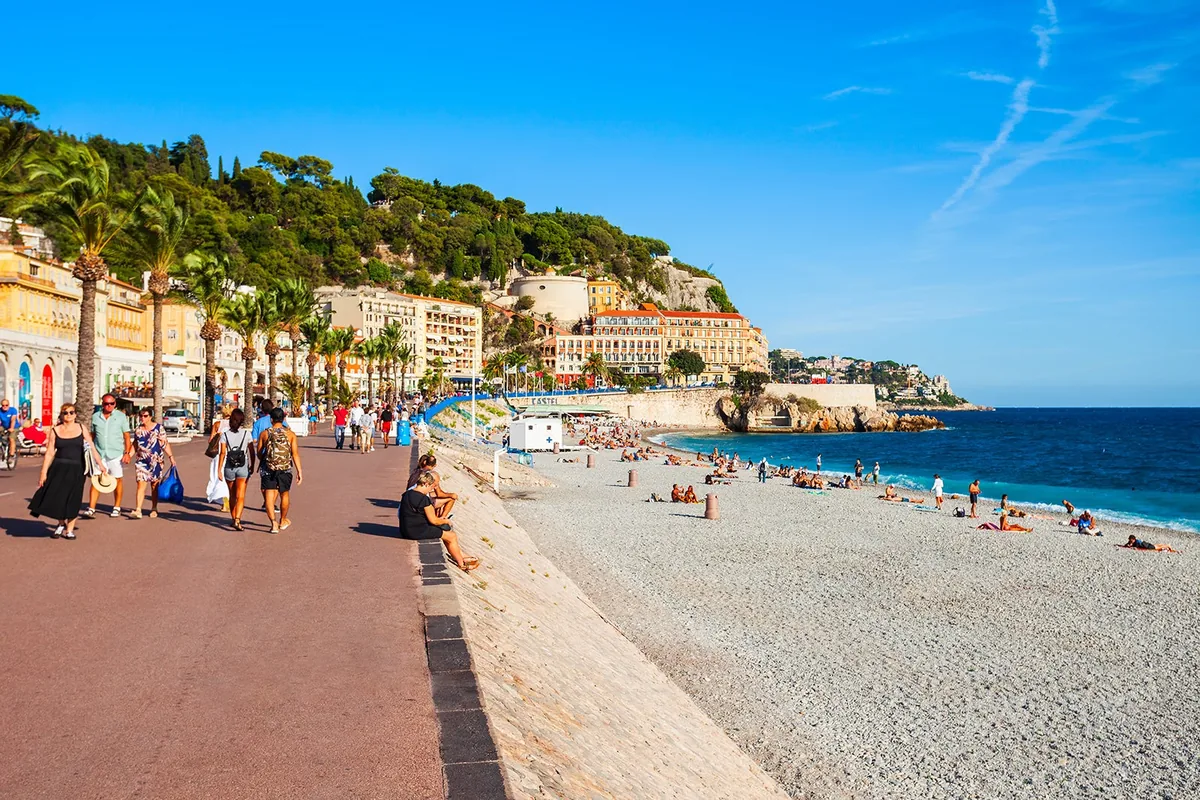
An Anglican minister organized a coastal path in Nice in 1822 using English community money to provide work during a poor harvest, the path grew into a seven-kilometre boulevard that is now the social spine of one of the French Riviera's largest cities.
About Promenade des Anglais
Nice was Sardinian until transferred to France in 1860. The English aristocratic winter colony established the coastal path in 1822; the boulevard was widened and formalized repeatedly as Nice became one of Europe's most fashionable resort cities through the nineteenth century.
What Promenade des Anglais actually is
The Promenade des Anglais runs for seven kilometres along the edge of the Baie des Anges in Nice, a wide seafront boulevard with the Mediterranean on one side and a continuous line of hotels, apartment buildings, and palaces on the other. The pebble beach below the promenade descends directly to the sea; the name comes from the English colony that wintered in Nice in the early nineteenth century and funded the construction of the original coastal path. The promenade is Nice's social spine, a place for cycling, walking, swimming, watching, and being watched that functions continuously from morning to late night.
Nice was part of the Kingdom of Sardinia until 1860, when it was transferred to France as payment for Napoleon III's support of Italian unification. The English aristocracy had been wintering here since the late eighteenth century, fleeing northern winters for the Côte d'Azur's Mediterranean climate. An Anglican minister, Lewis Way, organized the construction of a coastal path in 1822 to provide work for local people affected by a poor harvest; the English community funded the project, which is why the path bears their name rather than a French one. The boulevard was widened and formalized repeatedly through the nineteenth century as Nice grew into one of Europe's most fashionable resort cities.
The promenade is best experienced at its different rhythms: the early morning joggers and swimmers before 8am; the late morning beach crowd settling onto the pebbles; the afternoon promenade of walkers; the evening aperitivo hour when the beach bars open and the light turns gold over the bay. The Hôtel Negresco, its pink dome visible from the beach, is the architectural landmark, its rotunda, ballroom, and historic room collection are worth a lobby visit. The old town of Nice (Vieux Nice) connects to the eastern end of the promenade; the Colline du Château, a park and viewpoint above the old town, gives the best elevated view back over the full bay curve.
Nice has an international airport two kilometres from the city center, connected by tram line T2 in under twenty minutes. The promenade runs the length of the city; trams and buses run parallel to it and the cycle path on the boulevard is a practical way to cover the full seven kilometres.
The Experience
Walk the full promenade at its different daily rhythms from morning swimmers to evening aperitivo, visit the Hôtel Negresco lobby for the historic rotunda and ballroom, and climb the Colline du Château park at the eastern end for the bay-wide view back over the full promenade curve.
Why It Matters
The defining public space of the French Riviera, a seven-kilometre seafront boulevard whose history encapsulates Nice's layers of Italian, English, and French identity.
Why Visit
The Colline du Château view, looking west from above the old town over the full curve of the Baie des Anges with the promenade and the beach in the foreground, is the perspective that explains why the English chose to winter here and why the French have been celebrating it ever since.
✦ Photo Gallery
Best Season
🌤 April through October. The Riviera winter is mild but the beach pebbles are cold and the promenade is quieter. Summer evenings when the beach bars are open and the light is long are the peak social experience.
Quick Facts
Best time to visit
April through October. The Riviera winter is mild but the beach pebbles are cold and the promenade is quieter. Summer evenings when the beach bars are open and the light is long are the peak social experience.
Getting there
In Nice, France; reach Nice first, then continue to the site.
Location
Nice, France
Type
attraction
Insider Tips
- 1
The Colline du Château is accessible by lift from near the beach at the eastern end of the promenade, or by staircase for the view from the climb itself.
- 2
The Hôtel Negresco allows non-guest access to the public areas, including the historic rotunda and ballroom, worth a brief visit.
- 3
Nice's old town (Vieux Nice) is immediately behind the eastern end of the promenade, the best local food and market is there.
- 4
The pebble beach requires water shoes unless you're comfortable on the stones, the stones are large and the slope is steep at the water's edge.