A poet invented the Loreley siren in 1801. Another poet's 1824 poem about her became a German folk song. The rock she supposedly sang from is a real navigational hazard on the Rhine. The myth and the geography are now impossible to fully separate.
About Loreley Rock
The Loreley myth was created by Clemens Brentano in 1801 and popularized by Heine's 1824 poem, set to music by Silcher in 1837. The Romantic movement used the Rhine, and the Loreley specifically, as a symbol of German cultural identity before political unification. The Upper Middle Rhine Valley has been a UNESCO World Heritage Site since 2002.
The Loreley is a 132-meter slate rock at a sharp bend in the Rhine between Koblenz and Bingen, where the river narrows to its most confined channel. The rock takes its name from a mythological siren figure, invented by the poet Clemens Brentano in 1801 and given its famous form by Heinrich Heine's 1824 poem, whose song supposedly lured Rhine boatmen to their deaths on the rocks below. The bend is a navigational hazard; the myth is a literary construction that most visitors treat as historical fact. It received UNESCO status the Upper Middle Rhine Valley a World Heritage Site in 2002.
“The Loreley is a 132-meter slate rock at a sharp bend in the Rhine between Koblenz and Bingen, where the river narrows to its most confined channel.”
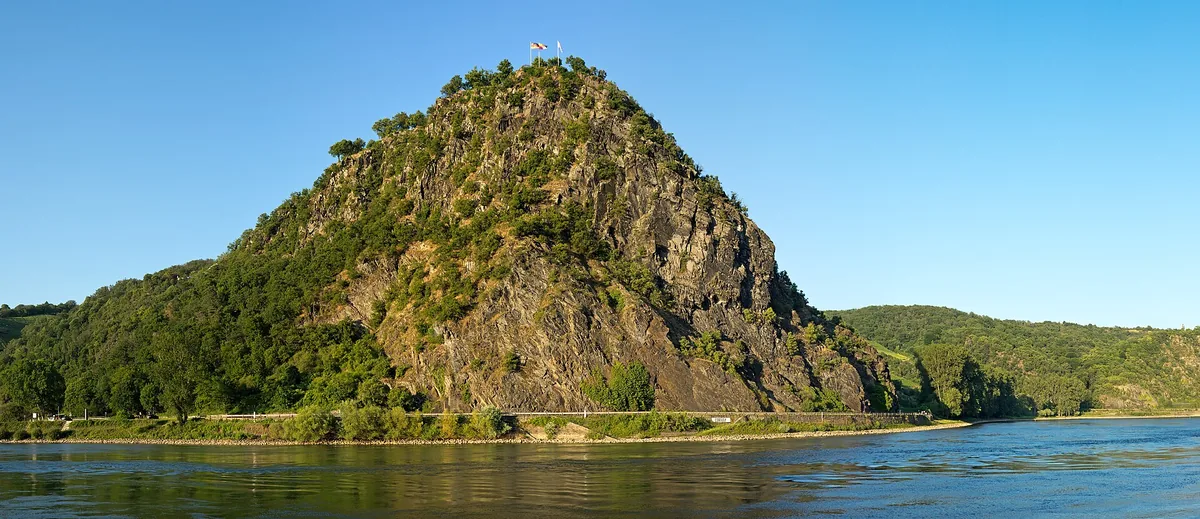
Loreley Rock, Germany
The Loreley myth was created at the height of the German Romantic movement's investment in the Rhine as a national landscape. Brentano invented the siren in 1801; Heine's poem, set to music by Friedrich Silcher in 1837, made the melody one of the most recognized in German folk culture. The fact that the Loreley was a known navigational hazard, the narrow channel, the currents, the echoes that could disorient boatmen, gave the invented myth a plausible physical basis. The Romantic movement used the Rhine in general and the Loreley in particular as a symbol of German cultural identity at a time when German political unity did not yet exist. The rock and the myth became so inseparable that distinguishing between the geography and the story is now part of visiting it.
The rock summit is accessible via the Loreley visitors' center and a path to the top, with views down the Rhine bend in both directions, the narrowing of the channel and the current pattern that makes the bend navigationally difficult are visible from above. The viewpoint at the top looks down on the stretch of river that Rhine barges still navigate with care. The surrounding valley, with castle ruins on both banks, terraced vineyards, and passing river traffic, is the Middle Rhine at its most concentrated. Sankt Goarshausen on the right bank is the nearest village, accessible by train from Koblenz (45 minutes). Rhine ferry connections cross between St. Goar and St. Goarshausen. The Loreley summit path is a 30-minute walk from the village.
The Experience
A summit viewpoint above the Rhine's narrowest navigable channel, with castle ruins, vineyards, and river traffic visible on both banks, the bend where the current and echo effects that inspired the myth are physically apparent from above.
Why It Matters
The Loreley is simultaneously a navigational reality and a literary construction that became folk myth, one of the clearest examples in European cultural geography of a landscape being transformed by the stories told about it.
Why Visit
The view from the summit over the Rhine bend is genuinely beautiful, the valley narrowing, the castle ruins on both banks, the barges negotiating the current, and understanding that the siren was invented in 1801 makes the landscape more interesting, not less.
Insider Tips
- 1
Take the Rhine ferry between St. Goar and St. Goarshausen for the water-level view of the rock before climbing it.
- 2
The summit viewpoint is most dramatic in late afternoon when the valley shadows deepen.
- 3
Combine with the Marksburg Castle in Braubach, the only completely preserved medieval Rhine castle, on the same day trip from Koblenz.