“A Roman gate survived because a Greek monk moved into the tower in 1028, was canonized, and the medieval church converted the building to honor him. Napoleon ordered the church stripped out in 1804 and the Roman structure restored. Nothing else has been changed.”
About Porta Nigra
Built 186–200 CE as the northern gate of Augusta Treverorum. A Greek hermit named Simeon lived in the east tower 1028–1035; his canonization led to conversion of the gate to a church. Napoleon ordered de-Christianization and Roman restoration in 1804. UNESCO World Heritage Site 1986.
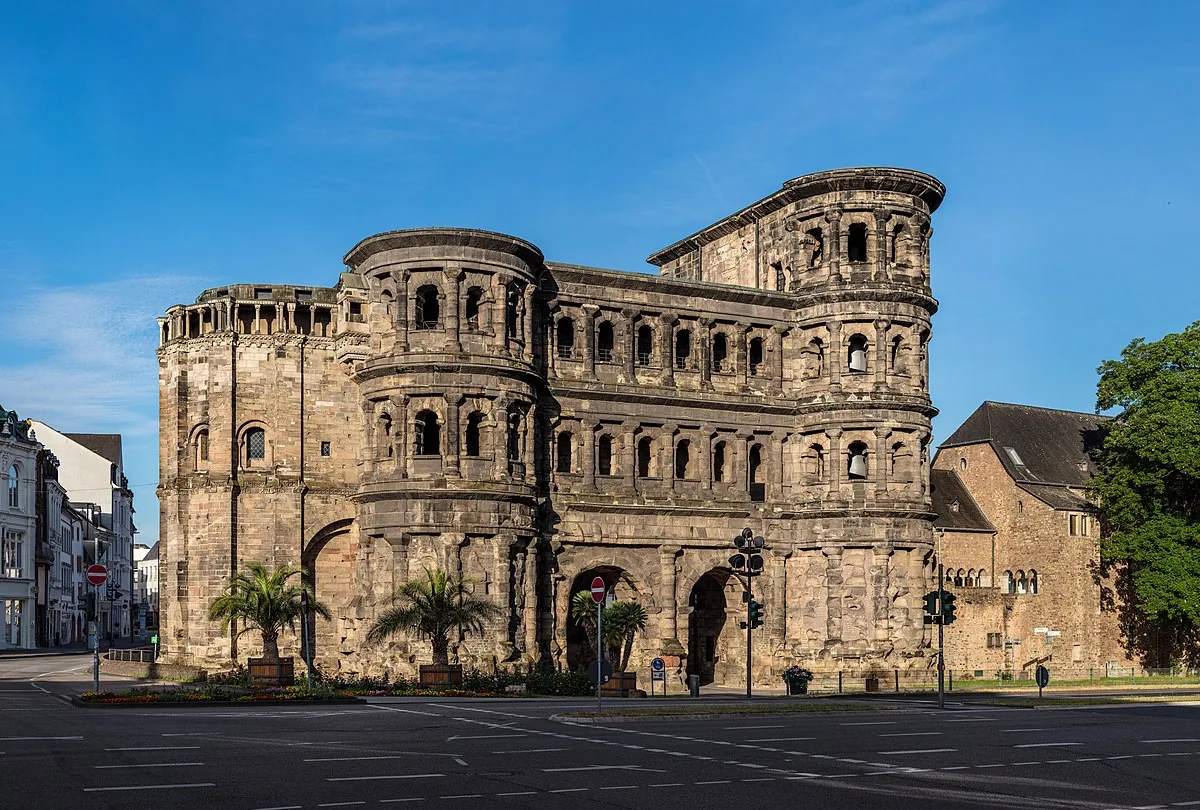
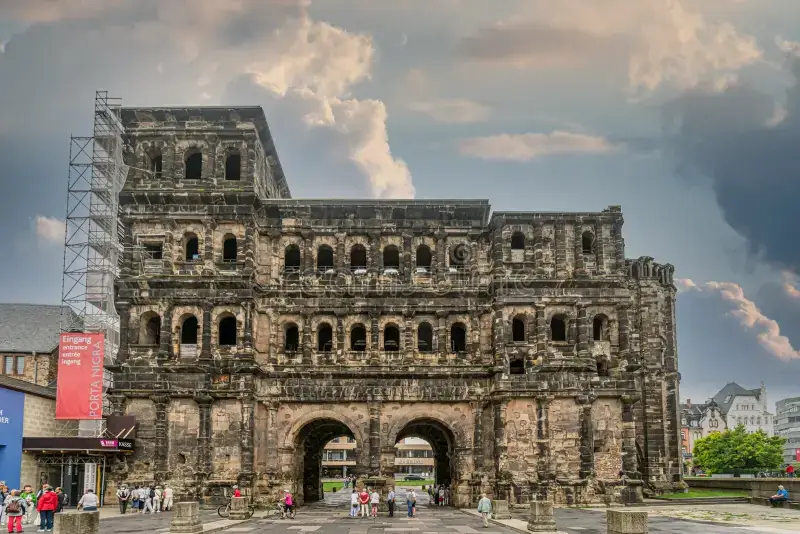
The Porta Nigra, Black Gate, in Trier is the largest surviving Roman city gate north of the Alps and the best-preserved Roman building in Germany. Built from grey sandstone between 186 and 200 CE as the northern entrance to Augusta Treverorum, the most important Roman city in the northern provinces, the gate has remained standing for nearly two millennia because a Greek monk named Simeon chose to live inside it as a hermit in 1028, and his subsequent canonization made the structure a sacred site that the medieval church converted and preserved.
The Porta Nigra, Black Gate, in Trier is the largest surviving Roman city gate north of the Alps and the best-preserved Roman building in Germany.
Augusta Treverorum was founded around 16 BCE and became one of the largest Roman cities in the empire, at its fourth-century peak, possibly the western capital of the Roman Empire under Valentinian I. The Porta Nigra was part of a circuit of city gates; it is the only survivor. The gate's name, Black Gate, comes from the dark patina the sandstone acquired over centuries of weathering; the original structure was the same grey-brown color as the surrounding stone. Simeon of Syracuse arrived in Trier in 1028 and, with Bishop Poppo's permission, enclosed himself in the east tower of the gate as a recluse. He died in 1035 and was canonized in 1042; Poppo converted the gate into a double-decker church to honor him. Napoleon ordered the medieval additions removed and the Roman structure restored in 1804, the only significant structural change made to the building in eight centuries.
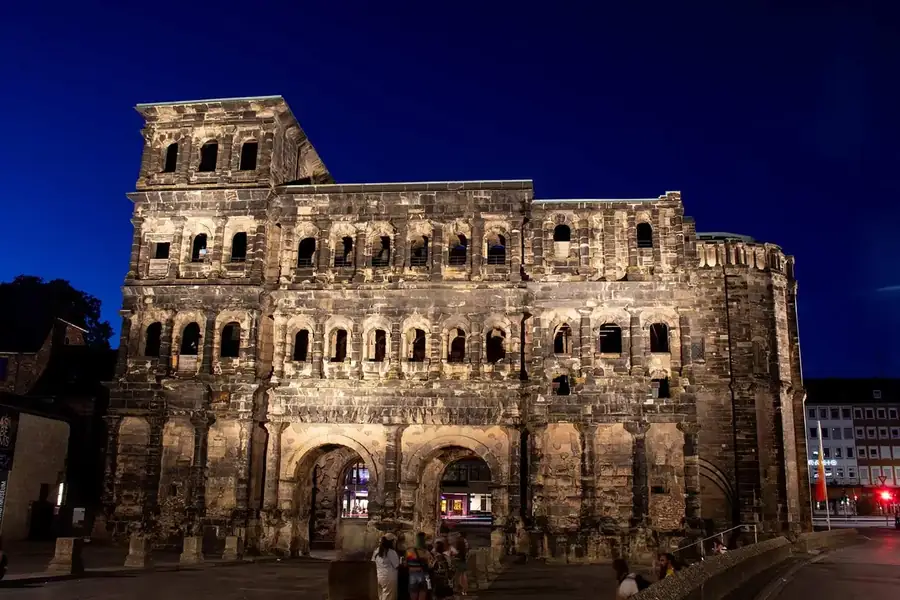
The gate's four-story interior is accessible; the upper galleries provide views over Trier's city center. The sandstone construction, the blocks fitted without mortar, held by iron clamps whose oxidation has stained the stone, is visible throughout. The Simeon cells in the east tower, where the hermit lived, are part of the tour. Trier's other Roman monuments, the Imperial Baths, the Amphitheatre, the Aula Palatina throne hall, are all within walking distance. Trier Hauptbahnhof is a 10-minute walk from the Porta Nigra. Trier is accessible from Koblenz by train (1.5 hours) and from Luxembourg City by train (50 minutes).
The Experience
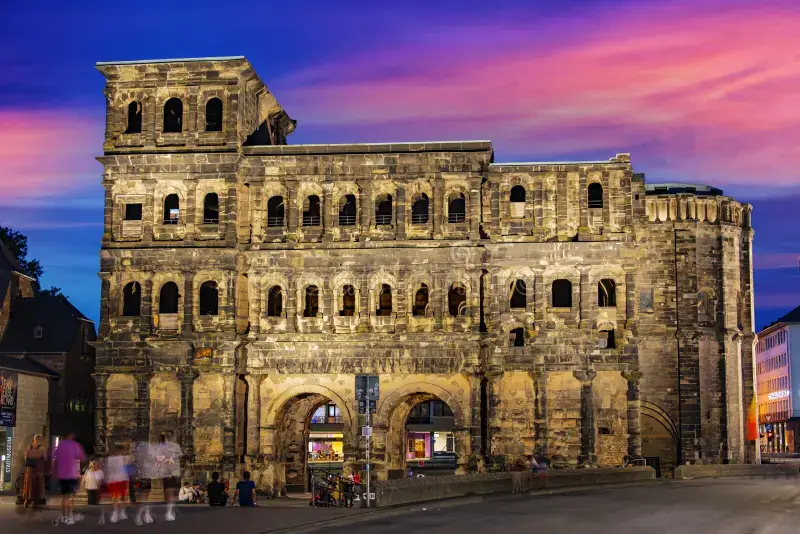
A four-story Roman gate accessible throughout, with the iron-clamp construction visible in the mortar-free sandstone, Simeon's hermit cells in the east tower, and an upper gallery view over Trier's city center.
Why It Matters
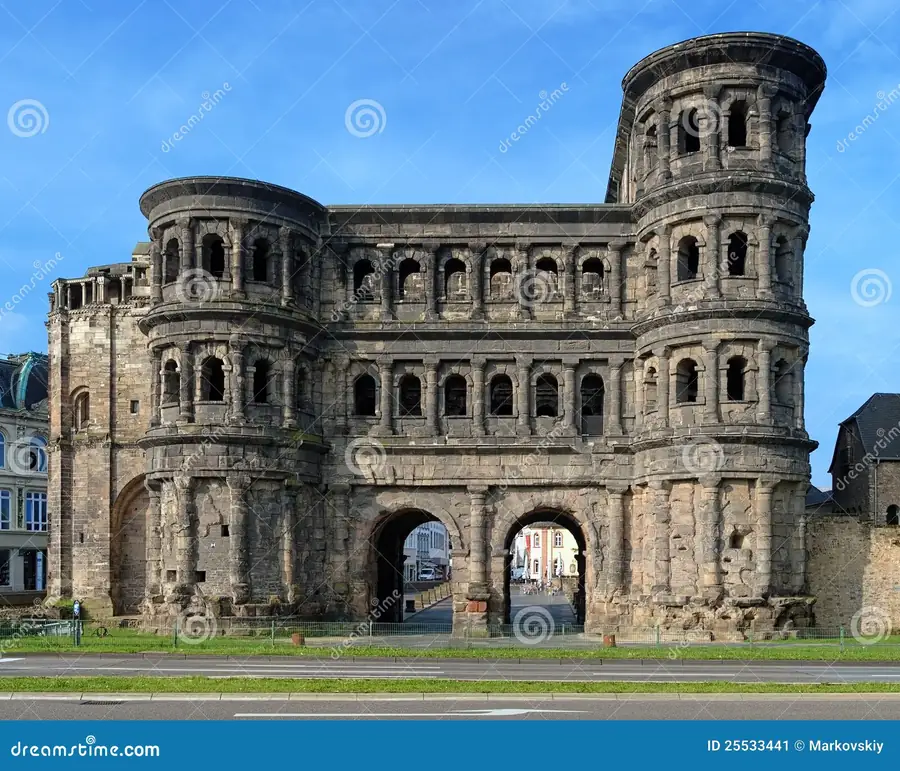
The Porta Nigra is the most complete surviving Roman city gate in the world north of the Alps and the physical starting point for understanding Augusta Treverorum, a city whose Roman scale made it more significant than its current modest size suggests.
Why Visit
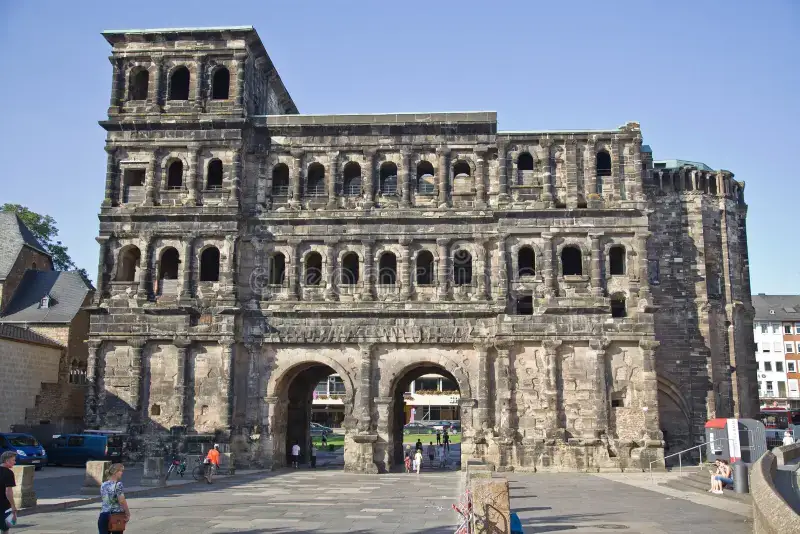
The construction technique, massive sandstone blocks without mortar, held by iron clamps, is visible and extraordinary. The hermit-to-church-to-restored-Roman-gate biographical arc gives the building a more complicated history than most ancient monuments.
✦ Insider Tips
- 1
Climb to the upper gallery for the city view and to see the iron-clamp construction from above.
- 2
Combine with the Aula Palatina throne hall (now a Lutheran church) 10 minutes walk away, the two buildings together give the clearest sense of Augusta Treverorum's scale.
- 3
The Roman Card covers the Porta Nigra, Baths, Amphitheatre, and Rheinisches Landesmuseum, worth buying if spending a day on Trier's Roman monuments.