Kaiser Wilhelm II called it the imperial monkey house. The Nazis used the fire that damaged it to seize dictatorial power. Soviet soldiers wrote their names inside the walls in 1945. Norman Foster's glass dome now lets the public look down into the parliament from above, free of charge.
About Reichstag
Completed 1894. The Reichstag fire of February 1933 provided the pretext for Nazi dictatorship. Destroyed in WWII; Soviet flag raised on the ruins May 1945. Christo wrapped it in 1995. Norman Foster's renovation opened 1999, including the public glass dome.
What Reichstag actually is
The Reichstag building on the Platz der Republik in Berlin has housed the German parliament since 1894, with interruptions for a fire, a war, and a 28-year division. Norman Foster's 1999 renovation added the glass dome above the plenary chamber, a publicly accessible rooftop walkway that has become one of the most visited structures in Germany and turned the parliament building into a civic destination as much as a political one.
“The Reichstag building on the Platz der Republik in Berlin has housed the German parliament since 1894, with interruptions for a fire, a war, and a 28-year division.”
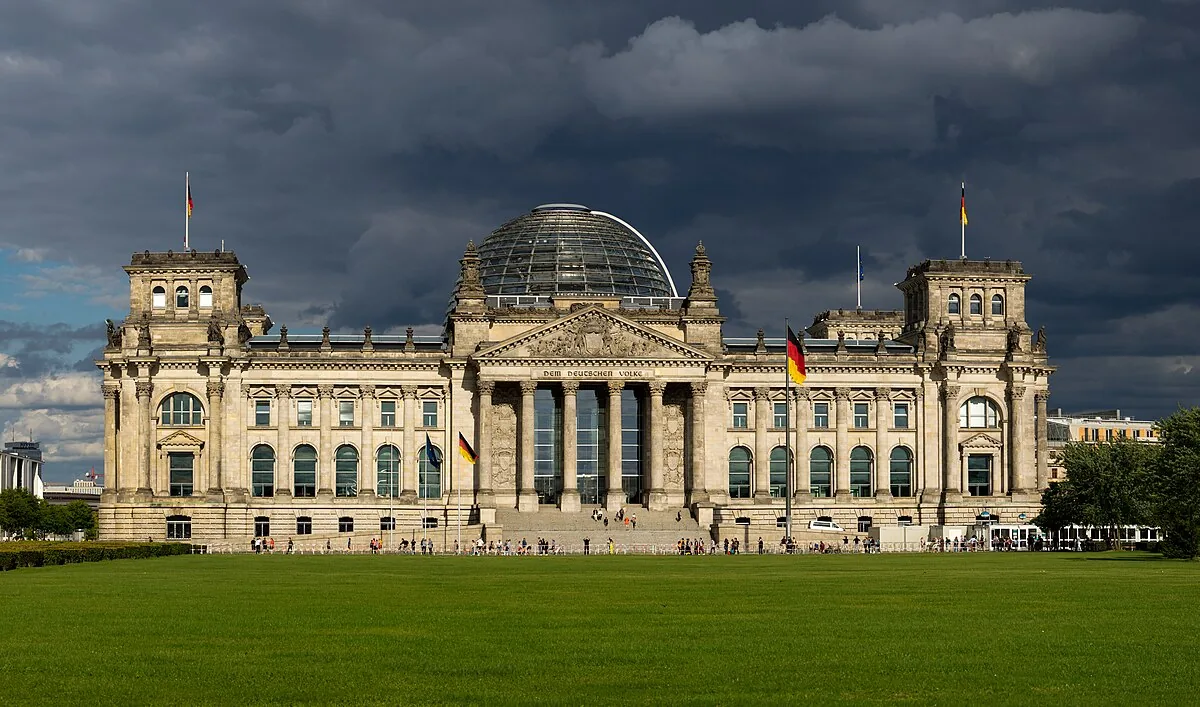
Reichstag, Germany
Reichstag was completed, 1894
The Reichstag was completed in 1894 under Kaiser Wilhelm II, who reportedly called it the imperial monkey house because he disliked the building and its democratic associations. The Reichstag fire of February 27, 1933, attributed by the Nazis to a Dutch communist, provided the pretext for the Enabling Act that gave Hitler dictatorial power. The building was not used by the Nazi parliament and fell into disuse; Soviet troops raised their flag on the shell in May 1945 in one of the most reproduced photographs of the twentieth century. After German reunification, the Bundestag voted narrowly in 1991 to move the capital back to Berlin, and Foster was commissioned to renovate the building. Christo and Jeanne-Claude wrapped it in silver fabric in 1995 before reconstruction began. The graffiti left by Soviet soldiers inside the walls was preserved as part of the historical record.
The glass dome is accessible to the public free of charge after advance online registration. A spiral ramp inside the dome leads to the top, with the plenary chamber visible below through the glass floor and the Berlin skyline visible in 360 degrees above. An audio guide describes the political buildings visible from the dome. The dome's central mirrored cone reflects natural light down into the chamber below. Soviet soldier graffiti preserved in the lobby is visible on guided tours of the interior.
S-Bahn and U-Bahn to Brandenburger Tor station, then a 5-minute walk north. Visitor registration must be completed online in advance at the Bundestag website.
The Experience
A free-access glass dome with a spiral ramp above the plenary chamber, 360-degree Berlin skyline views, the chamber visible below through glass, and Soviet soldier graffiti preserved in the lobby.
Why It Matters
The Reichstag is Germany's most politically charged building, the address of parliamentary democracy, its destruction by the Nazis, and its restoration as a transparent civic space that literally allows citizens to stand above their elected representatives.
Why Visit
The glass dome is architecturally exceptional and genuinely free. The political meaning of standing above the plenary chamber, looking down through the glass into the space where Germany is governed, is not something Foster's design allows you to miss.
Insider Tips
- 1
Register online at the Bundestag website before visiting, walk-up access is not available.
- 2
The evening dome visit (available until 10pm) is less crowded than daytime and the Berlin night view is excellent.
- 3
Ask about guided parliamentary tour access separately, the Soviet graffiti tour requires a different booking.