A farmer's wife cried in front of a discarded wooden Christ in a meadow in 1738. Pilgrims came. The church built for them is one of the finest Rococo interiors in the world, and the architect liked it so much he moved next door and lived beside it until he died.
About Wieskirche
A reported miraculous healing at a discarded Christ figure in 1738 established the pilgrimage. The Steingaden monastery commissioned Dominikus Zimmermann, who designed the church and interior decoration while his brother Johann painted the ceiling. Completed 1754; UNESCO World Heritage Site 1983.
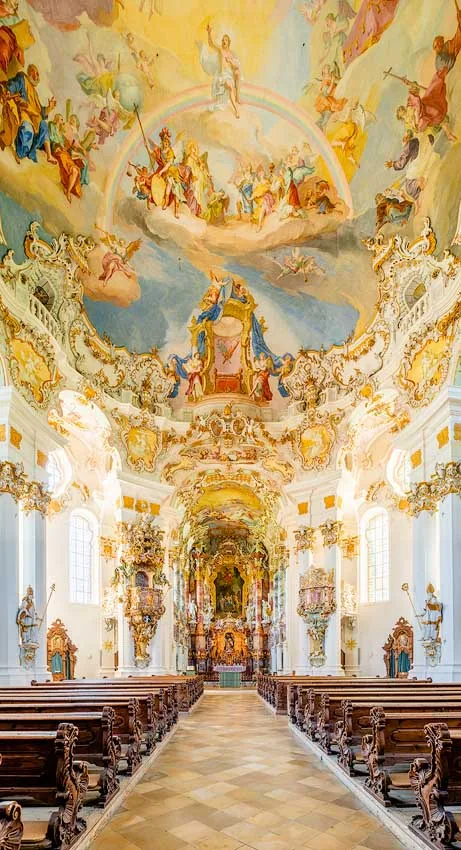
The Wieskirche, Church of the Scourged Saviour in the Meadow, is a Rococo pilgrimage church in a meadow in the Bavarian Alpine foothills, built between 1745 and 1754 by brothers Dominikus and Johann Baptist Zimmermann. It received UNESCO status it a World Heritage Site in 1983. The interior is among the finest expressions of Rococo decorative art anywhere in the world, a white and gold oval nave whose ceiling fresco, plasterwork, and carved woodwork reach a density of ornament that manages to remain coherent rather than chaotic.
“It received UNESCO status it a World Heritage Site in 1983.”
Wieskirche, Germany
origin is specific:, 1738
The pilgrimage origin is specific: in 1738, a farmer's wife named Maria Lory was moved to tears while praying before a roughly carved figure of Christ at the scourging post, which had been placed in a meadow after being judged too crude for ceremonial use. Word spread of miraculous healings; pilgrims came. Within a year, a small chapel was overwhelmed by the numbers, and the Premonstratensian monastery of Steingaden commissioned a proper church. Dominikus Zimmermann designed both the structure and the decoration, his brother Johann painted the ceiling. The Zimmermann brothers had already built the Steinhausen church in the same region; the Wieskirche is the culmination of their style. Dominikus was so attached to the result that he moved into a small house next to the church and spent his final years living beside it.
The exterior, a modest oval of white plaster in a green meadow, gives no warning of the interior. The transition from plain exterior to Rococo interior, columns, frescoes, carved wood altars, and gilded stucco in every direction, is one of the great architectural surprises in Bavaria. The ceiling fresco depicts Christ on a rainbow above the nave; the carved choir stalls are the finest woodwork in any German pilgrimage church. The church is still an active pilgrimage site.
The Wieskirche is 30 kilometers from Füssen and 5 kilometers from Steingaden on Route B17. The Romantic Road tourist bus stops here; a car or bicycle is the practical independent option.
“The Wieskirche is 30 kilometers from Füssen and 5 kilometers from Steingaden on Route B17.”
The Experience
A plain white meadow exterior opening to a Rococo oval nave of gilded stucco, ceiling frescoes, carved woodwork, and decorative density that remains coherent, the architectural surprise of the transition from exterior to interior is the defining experience.
Why It Matters
The Wieskirche is the highest achievement of German Rococo church design, a building whose decorative program demonstrates that the style could achieve grandeur without excess and that sacred architecture could use beauty as theology.
Why Visit
The interior of the Wieskirche is the best argument in German architecture for the Rococo as a serious style rather than a frivolous one. The setting in a meadow, with cows occasionally visible through the windows, adds a specific Bavarian grounding to the celestial ceiling.
Insider Tips
- 1
Arrive before tour buses, the church accommodates small groups comfortably but becomes crowded by mid-morning in summer.
- 2
Look at the ceiling fresco from directly below the nave center, the perspective program is designed for that position.
- 3
The Steinhausen church 20 kilometers north is the Zimmermanns' earlier work and worth comparing on the same drive.