The medieval wine produced here and known across Europe as Malmsey was so valued that Shakespeare made it the murder weapon in Richard III, and the town that produced it is accessible through exactly one gate in one wall.
About Lower Town
Monemvasia was founded in the late sixth century CE by mainland Greeks seeking refuge from Slavic incursions, the choice of a near-inaccessible sea-rock being the point rather than the compromise. Under Byzantine administration it became a significant Aegean port, and the wine grown on the surrounding hillsides, known as Monemvasia or Malmsey in the wine trade, reached markets from England to Egypt. The town passed between Frankish, Byzantine, Venetian, and Ottoman control through the medieval period, each administration adding architecture without removing what preceded it. The Venetians built the vaulted houses; the Ottomans added a mosque and fountain; the Byzantine churches predated both. The accumulated layers are visible in the fabric of every street. The rock was never substantially demolished because it was too valuable, commercially and strategically, to abandon.
What Lower Town of Monemvasia actually is
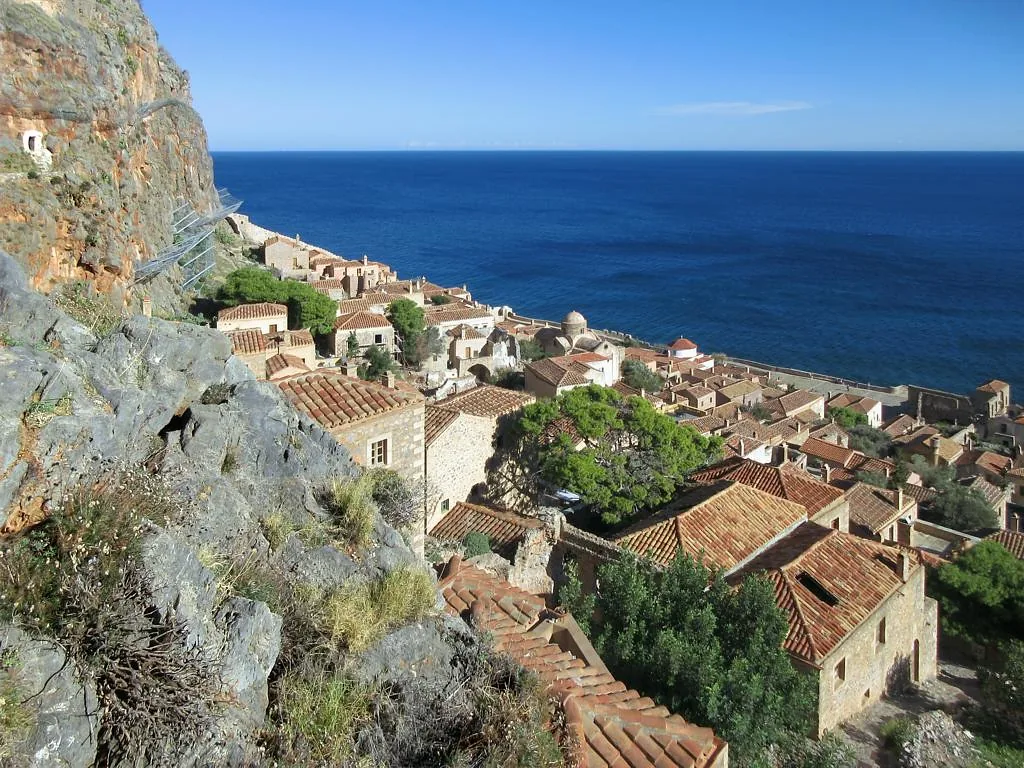
Monemvasia is a town built on a rock. The rock, a monolithic mass of limestone connected to the southeastern Peloponnese by a narrow causeway, rises from the sea with near-vertical faces on most sides, and the lower settlement (kato poli) occupies a natural ledge between the water and the cliff. One tunnel gate in the outer wall provides the only pedestrian entry from the causeway side. Once through it, the medieval street plan opens into a compact settlement of Byzantine churches, vaulted Venetian-period houses, and Ottoman additions that have been inhabited continuously since the sixth century. The name Monemvasia means 'single entrance' in Greek.
“One tunnel gate in the outer wall provides the only pedestrian entry from the causeway side.”
Lower Town, Greece
town was founded, 583
The town was founded in 583 CE by inhabitants of the Peloponnesian mainland fleeing Slavic incursions, the rock's defensibility was the entire point of choosing it. Under Byzantine rule, Monemvasia became a significant Aegean port and the source of a wine, called Malmsey in northern Europe, traded across the medieval Mediterranean. When the Duke of Clarence met his end in a butt of Malmsey in Shakespeare's Richard III, it was this wine. The town passed through Frankish, Byzantine, Venetian, and Ottoman administration, each power adding architectural layers without demolishing what preceded it, because the site's commercial value made continuity preferable to reconstruction. Greek sovereignty came with independence in the nineteenth century.
The main lane through the lower town is rarely more than two metres wide and runs between buildings that span eight centuries of construction. The Cathedral of Christ in Chains (Elkomenos Christos), the largest Byzantine church in the southern Peloponnese, anchors the town's main square. The upper town (ano poli), a steep climb from the lower settlement, is largely ruined but retains the shell of the Byzantine Church of Hagia Sophia on the cliff edge, with the sea visible through the absent windows. Staying overnight within the walls gives the town after the day visitors have left, which is when its actual character becomes accessible. Monemvasia is approximately 340 kilometres south of Athens, four to five hours by road. The nearest mainland town is Gefyra, immediately across the causeway. Buses connect from Athens and Sparta; ferries link Monemvasia with Piraeus seasonally.
The Experience
Walking through the tunnel gate from the causeway side into the lower town is an abrupt transition. Audibly, the changes, the sea wind stops, the acoustics become close and stone-hard, and the lane opening ahead has the compressed depth of a place that has been continuously inhabited for fourteen centuries. The upper town requires a climb of roughly twenty minutes from the lower settlement and is largely empty of other visitors. The ruined Byzantine church at the summit has walls open to the sky and windows facing the sea below. Standing in it on a clear afternoon, with the Aegean visible on both sides of the rock and the lower town's rooftops beneath you, gives the site its full spatial logic.
Why It Matters
Monemvasia survived because its geography made it worth holding and difficult to destroy. The result is one of the densest accumulations of medieval architectural layers in Greece, Byzantine, Frankish, Venetian, and Ottoman construction on a single rock, continuously inhabited across fourteen centuries. The lower town is not a museum reconstruction; people live and work in buildings that have not changed their function since the medieval period.
Why Visit
Most visitors arrive by car, walk through the gate, take photographs of the Cathedral, and leave within two hours. The town that remains after they go, quieter, its domestic architecture more apparent, the upper town accessible in the evening light, is the better version. Stay at least one night inside the walls.
Insider Tips
- 1
Book accommodation inside the walls rather than in Gefyra on the mainland, the overnight experience is qualitatively different from a day visit.
- 2
The upper town is a steep twenty-minute climb from the lower settlement and is visited by a fraction of day-trippers; the views and the ruined Byzantine church reward the effort.
- 3
The cannon on the town walls are Ottoman; the walls themselves are predominantly Venetian; the churches inside are Byzantine, reading the layers requires a basic timeline of the town's history.
- 4
Arrive through the tunnel gate on foot rather than reading about the town first, the spatial surprise of the confined lane opening out is better experienced without preparation.