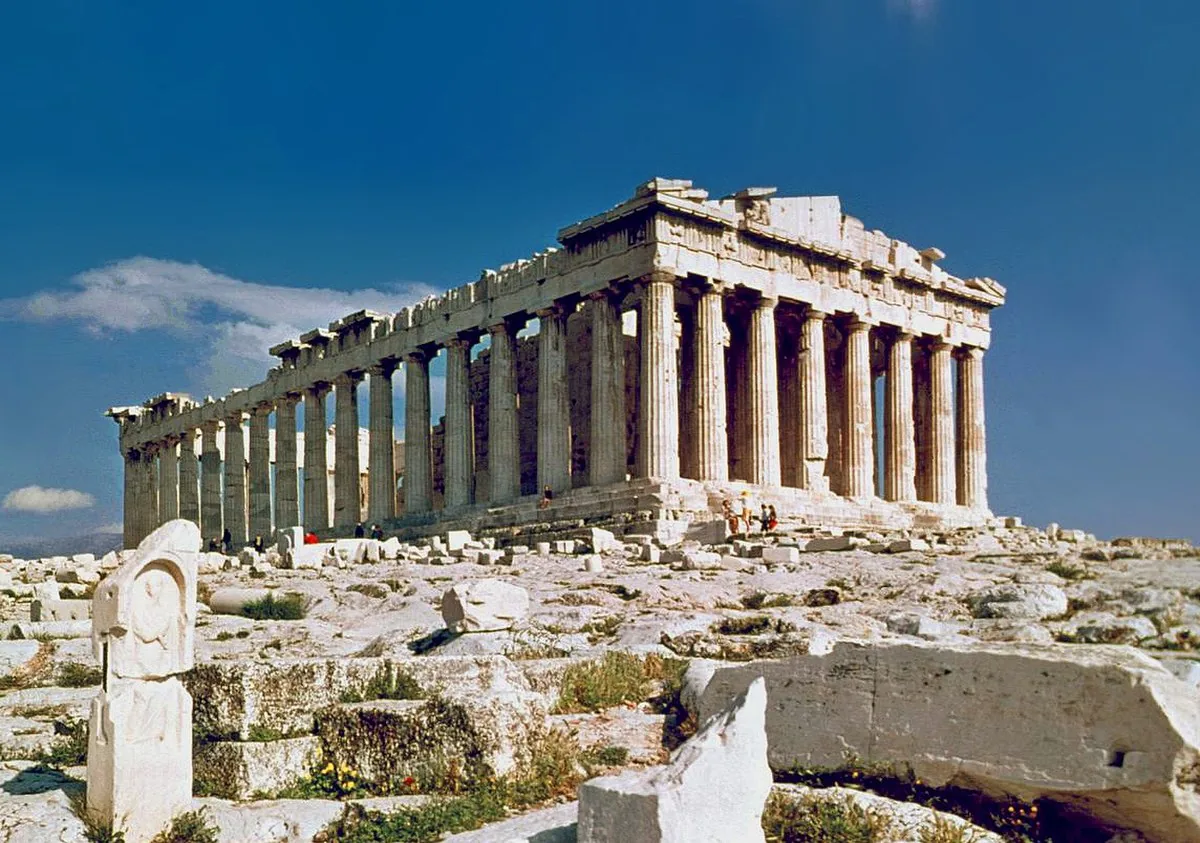
Every single column on the Parthenon leans inward and swells outward, forty-six individual optical corrections, none identical, all calculated to make the building look perfectly straight.
About Parthenon
The hill had been sacred for centuries before Pericles initiated the rebuilding in 447 BCE, two decades after Persian forces burned its predecessor. The project was funded at least partly by tribute from the Delian League, a detail that still makes democratic idealists uncomfortable. Architects Iktinos and Kallikrates completed the structure by 432 BCE; Pheidias oversaw the sculpture, including a chryselephantine Athena inside the cella that stood twelve metres tall and vanished sometime in late antiquity. The building survived as church and mosque for two thousand years before the explosion of 1687 shattered its interior. Thomas Bruce removed the remaining frieze sections and pediment figures between 1801 and 1812 under an Ottoman permit of contested legitimacy. Those pieces are in the British Museum. Greece has been formally requesting their return since 1983.
What Parthenon in Greece is
Every column on the Parthenon is different. Each of the forty-six outer shafts leans slightly inward, swells outward at mid-height, and tapers at a slightly varied rate, corrections calibrated to prevent the optical illusions the eye would otherwise impose. The platform itself curves upward at the corners by less than an inch. These refinements were executed in Pentelic marble quarried from the mountain visible to the northeast, stone that weathers to a pale gold under Greek light. The building is not white. It has never been white.
of the Acropolis, 447
Pericles commissioned the rebuilding of the Acropolis in 447 BCE, twenty years after Persian forces burned the earlier temple to the ground. The new structure was funded partly by tribute from the Delian League, Athenian allies who had not been consulted on the expenditure. Architects Iktinos and Kallikrates designed the structure; Pheidias directed the sculptural programme, including the forty-foot gold-and-ivory statue of Athena that stood inside the cella and is now entirely lost. For two thousand years the building served successive functions: pagan temple, Byzantine church, Ottoman mosque. The catastrophic event was 1687, when Venetian artillery struck the powder magazine the Ottomans had stored inside. The explosion destroyed the interior and scattered metopes and frieze blocks across the hillside. Thomas Bruce removed much of the surviving sculpture between 1801 and 1812 under a permit from the Ottoman authorities. Those pieces remain in the British Museum.
Arriving at the Acropolis gate at 8am gives you roughly forty minutes before the first tour groups reach the summit. The light at that hour falls at an angle that makes the fluting cast actual shadows, something midday photography rarely captures. Scaffolding is a constant presence; restoration has run for five decades and shows no sign of conclusion. The Acropolis Museum at the base of the hill holds the surviving original frieze sections at eye level, in a building whose south-facing glass wall faces the monument directly. The juxtaposition makes the case for reunification more forcefully than any argument.
Metro Line 2 to Acropolis station.
The combined ticket covers the Theatre of Dionysus, the Odeon of Herodes Atticus, and the Ancient Agora. Allow two hours minimum on the hill, and plan a separate visit to the museum below.
The Experience
The colour is the first surprise. Pentelic marble weathers to warm gold under Greek sun, not the clinical white of plaster casts in European museums. The refinements, entasis, curvature, column inclination, register first as a general sense that the building looks right before you understand why. The Acropolis Museum is worth a separate afternoon. The surviving frieze sections are displayed at the approximate original viewing height, and the south wall of glass faces the Parthenon across the hill. Standing inside the museum looking at original marble while the monument is visible through the window behind it makes the argument about displacement in a way no text can.
Why It Matters
The Parthenon is the building that other buildings have been measuring themselves against for two and a half millennia. Its proportions seeded Roman temple design, Renaissance civic architecture, and the neoclassical buildings that now house governments from Washington to Helsinki. Beyond its architectural legacy, it was built in the same generation that produced Sophocles, Socrates, Thucydides, and the foundational experiments in democratic governance.
Why Visit
Every famous monument disappoints slightly in person except this one. The scale, the colour, the precision of execution, and the specific quality of Attic light combining on an early morning when the city is still waking below, these things do not translate into photographs. Come before 9am. Stand at the east end and look west. It will take a few minutes, and then you will understand.
✦ Photo Gallery
Best Season
🌤 April and late October offer manageable crowds and the best light. August is brutally hot on the exposed hill, and lines at the main gate are longest from late June through early September.
Quick Facts
Entry
Around 20 EUR in summer for the Acropolis (the Parthenon stands on it); a combined ticket covers other Athens sites.
Opening hours
Open daily, roughly 8am to 8pm in summer, closing earlier in winter.
Time needed
About 1.5 to 2.5 hours for the Acropolis.
Best time to visit
April and late October offer manageable crowds and the best light. August is brutally hot on the exposed hill, and lines at the main gate are longest from late June through early September.
Getting there
On the Acropolis hill in central Athens; metro to Acropoli station, then a walk up.
What's nearby
Plaka, National Garden and National Archaeological Museum are also in the area.
Location
Athens, Greece
Type
attraction
Coordinates
37.9715°, 23.7266°
Insider Tips
- 1
The Acropolis Museum requires a separate ticket; buy both online in advance to avoid queuing at two different entrances.
- 2
The north slope entrance near the Theatre of Dionysus is consistently less congested than the main Propylaia gate on the west side.
- 3
The frieze sections visible on the monument itself are modern casts; the surviving originals are in the Acropolis Museum at close range.