“The monastery library on Patmos holds a sixth-century purple parchment Gospel and over a thousand Byzantine manuscripts, much of the collection accumulated over nine centuries has never been fully catalogued.”
About Monastery of Saint John the Theologian
The monk Christodoulos arrived on Patmos in 1088 with an imperial licence from Alexios I Komnenos granting him the island. His first task was building walls, not a church: the Dodecanese in the eleventh century was pirate territory, and a religious community without fortification was simply a target. The resulting complex looks more like a castle than a monastery from outside, the defensive logic having shaped every architectural decision. Over the following centuries, the monastery library became one of the premier repositories of Orthodox scholarship in the Mediterranean. Scholars, iconographers, and theologians arrived; manuscripts were commissioned, donated, and copied. The purple parchment Codex Purpureus Petropolitanus, a sixth-century Gospel, is one of the most significant items, though it was partially dispersed before the nineteenth century, with sections in multiple European collections.
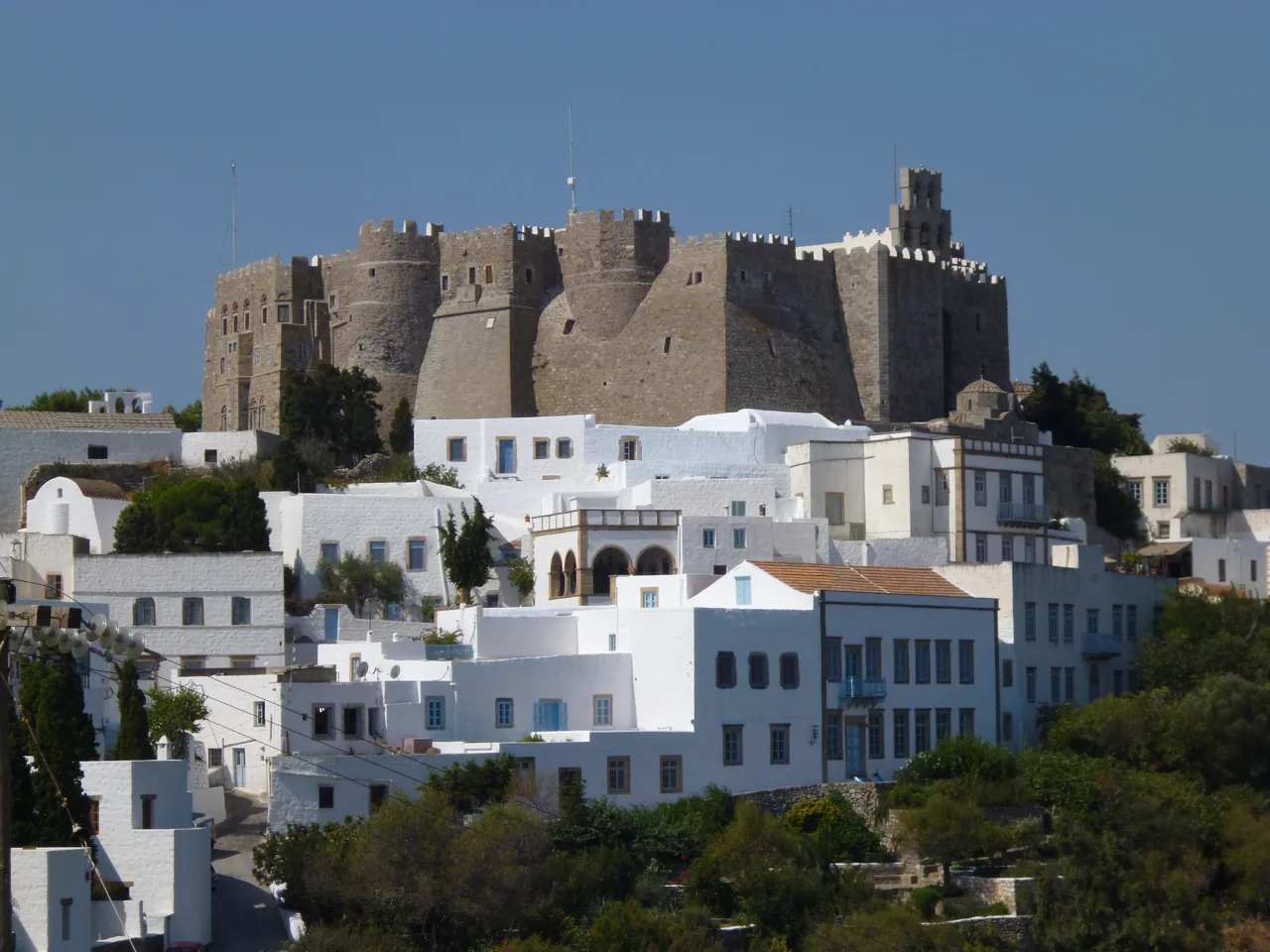
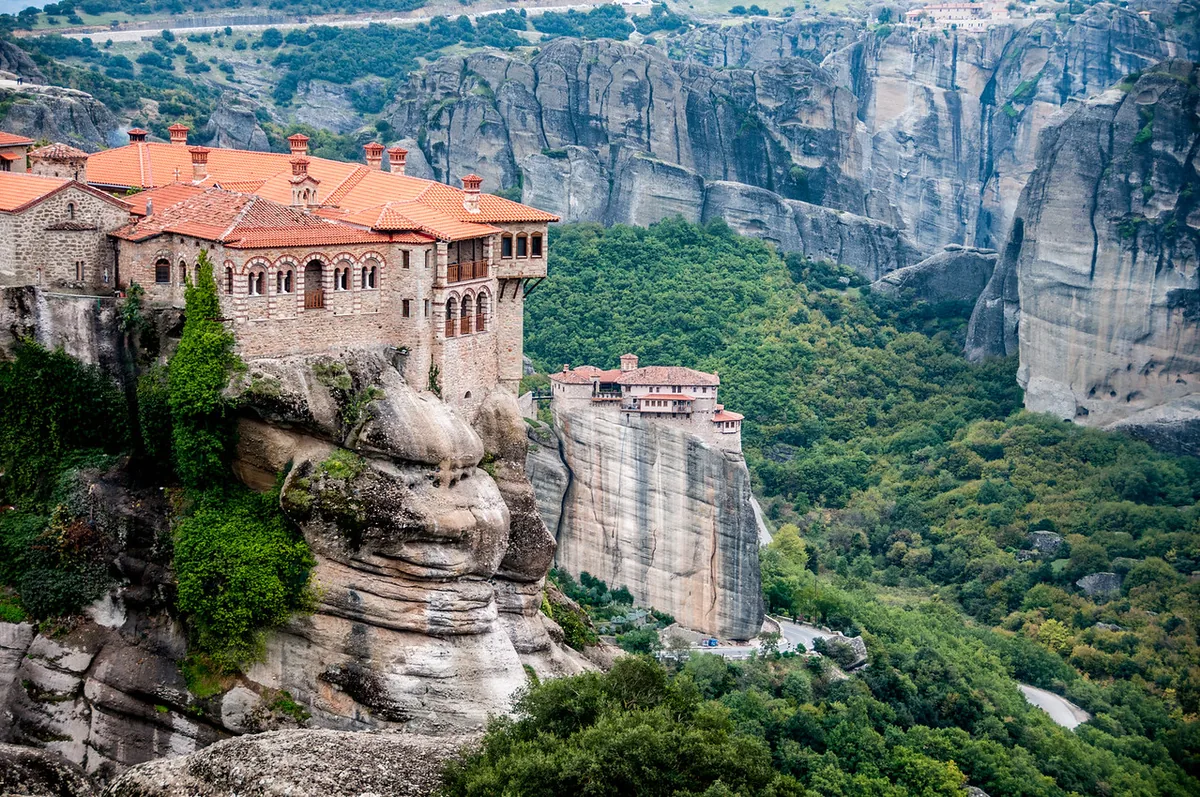
The Monastery of Saint John the Theologian sits at the top of the hill above Chora on Patmos, a fortified Byzantine complex whose construction effectively created the village below it. Chora grew in the shelter of the monastery walls from the eleventh century onward, its buildings pressed against the fortress exterior and organised around the logic of the hill's defence. The monastery was built on the site associated with the Apostle John's exile on Patmos, the island to which, according to Byzantine tradition, he was banished by the Roman emperor Domitian and where he dictated the visions recorded in the Book of Revelation.
The Monastery of Saint John the Theologian sits at the top of the hill above Chora on Patmos, a fortified Byzantine complex whose construction effectively created the village below it.
monastery was founded, 1088
The monastery was founded in 1088 by the monk Christodoulos, who obtained a chrysobull from Byzantine Emperor Alexios I Komnenos granting him the island of Patmos and the right to build a monastic community. The fortified construction, walls, towers, narrow gateways, was a direct response to the reality of Dodecanese island life in the medieval period: pirate raids were frequent, and the monastery's treasury and library required protection that simple religious buildings could not provide. Over nine centuries, the library accumulated one of the most significant collections of Byzantine manuscripts in existence. The holdings include a sixth-century purple parchment Gospel and over a thousand illuminated codices, much of which remains incompletely catalogued.
Visiting Monastery of Saint John the Theologian
The treasury is partially accessible to visitors and displays icons, ceremonial vessels, vestments, and selected manuscripts. The full library collection is restricted to accredited scholars. The main church, the katholikon, contains eleventh-century frescoes alongside later Byzantine additions; the space is small, candlelit, and actively devotional rather than museum-like. A ten-minute walk down the hill below the monastery leads to the Cave of the Apocalypse, a functioning chapel built into the cave where John is said to have dictated the Book of Revelation, with the rock ledge he supposedly used as a desk still pointed out to visitors.
Patmos has no airport . Ferries from Piraeus take 8 to 10 hours; high-speed catamarans from Rhodes and Kos are faster. From the port of Skala, buses and taxis serve Chora and the monastery.
Ferries from Piraeus take 8 to 10 hours; high-speed catamarans from Rhodes and Kos are faster.
The Experience
The monastery operates as a functioning religious community, not a museum, and the atmosphere inside the katholikon reflects this: liturgical vessels, candle smoke, the weight of a continuous tradition in the architecture. Visiting during a morning liturgy, check the schedule with local accommodation, gives a completely different experience from the standard tourist visit. The Cave of the Apocalypse below the monastery is where most pilgrims focus their attention. The cave itself is small, the chapel tight, and the rock ledge pointed out as John's writing surface is polished from centuries of touch. If you share the theological investment or not, the place carries a specific gravity from the sheer duration of veneration.
Why It Matters
Patmos holds a unique position in Christian history: the island where the Book of Revelation was written, home to a manuscript collection of extraordinary depth, and a functioning monastic community that has maintained continuous occupation since 1088. For Orthodox Christians, it is a primary pilgrimage destination. For everyone else, it is a small Aegean island whose library holds some of the most important surviving documents of Byzantine civilisation.
Why Visit
Patmos is not an easy destination, no airport, a long ferry ride, modest infrastructure. That difficulty is part of what preserves it. The monastery, the village of Chora around it, the cave below, and the island's unhurried pace constitute an experience that the more accessible Greek islands have largely lost. Come for at least two nights to understand the rhythm.
✦ Insider Tips
- 1
The monastery treasury has reduced visiting hours compared to the main church, check current times locally, as they change seasonally.
- 2
The Cave of the Apocalypse has its own separate entrance ticket and is worth visiting before the monastery to understand the theological narrative the monastery was built to serve.
- 3
Chora village around the monastery has some of the best preserved medieval domestic architecture in the Dodecanese; allow time to walk the lanes after visiting the main sites.