For five centuries, the only access to these monasteries was a rope net hauled up by a hand winch, replaced only when it broke, at which point the monks considered the ropes adequately maintained.
About Meteora Monasteries
Solitary monks had lived in the Meteora caves since the eleventh century before the first organised community arrived. The shift from hermitage to monastery came in the mid-fourteenth century, driven by the instability of late Byzantine political life, the Ottoman advance made high, defensible locations attractive to communities that wished to survive. The Great Meteoron was established by the monk Athanasios of Meteora from the 1350s, supported by Serbian royal patronage. By the sixteenth century twenty-four monasteries occupied the summits, producing manuscripts and icons while the Ottoman Empire consolidated around them. Subsequent centuries brought decline: earthquakes, administrative neglect, falling monastic recruitment. Six remain active today. The rope-and-net access system was replaced by carved stairways in the 1920s, the first significant architectural concession to the outside world in five centuries of occupation.
What Meteora Monasteries actually is
The sandstone pillars of Meteora have no business being in the middle of the Thessalian plain. These columns of compressed river sediment, formed over millions of years and then exposed as the valley floor eroded away, rise between three hundred and six hundred metres from the flatland below, sheer on most faces and accessible only by the routes that monks and their successors deliberately cut. Six monasteries remain active on the summits. Their presence here was never accidental: the height was the point.
“The sandstone pillars of Meteora have no business being in the middle of the Thessalian plain.”
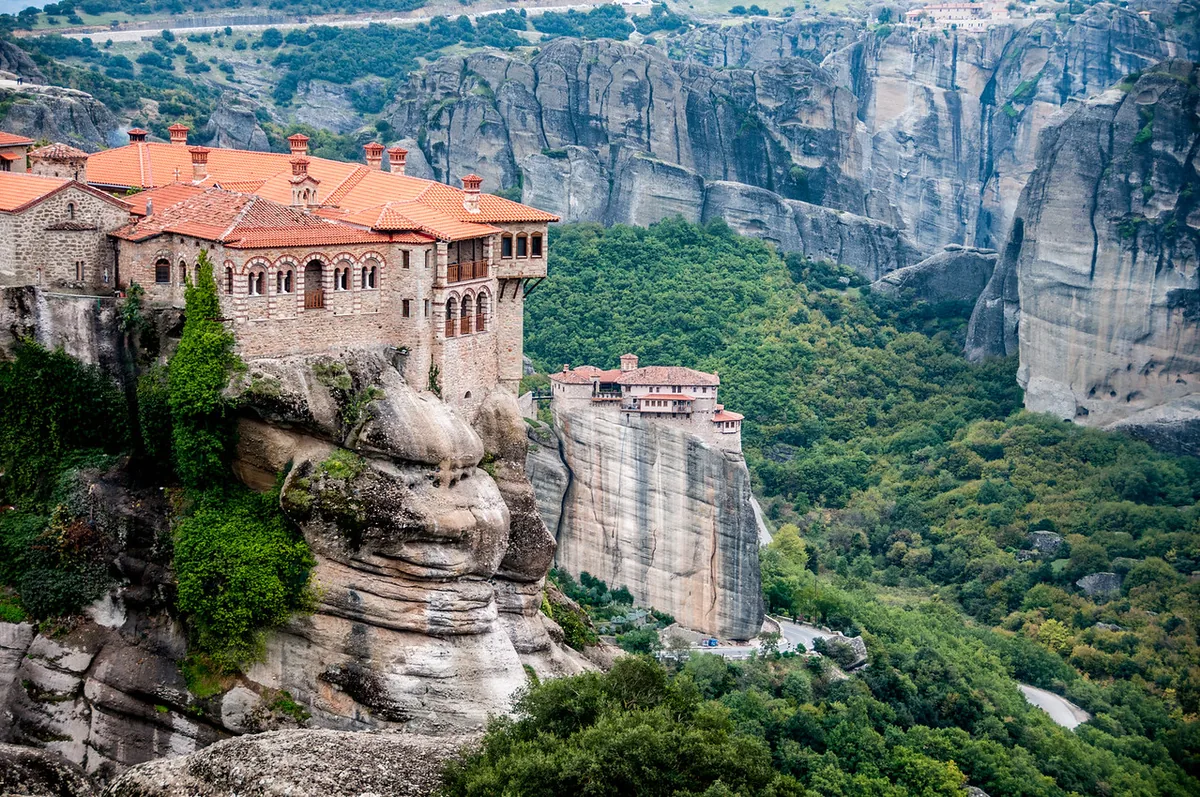
Meteora Monasteries, Greece
Hermit monks occupied the Meteora caves from the eleventh century onward, drawn by an isolation the terrain enforced rather than suggested. Organised communities began forming in the fourteenth century as Ottoman expansion and Byzantine fragmentation made remote fortresses attractive to religious communities that wished to continue operating. The Great Meteoron, the largest monastery, was built from the 1350s with timber, stone, and financial support from Serbian rulers. At the sixteenth-century peak, twenty-four monasteries occupied the pillars. Access was by rope ladder and net; the ropes were replaced only when they broke, a maintenance philosophy that concentrated the mind on the height below. Stairways were cut in the 1920s.
Kalambaka is the nearest town, reachable by train from Athens in approximately four hours. Local buses run a circuit of the monasteries in season. The full circuit between all six is walkable but involves significant ascent and is demanding in summer heat. Check current opening days for each monastery before planning your route.
The experience
The six active monasteries, Great Meteoron, Varlaam, Rousanou, Saint Nicholas Anapafsas, Holy Trinity, and Saint Stephen, keep staggered visiting days and require long trousers or skirts and covered shoulders. The interior frescoes in Varlaam and Great Meteoron date from the sixteenth century and rank among the finest Byzantine paintings in Greece. The landscape works differently at different hours: morning mist fills the valley and isolates the pillars; midday light is flat and clear; the hour before sunset, when amber light picks out the grain of the conglomerate, is when most visitors finally stop photographing and simply look.
The Experience
Walking the paths between monasteries makes the scale of the pillars legible in a way that road views do not. The valley is very far below. The monastery buildings visible across the void are smaller than they appear from the road, and the exposure is constant. Inside the churches, the contrast is complete: low ceilings, candlelit icons, incense absorbed into the stone over six centuries. The light transforms the place across the day. Visit one monastery in the morning mist and another in the late afternoon, and you will see two entirely different landscapes. The hour before the last monastery closes, when most of the day visitors have descended, is when the place finally feels quiet enough to register.
Why It Matters
Meteora is exceptional because it has never stopped being used. The monasteries are active religious communities, not preserved ruins, and have maintained continuous Orthodox practice on these summits through Byzantine decline, Ottoman rule, Greek independence, and mass tourism. The frescoes inside are not museum objects, they are still liturgically functional. Few places in Europe offer that kind of unbroken continuity.
Why Visit
Photographs of Meteora are everywhere. None of them convey the experience of standing on a monastery terrace with the valley four hundred metres below on three sides. The rock changes colour through the afternoon in ways that no image captures. Some places need the body present to register their full effect. This is one of them.
Insider Tips
- 1
No single day has all six monasteries open simultaneously, download the current weekly schedule and plan your day around it.
- 2
Rousanou is the most dramatically positioned monastery and has the least foot traffic; visit it first before the tour buses arrive.
- 3
The path between Great Meteoron and Varlaam takes about twenty minutes on foot and skips the road entirely, far preferable to waiting for the bus.
- 4
Photography inside the katholikon is prohibited in all six monasteries; the ban is enforced and the interiors are worth experiencing without a screen in front of your face.