“For over a thousand years, no significant war in the Greek world began without a delegation first consulting a woman sitting above a gas-leaking crack in the earth at Delphi.”
About Sanctuary of Apollo
The sanctuary developed from a local cult site of the eighth century BCE into an institution whose authority reached Lydia, Persia, and eventually Rome. Dedications arrived from across the Greek world; the treasury buildings lining the Sacred Way represent the accumulated wealth of centuries of consultation fees and votive offerings. The Pythia's responses were famously ambiguous, a quality that protected the oracle's reputation when events diverged from predictions. The site was damaged by successive sackings but recovered each time until Theodosius I closed it in 393 CE. Modern geological investigation identified fault-released gases beneath the adyton as a probable factor in the trance states ancient sources describe. The excavation that began in 1892 under French Archaeological School direction uncovered the site's main monuments and continues today.
What Sanctuary of Apollo actually is
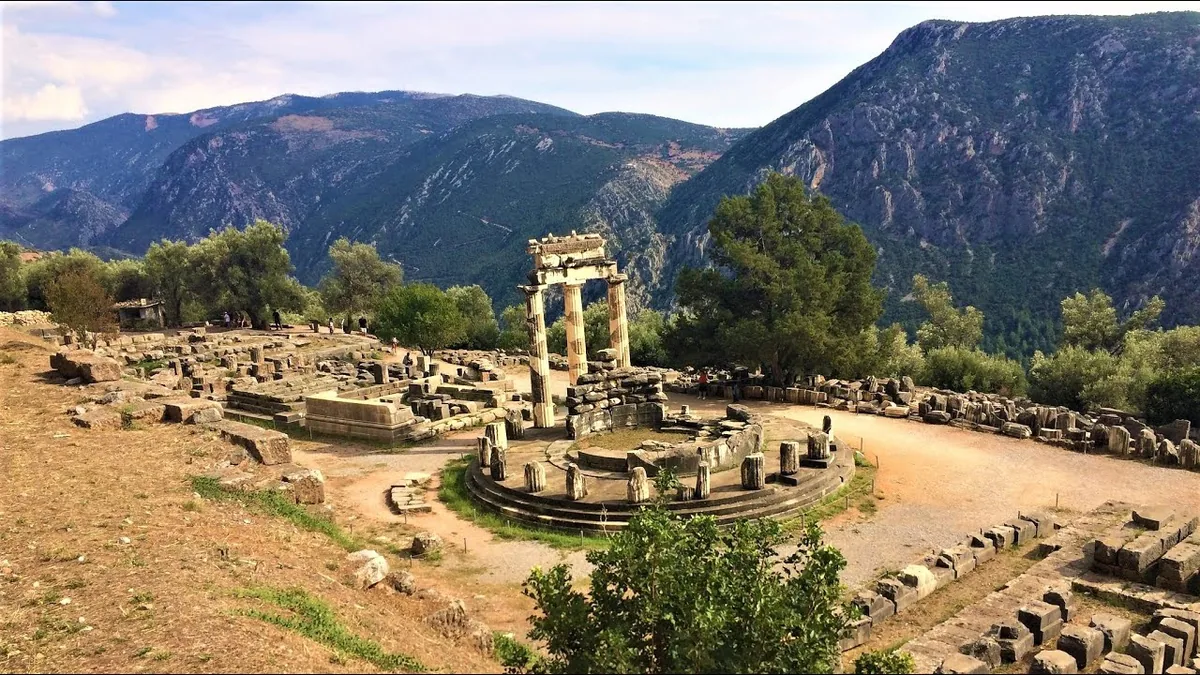
Delphi sits on the southern flank of Mount Parnassus at an elevation that places it above the olive groves spilling down to the Gulf of Corinth and below the raw limestone cliffs above. The ancient Greeks identified this terraced hillside as the centre of the earth, omphalos stones marked the spot, and for eleven centuries, kings, city-states, and private individuals sent delegates here to consult the oracle of Apollo. The Pythia, a priestess who inhaled gases rising through a fissure in the rock, delivered responses that shaped wars, colonial expeditions, and constitutional reforms across the Mediterranean world.
Delphi sits on the southern flank of Mount Parnassus at an elevation that places it above the olive groves spilling down to the Gulf of Corinth and below the raw limestone cliffs above.
The sanctuary grew from an eighth-century BCE cult site into the most consulted oracle of the ancient world. Wealth arrived from every direction: each major city-state built its own treasury on the terraced hillside, small marble buildings crammed with valuable offerings. The oracle survived multiple sackings, by Persians in 480 BCE, by Phocian mercenaries in the 350s who looted the treasuries to fund a decade of war, by the Roman general Sulla in 86 BCE, and recovered from each. The emperor Theodosius I closed the sanctuary in 393 CE as part of a systematic suppression of pagan worship. Modern geological surveys have identified fault lines beneath the adyton, the inner sanctum where the Pythia sat, that release ethylene and other gases through the rock, a finding that lends physical plausibility to ancient accounts of her altered states.
The Sacred Way climbs the terraced hillside past ruined treasury buildings to the Temple of Apollo, where six columns still stand. Above the temple sits the ancient theatre, intact enough to convey the viewing experience. Above that, reached by a steep climb most visitors abandon, the ancient stadium where the Pythian Games were held remains largely unrestored, wide, silent, and often empty. The Archaeological Museum at the base holds the bronze Charioteer of Delphi, a standing figure of extraordinary stillness, and the carved omphalos stone.
Buses from Athens' Liossion terminal take approximately three hours to Delphi village, which sits directly above the site entrance. The site sits at 570 metres elevation; temperatures are noticeably cooler than coastal Greece in summer.
Buses from Athens' Liossion terminal take approximately three hours to Delphi village, which sits directly above the site entrance.
The Experience
The Sacred Way gains real altitude, and the stadium above the theatre adds another fifteen minutes of steep climbing that most visitors skip. Those who make it find an intact ancient athletics venue with no interpretation boards, no crowd barriers, and the mountain above. The silence is significant. The museum at the base repays as much time as the ruins above. The Charioteer stands in its own room: a full-length bronze figure, the reins still in his hands, calm in a way that stops the room. Sit on the bench facing it for ten minutes. The rest of the collection, the omphalos stone, the Sphinx of Naxos, is strong, but the Charioteer is the reason to be here.
Why It Matters
Delphi was the one institution in the ancient world that all Greek city-states, locked in perpetual competition with each other, agreed to consult on equal terms. Its authority was political as much as religious: the oracle influenced the colonisation of Sicily, the founding of Cyrene, and the Athenian decision to build a fleet that defeated the Persians at Salamis. No other single site offers clearer evidence of how religious authority shaped ancient Mediterranean politics.
Why Visit
Other Greek sites have better-preserved structures. Delphi has the location, mountain behind, valley below, the particular quality of high-altitude Greek light, and the persistent sense that something happened here that moved the world. The Charioteer alone justifies the bus ride from Athens. The stadium at the top, empty and unrestored, is a different kind of gift.
✦ Insider Tips
- 1
The combined ticket covers both the archaeological site and the museum, they are physically separate buildings and you need both.
- 2
The stadium above the theatre is a steep fifteen-minute climb that most visitors skip; it is usually empty and completely intact.
- 3
Delphi village sits above the site entrance and has café terraces with direct views down the Pleistos valley.
- 4
The Charioteer room in the museum has a bench facing the statue, sit down and give it time rather than photographing it from the doorway.