“The Knights Hospitaller spent two hundred years thickening their walls to resist Ottoman artillery, and still lost the city after a six-month siege in 1522, leaving behind a fortification system so well-built the Ottomans simply kept it.”
About Medieval City of Rhodes
The Knights Hospitaller took Rhodes in 1309, two decades after losing their Crusader foothold at Acre, and immediately began converting the existing Byzantine town into a military headquarters. Two centuries of construction produced the Palace of the Grand Master, the Street of the Knights with its national inns, and a wall circuit progressively reinforced against advancing artillery technology. The siege of 1522 brought an Ottoman army under Suleiman against a Hospitaller garrison of around 7,000. After six months the Knights negotiated an honourable withdrawal; Rhodes became an Ottoman city for nearly four centuries. Churches were converted to mosques; new construction added Ottoman fountains, a hamam, and administrative buildings. Italian colonial administration from 1912 to 1947 added neoclassical and fascist-era elements. The layering of these periods within a single intact wall circuit earned UNESCO World Heritage listing in 1988.
What Medieval City of Rhodes actually is
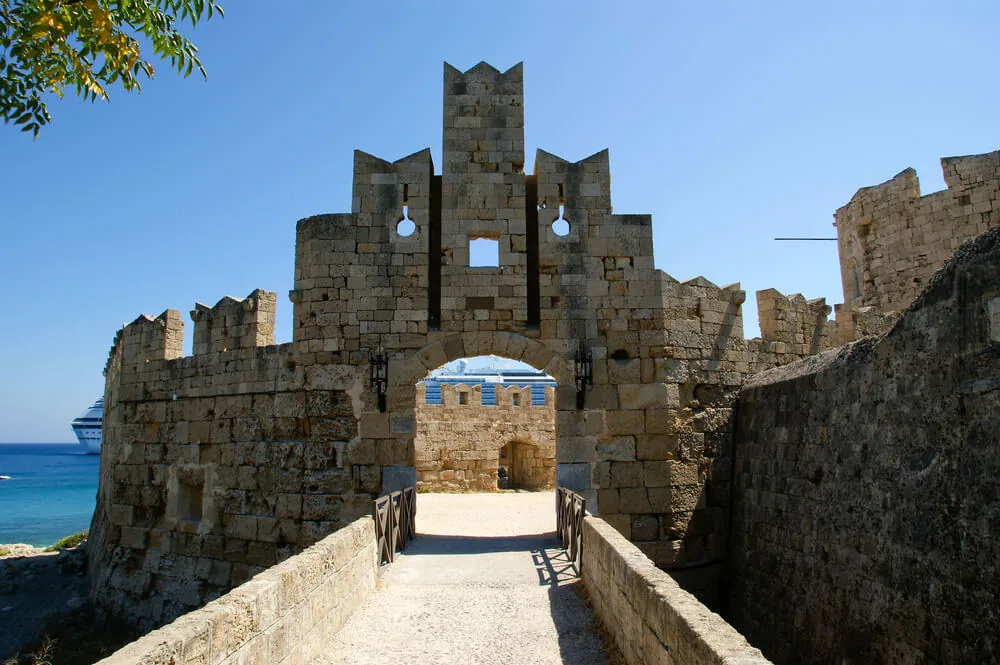
The walls around the old city of Rhodes were built to absorb cannon fire. The Knights Hospitaller, who controlled the island from 1309 until 1522, progressively thickened and reconfigured their defensive circuit as artillery technology advanced through the fifteenth century, the walls reach twelve metres thick in places, with a dry moat fifty metres wide on the landward sides. The investment did not ultimately save them: Suleiman the Magnificent's forces took the city after a six-month siege in 1522. What the defeat left behind is one of the best-preserved medieval defensive systems in Europe, intact precisely because the Ottomans maintained rather than demolished it.
The walls around the old city of Rhodes were built to absorb cannon fire.
The Knights arrived at Rhodes in 1309 after being expelled from their previous headquarters at Acre following the Crusader collapse in the Holy Land. They immediately began building, and kept building for two centuries: the Palace of the Grand Master, the Street of the Knights, the Hospital, the individual inns of the national divisions of the Order, and the progressive reinforcement of the wall circuit. The 1522 siege brought an Ottoman force that contemporary accounts put at between 100,000 and 200,000 against a defending garrison of perhaps 7,000. The Knights were allowed to leave with their possessions; Rhodes passed to Ottoman administration, the churches became mosques, and new construction began layering Ottoman elements over the Hospitaller fabric. Italian colonial rule from 1912 added another layer. Greek sovereignty from 1947 brought the UNESCO listing in 1988.
The old city is inhabited and commercially active, which saves it from the preserved-emptiness that afflicts some heritage centres. Restaurants, hotels, shops, and residences fill buildings that span Hospitaller Gothic, Ottoman, and Italian periods within a few steps of each other. The Street of the Knights, which runs from the Palace of the Grand Master to the former Hospital, is the most architecturally coherent medieval street in Greece. The Chora, the lower town, contains mosques, a functioning Turkish bath, Byzantine churches, and Ottoman fountains in a density that rewards slow walking.
Rhodes has an international airport with direct European connections. The Medieval City is a short walk from the ferry port. The main gates are open continuously; individual museums within the walls keep separate hours.
Rhodes has an international airport with direct European connections.
The Experience
Walking the Street of the Knights on a morning before the tour groups arrive, the Gothic stone facades, the carved escutcheons of the national divisions, the absence of vehicles, gives a spatial impression of medieval institutional life that no reconstruction could replicate. The street is intact, not restored; it looks like this because people never stopped using it. The Chora below the Street of the Knights rewards undirected wandering. The Süleymaniye Mosque, the Mustafa Pasha mosque, the Ibrahim Pasha mosque, the functioning hamam, Byzantine churches converted and reconverted, all sit within ten minutes of each other. The city's layered history is legible in the fabric of the buildings.
Why It Matters
The Medieval City of Rhodes is unusual in European heritage for having been shaped by three successive cultural powers, Christian military order, Ottoman empire, Italian colonialism, each of which built substantially rather than simply occupying what existed. The result is a living palimpsest: a medieval city with Ottoman minarets and Italian administrative buildings, all within walls designed for cannon balls, all still in use.
Why Visit
The Street of the Knights is the most complete surviving example of medieval institutional urbanism in the eastern Mediterranean. The Chora around it has mosques, Byzantine churches, Ottoman fountains, and Gothic doorways within blocks of each other. This is not a reconstructed heritage quarter, it is a real city that has been continuously occupied since antiquity, and it shows.
✦ Insider Tips
- 1
The hamam (Turkish bath) near the Mustafa Pasha mosque is still operating and offers a functioning Ottoman bathing experience in an original building.
- 2
The walls circuit walkable from the Palace of the Grand Master gives the best overview of the defensive system, allow ninety minutes.
- 3
The Jewish Quarter in the southeast corner of the old city is almost entirely unvisited by day-trippers and has some of the finest Hospitaller domestic architecture.
- 4
The Sound and Light show in the dry moat outside the Palace of the Grand Master is a genuinely effective way to understand the siege of 1522 in its spatial context.