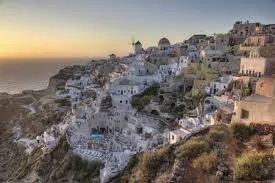
The village that millions of people photograph every year was mostly rebuilt after 1956, when an earthquake destroyed it and the population left, the reconstruction deliberately preserved the cave-house style to maintain what had been lost.
About Oia
Santorini's characteristic geography is the product of a volcanic eruption around 1600 BCE that destroyed the island's centre and sent a tsunami across the Aegean. The Minoan settlement at Akrotiri on the southern part of the island was buried under volcanic ash and preserved; it remains one of the most significant Bronze Age archaeological sites in the Aegean. Oia developed over centuries on the caldera's northern rim, its architecture shaped by the soft volcanic rock and the need for insulation. The 1956 earthquake measuring 7.8 caused widespread structural failure along the caldera edge and resulted in mass emigration. The subsequent rebuilding codified the cave-house and blue-dome aesthetic into the consistent visual identity the village now projects, a form that is simultaneously traditional and deliberately reconstructed.
What Oia in Greece is
Most of Oia was built for practical rather than aesthetic reasons. The cave houses carved into the caldera cliff face of Santorini's northern tip were dug out of the soft volcanic rock for insulation, the thick walls and below-grade rooms keeping interiors cool through the Aegean summer and warm through the mild winter. The blue-domed churches followed from the available pigments and traditional practice. The whitewash was calcium oxide, cheap and reflective. The village that results from these functional decisions happens to be one of the most photographed places on earth.
a volcanic eruption, 1600
Santorini's caldera was formed by a volcanic eruption around 1600 BCE of a scale that sent tsunamis across the eastern Mediterranean and probably contributed to the collapse of Minoan Crete. The island that remained was arc-shaped, the caldera open to the sea on the western side. Oia developed on the caldera rim at the northern tip, its cave-house typology a direct response to the terrain. In 1956, an earthquake registering 7.8 caused massive rock falls along the caldera rim and prompted most of the population to emigrate. The village was subsequently rebuilt over the following decades, with the reconstruction deliberately preserving the pre-earthquake cave house form. The Oia that appears in contemporary photographs is largely a post-1956 creation that codified and regularised an older vernacular.
Visiting Oia
The caldera sunset draws large crowds to the castle ruins at the western end of the village from about an hour before dusk, particularly in the peak months of July and August. The event is genuine, the light over the caldera water, the volcanic islands of Nea Kameni and Palea Kameni in the centre, the cliffs of Thirasia opposite, but the social conditions transform it. Earlier morning, before the day visitors arrive from Fira and the cruise ships, is when the stepped passages and the cave-house alleys feel more like a village and less like an event.
Santorini has an international airport with direct European connections. The main port at Athinios serves ferries from Piraeus and the Cyclades. From Fira, the island's main town, Oia is 11 kilometres north; buses run frequently in season.
The Experience
The alleys of Oia are narrow enough that two people can barely pass each other. In the deep summer they are shoulder to shoulder with visitors from 10am onward. Come before 8am and you will find cats, delivery trucks, and a handful of people eating breakfast on terraces above the caldera, a different version of the same place. The sunset from the castle ruins at the western end is real, and the view is earned. The caldera is genuinely dramatic: the water far below, the volcanic islands in the centre, Thirasia's cliffs across the gap. But the sunset crowd has become the attraction itself for much of the year. Visiting in April or October restores something of the original quality.
Why It Matters
Oia is one of a small number of places whose image has become more powerful than the place itself. The photograph, white walls, blue domes, caldera, functions as a symbol of the Greek island experience in global visual culture. What gives it substance is that the place is genuine: the cave houses were built this way for real reasons, the caldera is a real geological feature, and the village continues to be inhabited by actual residents.
Why Visit
If you go in July and August, Oia is a crowd event with a village attached. If you go in October, stay in a cave house for two nights, and walk the caldera rim to Fira in the morning, you get something that photographs have not adequately described. The light in the late afternoon, the caldera water changing colour below, the almost complete quiet, that version of Oia is worth the effort.
✦ Photo Gallery
Best Season
🌤 Late April to June and mid-September to October. The summer peak (July–August) brings cruise-ship crowds that reduce the village to a bottleneck. Spring and autumn have better light, cooler temperatures, and a caldera that still has its colour.
Quick Facts
Best time to visit
Late April to June and mid-September to October. The summer peak (July–August) brings cruise-ship crowds that reduce the village to a bottleneck. Spring and autumn have better light, cooler temperatures, and a caldera that still has its colour.
Getting there
In Santorini, Greece; reach Santorini first, then continue to the site.
Location
Santorini, Greece
Type
attraction
Insider Tips
- 1
The sunset crowd at the castle is genuine but dense in summer; the caldera view from Oia's main lane fifteen minutes before sunset, looking west over the rooftops, is less crowded and equally good.
- 2
The walk from Oia south along the caldera rim to Fira takes three to four hours and is one of the best ways to understand the island's geography.
- 3
Cave houses stay significantly cooler than surface rooms in summer, worth prioritising when booking accommodation.
- 4
The Ammoudi Bay fishing harbour below Oia involves a staircase descent and is usually uncrowded compared to the village above.