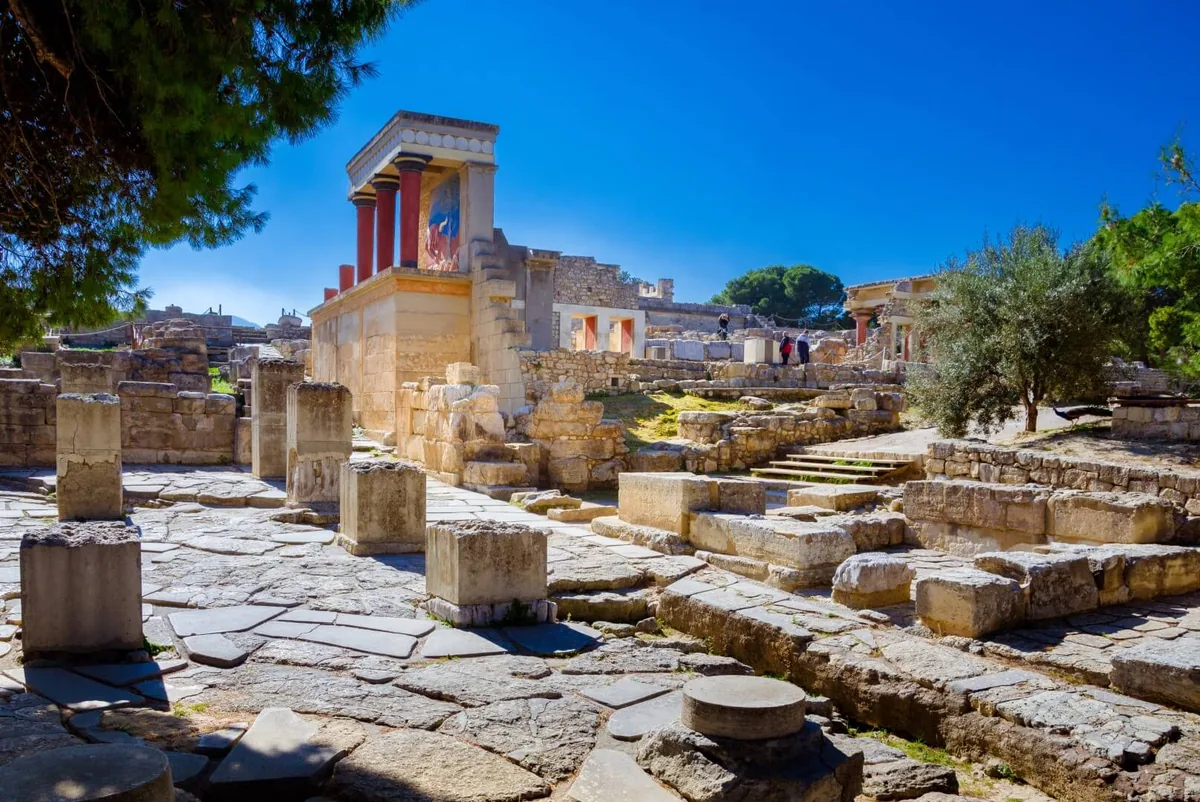
“The most famous image of Minoan Crete, the bull-leaping fresco, the dolphin paintings, the red columns, were largely reconstructed in concrete by one British archaeologist whose interpretation now defines how the world imagines the Bronze Age Aegean.”
About Palace of Knossos
Minoan civilisation at Knossos reached its height between approximately 1700 and 1450 BCE. The palace administered a redistribution economy across Crete and the Aegean, storing oil, grain, and wine in vast magazines still visible at the site. The writing system used, Linear A, has never been deciphered; what Minoans called themselves, their language, and the details of their religious practice remain unknown. Arthur Evans purchased the site and began excavating in 1900, working for three decades and making both extraordinary discoveries and highly interventionist decisions. His concrete reconstructions of the upper storeys and his direction of reproduction fresco painting on restored walls imposed a specific aesthetic interpretation that is now inseparable from Minoan visual culture globally. Scholars have debated the reconstructions ever since; most acknowledge that without them, the site would have eroded to rubble.
What Palace of Knossos actually is
Knossos presents a problem. The Minoan palace excavated south of Heraklion between 1900 and the 1930s was a Bronze Age administrative and ceremonial complex of genuine sophistication, multi-storey construction, drainage systems, elaborate frescoes, and a script (Linear A) that has never been deciphered. The archaeologist Arthur Evans, who directed the excavation, also substantially rebuilt portions of the palace in reinforced concrete and repainted the walls with reproduction frescoes. What visitors see at Knossos is partly Minoan, partly Evans. The boundary between the two is not always clear.
The archaeologist Arthur Evans, who directed the excavation, also substantially rebuilt portions of the palace in reinforced concrete and repainted the walls with reproduction frescoes.
Minoan Crete reached its peak between approximately 1700 and 1450 BCE, when Knossos functioned as the administrative hub of a network that extended across the Aegean. The palace covered roughly 22,000 square metres, housed hundreds of people, and stored agricultural products in vast ceramic pithos jars still visible in the western magazines. Around 1375 BCE the palace was destroyed by fire; whether by invaders, earthquake, or internal collapse remains debated. Evans began excavating in 1900 and continued for three decades, making major discoveries and major decisions: the concrete reconstructions of the piano nobile, throne room, and grand staircase gave the site structure that weathering would otherwise have destroyed, but they also impose Evans' interpretation of Minoan aesthetic on every surface.
The throne room is Evans' most controversial intervention: the alabaster throne itself is original, but the painted griffins flanking it, the reconstructed columns, and the overall decorative scheme are largely Evans' reconstruction. The original frescoes are in the Heraklion Archaeological Museum, a short drive away, seeing the originals before or after Knossos is essential for understanding the gap between what survived and what Evans added. The site's scale only becomes apparent on foot; the magazines, the service corridors, and the ceremonial spaces cover real ground.
Knossos is 5 kilometres south of Heraklion, reachable by city bus in approximately fifteen minutes. Heraklion has an international airport. Combined tickets for Knossos and the Heraklion Archaeological Museum are sold at both sites.
Knossos is 5 kilometres south of Heraklion, reachable by city bus in approximately fifteen minutes.
The Experience
The first encounter with Evans' reconstructions is disorienting, the red-painted concrete columns, the upper-storey terraces, the overall brightness feel more like a theme park than an archaeological site. Hold that reaction in suspension. Walk to the western magazines, where the original massive pithos storage jars sit in their original positions in stone-lined trenches, and the scale of Minoan palatial administration becomes real. The Heraklion Archaeological Museum is the essential companion to Knossos. The original frescoes are displayed in their actual fragment state, with reconstructed sections clearly indicated, the contrast with Evans' approach at the site is instructive. The museum also holds the Linear A tablets and the material that gives the ruins their context.
Why It Matters
Knossos is the evidence that a sophisticated literate civilisation occupied the Aegean more than three thousand years ago, before the Greeks, before the Romans, before the history that European culture has claimed as its foundation. The palace's scale, its plumbing, its multilingual trade connections, and its visual sophistication force a revision of assumptions about what Bronze Age Europe was capable of.
Why Visit
Knossos is complicated by its reconstructions, but dismissing it on those grounds misses the point. Walking through a Bronze Age palace at full scale, even a partially rebuilt one, does something to the understanding of ancient history that no museum display can replicate. Come with the Heraklion museum's context in mind, and the site's ambiguities become interesting rather than frustrating.
✦ Insider Tips
- 1
Visit the Heraklion Archaeological Museum before Knossos if possible, seeing the original frescoes first makes Evans' reconstructions at the site much easier to read critically.
- 2
The combined museum and site ticket saves money; buy it at whichever you visit first.
- 3
The west magazines with the original pithos storage jars are often overlooked by visitors focused on the reconstructed throne room, they are the most direct connection to actual Minoan administrative life.
- 4
Audio guides at the site are genuinely useful for distinguishing original elements from Evans' reconstructions, which signage alone does not always clarify.