“In 1977, an archaeologist opened a sealed Macedonian tomb that had not been touched since the fourth century BCE and found gold-wrapped cremated bones, ivory portraits, and weapons that pointed to one person: Philip II, father of Alexander the Great.”
About Royal Tombs of Aigai
Aigai served as the ceremonial capital of Macedon long after the administrative capital moved to Pella. The Great Tumulus at Vergina contained royal burials spanning centuries, but Tomb II, opened by Manolis Andronikos in 1977, was exceptional: it had never been looted. The cremated remains inside a gold larnax were identified by skeletal analysis as a male with an old eye injury consistent with Philip II's documented wound from 354 BCE. A second tomb, Tomb III, contained remains identified as Alexander IV, Alexander the Great's posthumous son, killed as a child by political rivals. The discovery transformed understanding of Macedonian royal culture. The painted tomb facades, the quality of the goldwork, and the ivory portrait miniatures, including a tiny head that closely matches descriptions of Philip II, demonstrated that the court that produced Alexander the Great had a visual culture of extraordinary sophistication.
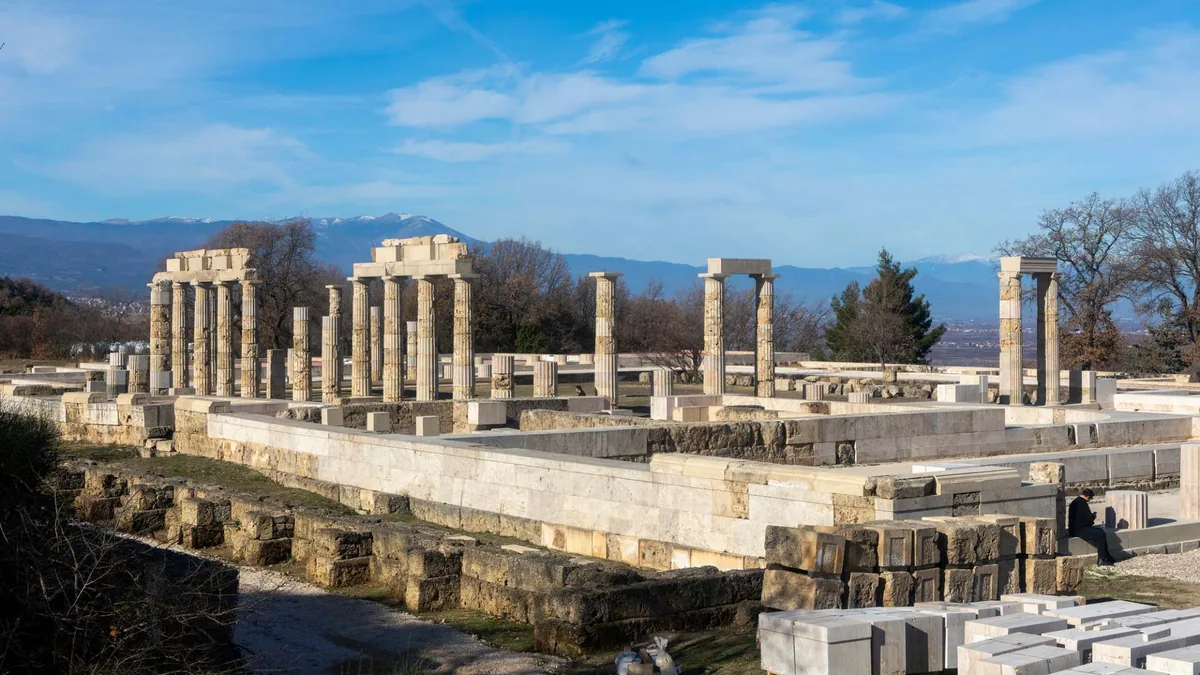
The museum at Vergina is underground.
You descend into the Great Tumulus, the burial mound itself, and find the tomb facades in their original positions, stone-built structures with painted facades, sealed for more than two thousand years before the excavation that opened them in 1977. The objects recovered from these tombs are displayed in adjacent galleries within the tumulus. Gold larnakes, oak wreaths, ivory portrait miniatures, iron swords, bronze greaves, the material culture of a dynasty that, within a generation of these burials, would conquer the Persian Empire. The setting gives the display an intensity that no detached museum building can replicate.
The objects recovered from these tombs are displayed in adjacent galleries within the tumulus.
Aigai was the original capital of the Macedonian kingdom and its ceremonial burial site; even after the capital shifted to Pella in the fourth century BCE, Macedonian kings continued to be interred here. The site was known to exist from ancient references and visible mounds, but systematic excavation only began in the twentieth century. In 1977, the Greek archaeologist Manolis Andronikos opened Tomb II inside the Great Tumulus and found it unlooted and sealed since antiquity. The gold larnax inside contained cremated bones wrapped in purple cloth, identified by skeletal analysis as an adult male with a healed eye wound consistent with the wound Philip II of Macedon received at the siege of Methone in 354 BCE. Most specialists accept the identification, though the debate continues.
The descent into the tumulus is through a modern entrance structure that delivers you underground without preparation for the scale of what follows. The tomb facades, Tomb II (attributed to Philip II) and Tomb III (attributed to Alexander IV, Alexander the Great's son), are full-size painted architectural structures, their frescoes preserved in near-original condition by two millennia of sealed darkness. The gold larnax, the oak wreath, the silver vessels, and the ivory portrait heads are displayed in the surrounding galleries at close range. Vergina is approximately 75 kilometres west of Thessaloniki, accessible by bus or car. The nearest city is Veria, 13 kilometres away. The site is most conveniently visited as a day trip from Thessaloniki.
The Experience
The underground museum is consistently cool regardless of the season, and the transition from daylight to the tomb interior takes a moment to adjust to. The painted hunting frieze above the entrance to Tomb II, Alexander hunting beside his father, according to the prevailing interpretation, is visible at close range and in good condition after centuries of sealed darkness. The gold is the thing that stops most visitors. The larnax sits in a case that allows viewing from all sides: an object of absolute precision, the star of Vergina worked in relief on the lid, the weight and density of the gold apparent even through glass. The oak wreath beside it, each leaf individually formed in gold, has a presence that photographs do not prepare you for.
The underground museum is consistently cool regardless of the season, and the transition from daylight to the tomb interior takes a moment to adjust to.
Why It Matters
The Vergina tombs are the only unlooted royal Macedonian burials ever found. The material inside represents the court culture of the dynasty that ended the Persian Empire and spread Greek culture from Egypt to Central Asia. For students of ancient history, the site provides direct physical evidence of a world usually known only through texts, the weapons Philip used, the vessels the court drank from, portraits of the people who changed the ancient world.
Why Visit
The underground setting alone justifies the journey from Thessaloniki. No conventional museum can reproduce the experience of seeing royal tomb facades in their original positions, descended into the same mound that sealed them. The gold objects at close range, in the space built to contain them, carry a weight that Greek antiquities in distant museums never quite achieve.
✦ Insider Tips
- 1
The audio guide is the most useful interpretive tool at the site, the painted friezes and the tomb architecture require context that the signage alone does not always provide.
- 2
Allow ninety minutes minimum; the tendency is to rush through the tomb galleries and miss the smaller objects in the surrounding display cases.
- 3
The ivory portrait heads require a moment of focused attention, they are small, but the craftsmanship and the historical claim they carry reward close examination.
- 4
The museum shop has a serious academic catalogue of the excavation; for anyone with more than passing interest in Macedonian archaeology, it is worth buying.