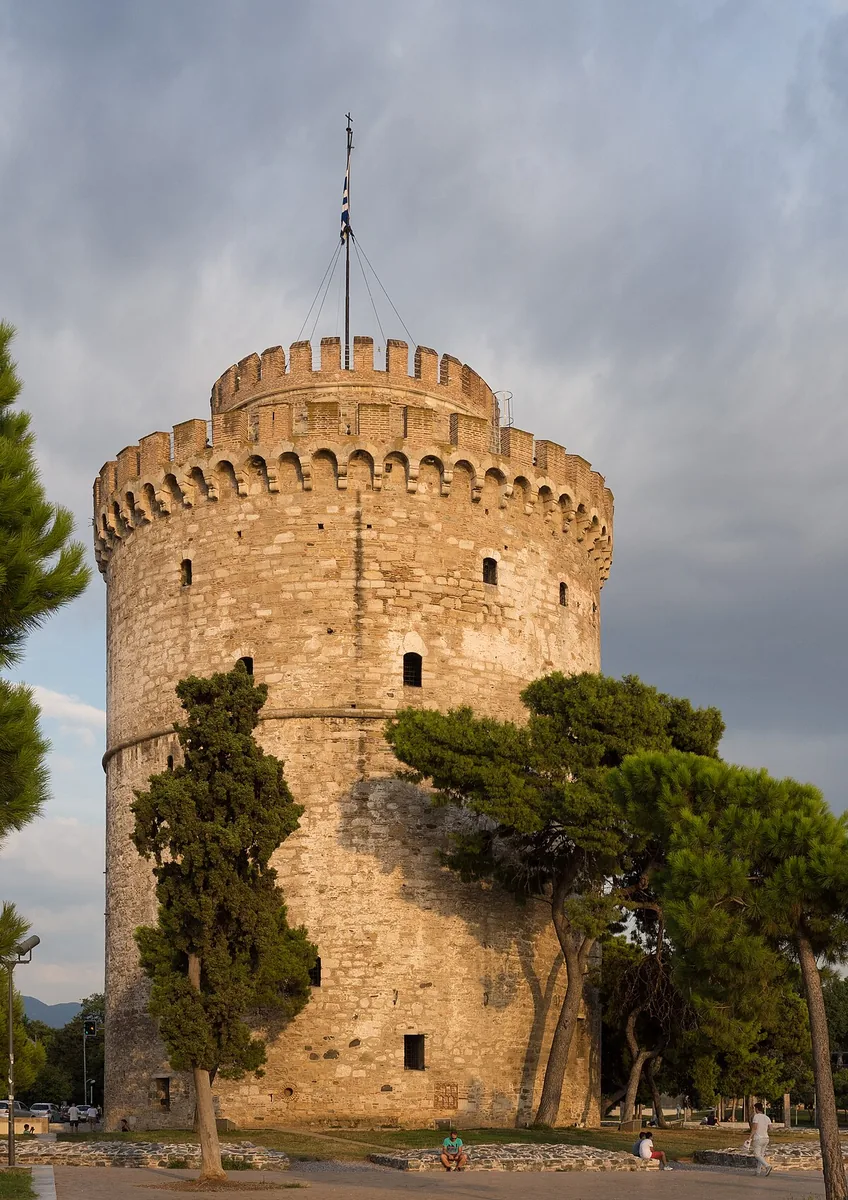
The White Tower got its name when a nineteenth-century prisoner whitewashed the exterior in exchange for his freedom, before that it was called the Blood Tower, for reasons the Ottomans considered self-explanatory.
About White Tower
The tower was built by the Ottomans following their conquest of Thessaloniki in 1430, as part of a reconstructed harbour wall replacing Byzantine fortifications. For several centuries it functioned as a garrison point and, periodically, as a prison, the Blood Tower name reflects a documented period when executions took place there. The whitewash episode of the nineteenth century gave it its current name despite the paint being subsequently removed. Thessaloniki's history shadows the tower: the fire of 1917 destroyed much of the city centre; the population exchange of 1923 removed the Muslim community; the Holocaust of 1943 to 1944 destroyed the Jewish majority. The city that emerged was Greek in a way it had never been before, its Ottoman and Jewish past physically reduced to fragments. The White Tower became the civic symbol partly by default, it was one of the few pre-modern structures that had survived intact through every transformation.
What White Tower in Greece is
The tower on the Thessaloniki waterfront has been called the White Tower since the nineteenth century, when a prisoner sentenced to clean and whitewash its exterior did so in exchange for his freedom. Before that it was known as the Blood Tower, Kanli Kule in Turkish, because it was a prison and execution site. The whitewash was eventually removed, the stone returned to its natural colour, and the name stayed. The tower stands 33 metres tall at the eastern end of the seafront promenade, cylindrical, with walls 4.6 metres thick at the base, built by the Ottomans in the late fifteenth century as part of the harbour defences after their conquest of Thessaloniki in 1430.
Thessaloniki has been, at various points, a Roman colonial city, a Byzantine imperial residence, an Ottoman provincial capital, and a major Jewish commercial centre. The city's Jewish community, present since antiquity and substantially expanded after the Spanish expulsion of 1492, constituted a majority of the population for centuries; by 1900 Thessaloniki was the largest Jewish city in the world outside of Eastern Europe. The community was almost entirely destroyed in the Holocaust between 1943 and 1944, when over 96 percent of the Jewish population was deported to Auschwitz. The city that emerged from the Second World War was demographically transformed beyond recognition. The White Tower, which had witnessed all of these changes without being substantially altered, became the symbol of a city searching for historical continuity.
Visiting White Tower
The interior houses a permanent museum on Byzantine Thessaloniki across six floors, with the exhibition ascending through the tower from the city's Roman foundation to the Ottoman period. The top floor terrace looks over the Thermaic Gulf toward Mount Olympus; on clear mornings in winter, the mountain's profile is sharp above the water. The seafront promenade surrounding the tower is one of the city's primary public spaces, busy morning and evening with residents rather than primarily tourists. The tower is on the central Thessaloniki waterfront, a fifteen-minute walk from the central railway station. Thessaloniki has an international airport with European and Greek island connections.
The Experience
The museum inside the tower is genuinely good: the exhibition on Byzantine Thessaloniki uses the circular rooms well, and the progression upward through the floors follows the city's history from Roman foundation through Ottoman conquest. The upper floors have windows that look down the promenade in both directions. The terrace at the top is the payoff. The view west along the waterfront takes in the curve of the Thermaic Gulf; to the northwest, on a clear winter morning, Mount Olympus is visible at a distance that makes its height credible. The promenade below is a functioning public space, joggers, families, old men with coffee, fishing rods, delivery vehicles, rather than a tourist zone.
Why It Matters
The White Tower carries Thessaloniki's history in compressed form: built by the Ottomans on Byzantine foundations, used as a prison, named for an act of clemency, and retained as a symbol by a Greek city rebuilt after demographic catastrophe. The museum inside recovers the Byzantine layer of that history with genuine scholarship. Outside, the seafront context restores the tower to a living city rather than a monument.
Why Visit
Thessaloniki is not Athens. The city is more relaxed, the food is better, the waterfront is a genuine public space rather than a tourist zone, and the Byzantine monuments scattered through the city are among the best-preserved in Greece. The White Tower is the logical first stop, it provides the historical framework for the rest of the city, and the walk west from it along the waterfront gives you the city's character in the space of half an hour.
✦ Photo Gallery
Best Season
🌤 October through April for the clearest views of Mount Olympus from the top terrace and the most comfortable walking temperatures.
Quick Facts
Best time to visit
October through April for the clearest views of Mount Olympus from the top terrace and the most comfortable walking temperatures.
Getting there
In Thessaloniki, Greece; reach Thessaloniki first, then continue to the site.
What's nearby
Royal Tombs of Aigai is also close by.
Location
Thessaloniki, Greece
Type
attraction
Coordinates
40.6264°, 22.9483°
Insider Tips
- 1
The museum inside the tower covers Byzantine Thessaloniki specifically, combine it with the city's Byzantine churches (Rotunda, Hagia Sophia, Hosios David) for a coherent itinerary.
- 2
The promenade west of the White Tower leads past the statue of Alexander the Great to the city's covered market, a forty-minute walk through the city's actual daily life.
- 3
Thessaloniki's food scene is considered by many Greeks to be superior to Athens; the neighbourhood around the Modiano and Kapani markets, fifteen minutes from the tower, is the place to test that claim.