“Revolutionaries once stormed these very steps to ignite a war for independence, yet today the quietest sound you’ll hear is the soft hum of the climate control guarding a thousand-year-old silk cloak.”
About Hungarian National Museum
Count Ferenc Széchényi’s 1802 donation of his vast personal collection formed the museum's nucleus, but it took the vision of architect Mihály Pollack to give these artifacts a home worthy of their gravity. Construction was a decades-long labor of love, culminating just in time to serve as the headquarters for the 1848 revolution. The building was more than a gallery; it was the upper house of the Hungarian Parliament for a time, lending its halls to the most critical debates in the country’s history. During the Siege of Budapest in 1945, the museum suffered significant damage, and many of its treasures were moved into bunkers for safety. The subsequent socialist era saw the museum expand its focus to include the struggles of the working class, but the core mission remained the same. In the 1990s, the return of the Coronation Regalia from the United States (where they had been kept for safekeeping since the war) marked a symbolic homecoming for the institution’s most sacred charges.
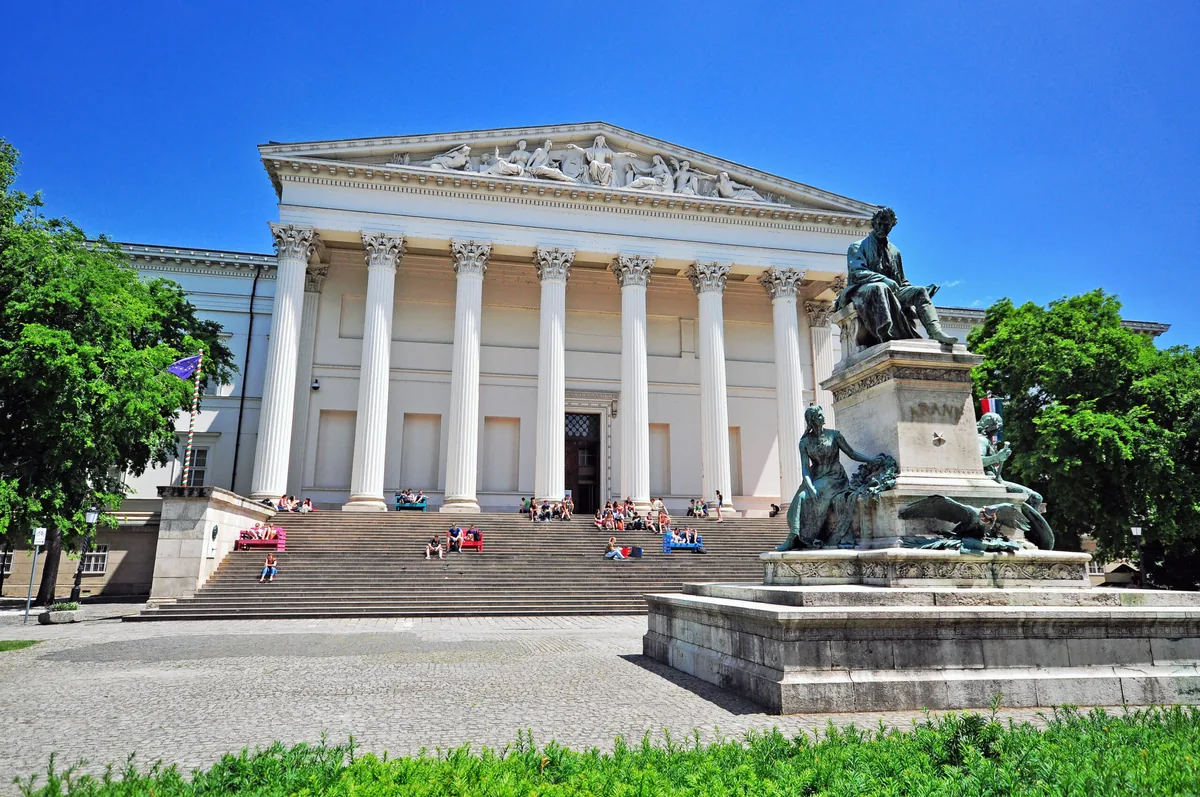
Standing before the massive Corinthian columns
Standing before the massive Corinthian columns of the Magyar Nemzeti Múzeum, you are not just looking at a building; you are standing on the very stage where a nation’s modern identity was shouted into existence. The limestone steps leading to the portico still echo with the ghost of 1848, when revolutionary fever swept through Budapest. While the exterior radiates a cool, Neoclassical restraint, the garden surrounding it is an urban sanctuary where students and elderly chess players drift through the dappled shade of ancient chestnut trees. Inside, the air grows still and smelling of beeswax and old stone, housing a collection that spans from the arrival of the Magyar tribes to the fall of the Iron Curtain.
The limestone steps leading to the portico still echo with the ghost of 1848, when revolutionary fever swept through Budapest.
Commissioned by Architect Mihály
Count Ferenc Széchényi provided the spark in 1802 by donating his private library and coin collection to the nation, but the temple-like home for these treasures arrived decades later. Architect Mihály Pollack drew inspiration from the pantheons of antiquity, completing the structure between 1837 and 1847. Fate placed the building at the center of the 1848 Hungarian Revolution when Sándor Petőfi allegedly recited his 'National Song' from the stairs, igniting a rebellion against the Habsburgs. Throughout the twentieth century, the museum witnessed the scars of two world wars and the 1956 uprising, with bullet marks occasionally still visible in the neighborhood’s architecture. It remains the custodian of the Hungarian soul, preserving artifacts that survived empires and occupations alike.
Climbing the grand staircase, your eyes are drawn upward to the magnificent ceiling frescoes that tell a story of artistic and scientific triumph. The transition from the bright, airy foyer to the darker, climate-controlled galleries creates a sense of traveling deeper into the earth’s memory. A trace of the weight of the Roman lapidarium in the basement, where cold stone sarcophagi rest in a quiet, subterranean gloom. In the Coronation Mantle gallery, the light is kept low to protect the eleventh-century silk and gold thread, creating an atmosphere of hushed reverence that borders on the religious. The rhythmic creak of parquet floors underfoot moving from the glittering prehistoric gold hoards to the stark, grey-toned exhibits of the communist era. The most poignant moment usually occurs in the small, sunlit courtyard, where the silence of the museum walls blocks out the frantic roar of the Kálvin tér traffic just a few meters away.
Arrival is effortless via the M3 or M4
Arrival is effortless via the M3 or M4 metro lines, surfacing at the Kálvin tér station and walking a few hundred meters down the tree-lined Múzeum körút. Alternatively, the iconic yellow trams 47 and 49 stop almost directly in front of the museum garden. Walking from the Great Market Hall takes less than ten minutes, leading you through the charming backstreets of the Palace District where the architecture prepares you for the museum’s own Neoclassical grandeur.
Arrival is effortless via the M3 or M4 metro lines, surfacing at the Kálvin tér station and walking a few hundred meters down the tree-lined Múzeum körút.
The Experience
What you see first is a shift in the air as you leave the busy Budapest streets and enter the museum garden, where the city noise is swallowed by high stone walls and thick greenery. The light inside the main hall is cathedral-like, pouring down from the skylights and glinting off the polished marble columns. Something like a chill in the Roman stonework gallery, a sharp contrast to the velvet warmth of the textile rooms upstairs. People generally rush past the medieval weapons to find the crown jewels, but the real magic is found in the quiet corners of the prehistoric gold collection, where the craftsmanship is so fine it seems impossible for the tools of the time. The experience stays with you as a series of textures: the roughness of iron age pottery, the smoothness of neoclassical marble, and the delicate fray of revolutionary banners.
Why It Matters
This institution is the definitive narrative arc of the Hungarian people, housing the physical proof of their survival through a millennium of shifting borders. It holds the only surviving garments of the first Hungarian kings and the very documents that defined the nation’s legal framework. More than a repository of art, it is a monument to the endurance of a language and a culture that has often stood alone in Central Europe.
Why Visit
While other museums focus on art or ethnography, this is the only place that provides the full, unvarnished biography of Hungary. You come here to stand where history was literally made on the front steps, and to see the Coronation Mantle, a piece of embroidery so rare and fragile it feels like a miracle that it exists at all. It is the essential prologue to understanding everything else you will see in Budapest.
✦ Insider Tips
- 1
Head straight to the basement lapidarium first to enjoy the Roman ruins in near-total solitude before the school groups arrive.
- 2
Look for the Seuso Treasure, a hoard of late Roman silver that was the subject of a decades-long international legal battle before returning home.
- 3
Spend twenty minutes in the museum garden; it is a favorite local spot for reading and offers the best perspective of the building's scale.
- 4
Check the temporary exhibit schedule in the modern wing, as they often feature rare photography from the 1956 revolution that isn't on permanent display.
- 5
Use the audio guide for the 'Transylvania' section, as the complex political history of that region is best understood with a narrated timeline.