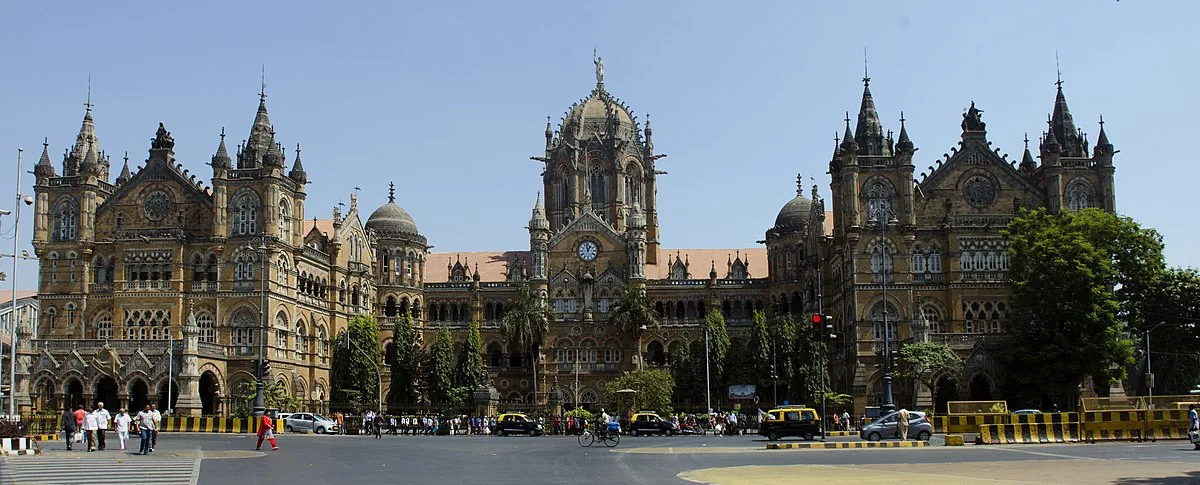
Deep within this Gothic cathedral of transport, three million people pulse through its gates every day, under the watchful gaze of stone gargoyles and Indian peacocks.
About Chhatrapati Shivaji Terminus
Stevens designed the station to be the most advanced of its time, incorporating a massive masonry dome that was the first of its kind in a public building in Mumbai. The construction took ten years, a period during which the city’s skyline was transformed into a colonial dream of spires and domes. The station survived the 2008 terror attacks, the scars of which are still quietly remembered by the staff and commuters. Its status as a UNESCO World Heritage site was cemented not just by its beauty, but by its continued function as the nerve center of the city’s daily life, proving that 19th-century infrastructure can still carry 21st-century loads.
In brief
Chhatrapati Shivaji Terminus, still known affectionately to locals as VT, is a sprawling stone interplay of Victorian Gothic Revival and traditional Indian craftsmanship. It is the architectural heart of Mumbai, a cathedral dedicated not to a deity, but to the unstoppable momentum of the Indian Railways. The building is a riot of gargoyles, turrets, and pointed arches, all carved from honey-colored sandstone that seems to glow against the city’s humid, salt-tinged haze. It is the busiest functional landmark in India, a place where the grandeur of the British Raj meets the frantic, democratic energy of three million daily commuters who pulse through its iron gates like a human tide.
“Chhatrapati Shivaji Terminus, still known affectionately to locals as VT, is a sprawling stone interplay of Victorian Gothic Revival and traditional Indian craftsmanship.”
Chhatrapati Shivaji Terminus, India
station was completed, 1888
Designed by the British architect Frederick William Stevens, the station was completed in 1888 to commemorate the Golden Jubilee of Queen Victoria. Stevens spent ten months traveling through Europe to study railway stations, but the result was uniquely Mumbaikar. He collaborated with local craftsmen from the Sir Jamsetjee Jeejeebhoy School of Art, who integrated Indian motifs, peacocks, lions, and tigers, into the Gothic structure. The central dome is topped by a colossal figure representing 'Progress,' a fitting symbol for a city that was then becoming The way into India. Originally the headquarters of the Great Indian Peninsular Railway, it was renamed in 1996 to honor the Maratha warrior king Shivaji, reflecting the city’s post-colonial identity.
Approaching the station at rush hour is an exercise in overwhelming. The vibration of the city’s traffic and the humid heat that rises from the asphalt. The sound is a constant, deafening roar of whistles, announcements in three languages, and the rhythmic thrum of thousands of footsteps on the polished stone floors. Inside the main concourse, the light filters through stained-glass windows, illuminating the intricate carvings on the vaulted ceilings. At first, the contrast between the quiet majesty of the architectural details and the sheer speed of the people moving beneath them. Most commuters never look up, but if you do, seeing a range of stone animals and floral friezes that have watched the city evolve for over a century.
The terminus is the southern anchor
The terminus is the southern anchor of the Central Railway line and is located in the Fort district of Mumbai. It is best reached by a local train, the lifeline of the city, though a taxi or an iconic black-and-yellow premier Padmini will drop you at the grand entrance. To appreciate the facade, walk across the street to the Mumbai Municipal Corporation building. The station is a working transport hub, so while you can admire the exterior and the main ticketing hall for free, the heritage gallery and the upper floors require a small fee and offer a more contemplative look at the station’s history away from the commuter crush.
“The terminus is the southern anchor of the Central Railway line and is located in the Fort district of Mumbai.”
The Experience
Inside, the space the terminus is thick with the scent of roasted coffee from platform stalls and the metallic tang of the tracks. The immense scale of the building when you stand under the central dome, where the ribbing looks like the skeleton of a giant stone whale. Immediately, the small, human moments: a family sharing a meal on a trunk, a newspaper vendor shouting above the din, and the frantic sprint for the 5:40 fast train. At night, the building is washed in color-changing LED lights, turning the Gothic stone into a psychedelic palace that stands in silent opposition to the dark, churning waters of the Arabian Sea nearby.
Why It Matters
Chhatrapati Shivaji Terminus is the finest example of Victorian Gothic architecture in India, successfully fused with Indian decorative arts. It represents the historical moment when Mumbai became a global trade hub and remains the ultimate symbol of the city's resilience and pace. It is a rare heritage site that is neither a museum nor a ruin, but a vital piece of the city's living machinery.
Why Visit
The reason to visit: you cannot understand Mumbai without standing in the middle of this station. It is the city's soul in stone. While other landmarks offer beauty, CST offers the raw, electric energy of India in motion. It is a masterclass in how architecture can be both an elitist statement and a democratic utility.
Insider Tips
- 1
Visit the Heritage Gallery on the first floor to see the original architectural drawings and the grand dining hall used by colonial officials.
- 2
The best photo of the facade is taken from the pedestrian overpass across the main road, especially just after sunset when the lights come on.
- 3
Do not try to take photos on the platforms during peak morning or evening rush hours; you will be swept away by the human tide.
- 4
Look for the stone lion and tiger at the entrance gates, symbolizing the United Kingdom and India respectively.
- 5
Check out the 'Star Chamber' ticketing office; the groined ceiling and Italian marble work make it the most beautiful place in India to buy a train ticket.