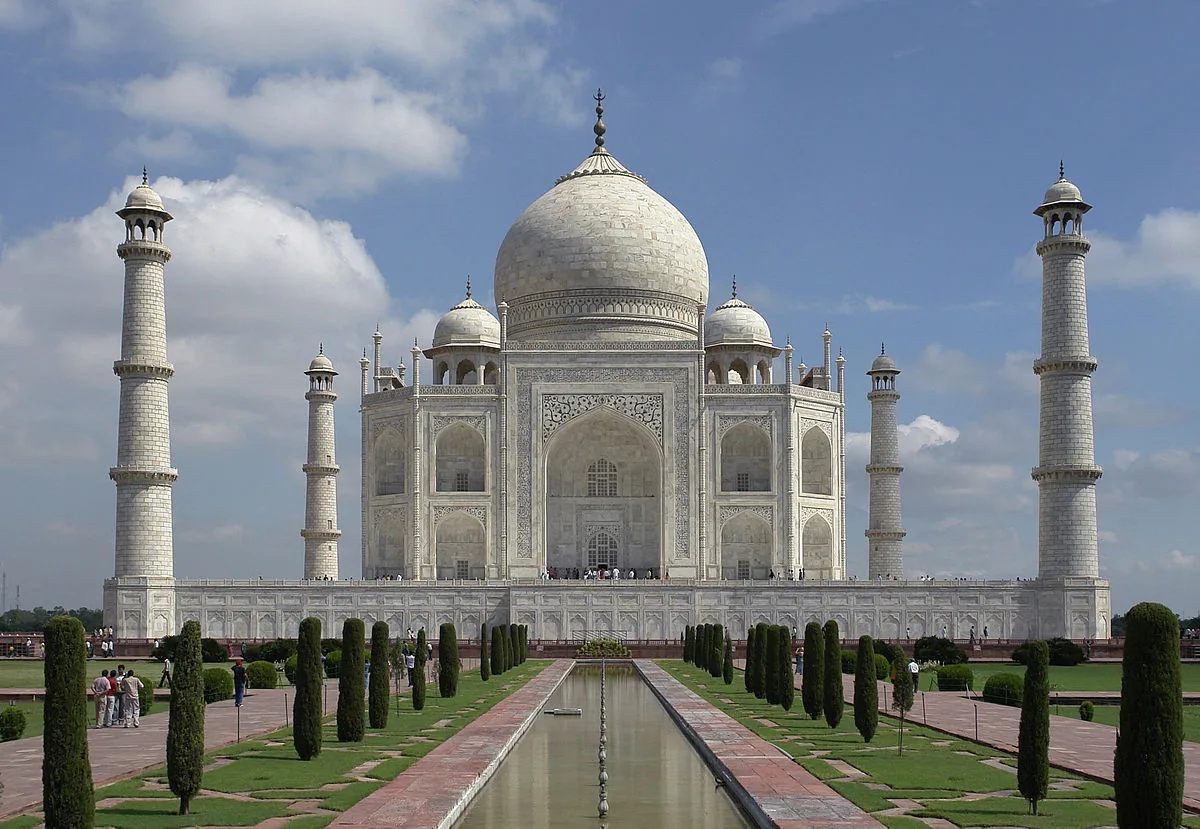
Twenty thousand men labored for two decades to ensure this mountain of white marble would appear as light as a cloud resting on the edge of a river.
About Taj Mahal
The Taj Mahal represents the zenith of Mughal architecture, a style that blended Persian, Indian, and Islamic influences into a singular, symmetrical masterpiece. Beyond the central tomb, the complex includes a red sandstone mosque and a matching guesthouse, ensuring the entire 42-acre plot maintained a perfect visual balance. In the 19th century, the monument fell into disrepair and the gardens became overgrown, even serving as a backdrop for British socialite picnics before Lord Curzon initiated a massive restoration project in 1908. Today, it faces modern threats from industrial smog, requiring a constant regiment of 'mud pack' treatments to keep the marble from yellowing.
What Taj Mahal actually is
Makrana marble possesses a peculiar, almost bioluminescent quality, soaking up the bruised violets of dawn and reflecting a searing, bone-white glare by high noon. Up on the banks of the Yamuna, the Taj Mahal feels less like a building and more like a collective gasp of breath frozen in stone. Its impossible symmetry defies the chaotic pulse of Agra just beyond the red sandstone walls. Here, There is a heavy, floral perfume of the garden’s blossoms mixed with the damp, earthy scent of the river. Every arch and minaret is a calculated anchor for the central dome, which seems to float above the ground, detached from the heavy labor that birthed it.
this gargantuan undertaking, 1632
Emperor Shah Jahan began this gargantuan undertaking in 1632, driven by a grief so profound it reportedly turned his hair silver overnight following the death of his empress, Mumtaz Mahal. He summoned twenty thousand artisans from across the Islamic world, including stonecutters from Bukhara and calligraphers from Syria. Over a thousand elephants hauled the translucent marble across Rajasthan to the site. The intricate floral patterns on the walls are not painted but are examples of pietra dura, where tiny slivers of lapis lazuli, carnelian, and jade are inlaid into the marble with such precision that the seams are invisible to a wandering fingertip. After twenty-two years of construction, the emperor was deposed by his own son and spent his final years imprisoned in the nearby Agra Fort, looking across the water at the monument he had built but could no longer touch.
Passing through the Great Gate, your depth perception momentarily fails as the mausoleum appears far larger than logic dictates. A remnant of the cool, polished stone beneath your stockinged feet as you ascend the main plinth. Inside the central chamber, the acoustics are designed to sustain the echo of a single prayer for nearly thirty seconds, a sonic metaphor for eternity. The light filters through marble screens known as jalis, casting dappled shadows that shift across the cenotaphs as the sun moves. What grabs you is the four minarets lean slightly outward, a clever engineering insurance policy to ensure they would fall away from the main dome during an earthquake. The sound of the crowds usually fades into a low, reverent hum, swallowed by the sheer volume of the white void. Agra is a two-hour blur from Delhi on the Gatiman Express, though many prefer the sunrise drive via the Yamuna Expressway. Pollution regulations prohibit motorized vehicles within five hundred meters of the site, meaning the final approach involves a battery-operated bus or a horse-drawn tonga. Arriving before the sun clears the horizon allows you to watch the marble transition from a ghostly grey to a warm, golden glow before the heat haze and the mid-morning crowds arrive.
The Experience
The morning mist often clings to the river, making the dome appear to levitate above the treeline. The mass of the vibration of the city outside the walls, yet inside, the atmosphere is governed by the slow, deliberate pace of the water channels. The tiny, iridescent flashes of malachite and mother-of-pearl embedded in the walls, catching the light like hidden stars. The most profound moment happens when you stand at the very back of the platform, looking down at the Yamuna; the contrast between the pristine white tomb and the rugged, unkempt riverbank reminds you that this place is a defiant bubble of perfection in a wild world.
Why It Matters
The Taj Mahal is the ultimate expression of Mughal artistic genius and a global shorthand for enduring devotion. It marks the high point of the pietra dura technique and remains a masterclass in structural engineering, specifically in the use of timber and well-foundations to support massive weight on a riverbank. Culturally, it anchors the identity of a nation and the history of a dynasty that redefined the Indian subcontinent.
Why Visit
No photograph can prepare you for the scale or the tactile reality of the marble. While other monuments are impressive, the Taj is haunting. It is the only place on earth where a tomb feels more alive and radiant than the living city surrounding it, a physical manifestation of a memory that refuses to fade.
✦ Photo Gallery
Best Season
🌤 October to March offers the crispest light and manageable temperatures, avoiding the scorching summer heat that can make the marble floors too hot for bare feet.
Quick Facts
Entry
Around 1,100 rupees for foreign visitors (less for the mausoleum mound), far less for Indian nationals; check current rates.
Opening hours
Open sunrise to sunset, closed on Fridays for prayers.
Time needed
About 2 to 3 hours.
Best time to visit
October to March offers the crispest light and manageable temperatures, avoiding the scorching summer heat that can make the marble floors too hot for bare feet.
Getting there
In Agra; reachable by fast train from Delhi (around 2 hours) and then a short ride, as vehicles are kept away from the monument.
Location
Agra, India
Type
attraction
Coordinates
27.1750°, 78.0419°
Insider Tips
- 1
Visit the Mehtab Bagh garden across the river at sunset for a mirror view of the Taj without the security lines or the elbowing crowds.
- 2
Carry a small flashlight to see the translucent quality of the marble and how the inlaid gems glow when lit from behind.
- 3
The monument is strictly closed on Fridays for prayers, so do not plan your Agra arrival for a Thursday evening.
- 4
Hire a government-approved guide at the ticket counter to avoid the freelance touts who often prioritize speed over historical accuracy.