Every single day, this golden fortress of peace feeds over one hundred thousand strangers for free, operating the world's largest kitchen fueled entirely by volunteer labor.
About Harmandir Sahib
In its earliest form, this was a small lake in the middle of a forest where the Buddha was said to have meditated, and later, Guru Nanak, the founder of Sikhism. The current structure is a 1764 reconstruction, as the earlier temples were repeatedly razed during the 18th-century Afghan-Sikh wars. The Maharaja's subsequent gold donation in the 19th century transformed it into the 'Golden Temple' known to the world today. It has survived the turbulent events of the 20th century, including the scars of Operation Blue Star in 1984, remaining the unwavering spiritual center for the global Sikh diaspora.
The Golden Temple floats in the center
The Golden Temple floats in the center of a vast pool of nectar, its gilded upper stories catching the Punjabi sun and casting a brilliant, dancing reflection on the water. Harmandir Sahib is more than a shrine; it is a living, breathing organism of radical hospitality. The space in Amritsar is often dusty and loud, but passing through the gates onto the white marble parikrama, the temperature seems to drop and the noise of the city is replaced by the hypnotic, rhythmic chanting of the Gurbani. The smell of buttery karah parshad and the steam from the communal kitchen drift across the sarovar, creating an atmosphere that feels both celestial and deeply grounded in the physical act of service.
“The Golden Temple floats in the center of a vast pool of nectar, its gilded upper stories catching the Punjabi sun and casting a brilliant, dancing reflection on the water.”
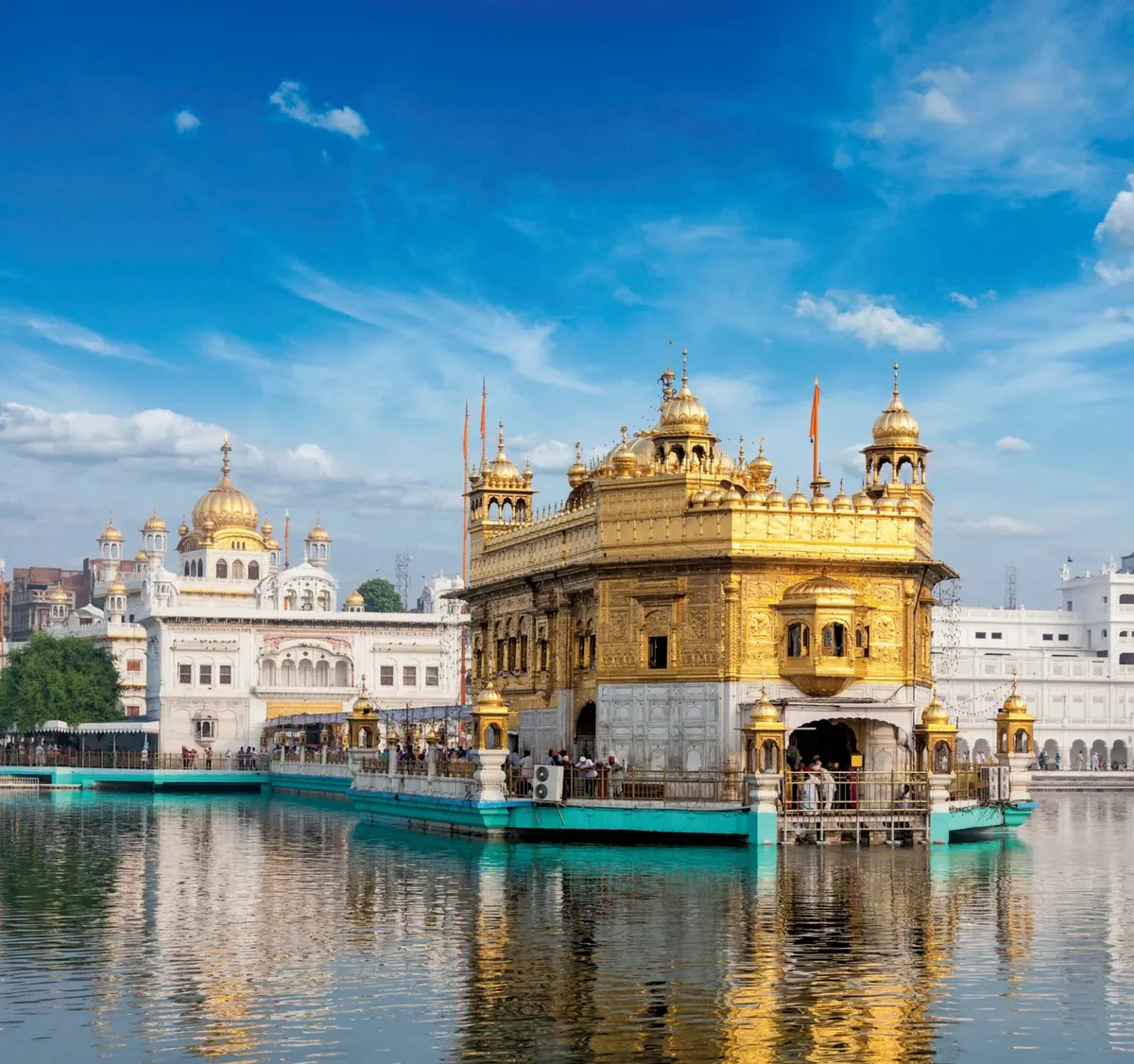
Harmandir Sahib, India
In 1581, Guru Arjan Dev
In 1581, Guru Arjan Dev, the fifth Sikh Guru, initiated the construction of the temple, purposefully designing it to sit at a lower level than the surrounding city to signify humility. He invited a Muslim Sufi saint, Mian Mir, to lay the foundation stone, emphasizing that the doors were open to all religions. The temple was built with four entrances, one for each cardinal direction, welcoming anyone regardless of caste or creed. Over the centuries, the structure was destroyed multiple times by invading Afghan armies, but each time it was rebuilt with greater resolve. The iconic gold plating that gives it its name was added in 1830 by Maharaja Ranjit Singh, who used over 160 kilograms of gold to cover the copper panels of the sanctum.
Amritsar is a major hub connected
Amritsar is a major hub connected by the Swarna Shatabdi train from Delhi and a busy international airport. The temple sits in central the old city, accessible through a newly paved heritage walk that is blissfully free of cars and rickshaws. Inside the complex at 4:00 AM allows you to witness the Palki Sahib ceremony, where the holy book is carried in a golden palanquin from the main sanctum to its resting place, a moment of intense devotion that occurs in the cool, blue light before dawn.
Visiting Harmandir Sahib
The ritual of entry involves covering your head and washing your feet in the shallow pools at the gates. The mass of the cold, smooth marble beneath your feet and notice the silent, focused energy of the sewadars, volunteers who clean the floors and polish the brass with quiet devotion. Inside the main sanctum, the walls are a riot of floral inlay and embossed gold, while musicians play the kirtan in a tradition that has continued for centuries. The most staggering experience is the Guru-ka-Langar, the massive dining hall where up to 100,000 people a day sit together on the floor to eat a free, simple meal. Sound-wise of thousands of stainless steel plates being washed is the percussive heartbeat of the complex.
The Experience
The light at the Golden Temple is at its most magical during the blue hour just before sunrise, when the gold seems to glow with its own internal energy against the dark water. First, the total absence of hierarchy; the billionaire and the beggar sit shoulder to shoulder in the Langar hall, eating the same dal and roti. The mass of the vibration of the kirtan in your chest, a sound that never stops, day or night. The most quiet, reflective moments are found sitting at the edge of the sarovar, watching the giant orange carp swim through the reflections of the golden arches.
Why It Matters
Harmandir Sahib is the physical manifestation of the Sikh values of equality, service, and humility. It is one of the few global religious sites where the primary activity is not just prayer, but the physical care of the stranger. Architecturally, it represents a unique synthesis of Indo-Islamic and Hindu Rajput styles, refined into a form that is both fort-like and ethereal.
Why Visit
Worth your time because this is the only place in the world where the scale of human generosity is as impressive as the architecture. It is an antidote to the cynicism of the modern world. You go for the gold, but you stay for the profound sense of peace that comes from watching thousands of people serve one another without expectation.
Insider Tips
- 1
Head to the kitchen and offer to help flip rotis or peel garlic; it is the most authentic way to experience the temple’s spirit.
- 2
If the marble is too hot in the afternoon, look for the wet burlap strips laid out as cooling walkways for pilgrims.
- 3
Visit the Central Sikh Museum upstairs to see the harrowing but vital history of the faith depicted in traditional paintings.
- 4
Bring a clean bandana or scarf to cover your head, or borrow one for free from the bins at the main entrance.
- 5
The tea served in the secondary Langar hall is spiced with ginger and cardamom and is arguably the best in Amritsar.