At ten thousand feet above sea level, you can ride a double-humped Silk Road camel across desert sand dunes while looking at a glacier.
About Nubra Valley
Nubra’s strategic importance meant it was often contested between the Rajas of Ladakh and the Emirs of Yarkand. The valley’s isolation was solidified during the 20th-century border conflicts, leaving it largely closed to the outside world until the 1990s. This seclusion preserved the traditional way of life in villages like Panamik, famous for its hot sulfur springs. The recent opening of Turtuk, a village that was part of Pakistan until the 1971 war, added a unique cultural dimension to the valley, showcasing a lost Balti heritage that survives in a pocket of apricot trees and stone houses.
What Nubra Valley actually is
Nubra Valley is a high-altitude contradiction, a place where jagged Himalayan peaks covered in permafrost loom over rolling sand dunes. Known as the 'Valley of Flowers,' this tri-armed valley in Ladakh sits at an average elevation of ten thousand feet, where the air is so thin and dry it crackles. The landscape is a monochrome of granite and shale, suddenly interrupted by the neon green of irrigated barley fields and apricot orchards. The Shyok and Nubra rivers weave through the valley floor in braided silver ribbons, carving a path through a desert like it belongs on another planet. It is a land of extreme silence, where the only sound is the flapping of prayer flags in a wind that carries the scent of wild sea buckthorn.
“Nubra Valley is a high-altitude contradiction, a place where jagged Himalayan peaks covered in permafrost loom over rolling sand dunes.”
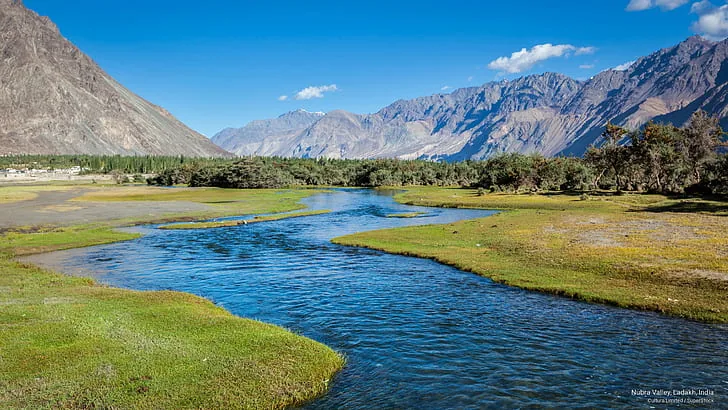
Nubra Valley, India
For centuries, Nubra was a vital junction
For centuries, Nubra was a vital junction on the Silk Road, the last major stop for caravans heading north over the Karakoram Pass toward Yarkand and Central Asia. Traders would rest their Bactrian camels here, exchanging spices, silk, and wool for the journey ahead. This history is written in the faces of the locals and the presence of the double-humped camels that still roam the Hunder dunes, descendants of the original caravan animals. The spiritual life of the valley is anchored by the Diskit Monastery, a fourteenth-century Tibetan Buddhist gompa that clings to a rocky spur. It is a sentinel over the valley, housing a colossal thirty-two-meter statue of the Maitreya Buddha that was inaugurated by the Dalai Lama to promote world peace.
The descent into the valley from the Khardung
La pass is a dizzying drop through clouds and scree slopes. The sense is the pressure in your ears shift and the sun become more intense as you reach the valley floor. Through the Hunder dunes, The surreal sight of snow-capped mountains framing the desert sand. Something of the coarse, thick wool of the camels and the bite of the evening wind that turns the sky a deep, bruised indigo. In the villages like Turtuk, which only opened to tourists in 2010, the culture is Balti rather than Ladakhi, and the air is full of rushing meltwater in stone channels. The light here has a crystalline quality that makes the distant glaciers look close enough to touch.
Reaching Nubra requires a five-hour drive from Leh
Reaching Nubra requires a five-hour drive from Leh, crossing the Khardung La, which is famously claimed to be one of the highest motorable roads in the world. The journey is a test of nerves and stomach, involving hair-pin bends and unpaved sections where the road is frequently washed away by mountain streams. An Inner Line Permit is mandatory for all visitors, as the valley sits close to the sensitive borders with Pakistan and China. People typically spend at least two nights in the valley to acclimatize to the altitude and to witness the shifting colors of the dunes at dawn when the mountains cast long, dramatic shadows across the sand.
“Reaching Nubra requires a five-hour drive from Leh, crossing the Khardung La, which is famously claimed to be one of the highest motorable roads in the world.”
The Experience
The silence in Nubra is so absolute that you can hear the heartbeat in your ears. What grabs you is the smell of the sun-baked earth and the faint, sweet aroma of drying apricots on rooftops. The light at Diskit Monastery during the morning prayer is soft and gold, illuminating the swirling smoke of juniper incense. The temperature plummet the moment the sun drops behind the peaks, a mark of the valley’s high-altitude reality. Sitting on a sand dune at Hunder, watching the stars emerge in a sky devoid of light pollution, you feel like you are perched on the very roof of the world.
Why It Matters
Nubra Valley is a living museum of the Silk Road and a critical ecological zone for high-altitude flora and fauna. Culturally, it represents the meeting point of Tibetan Buddhism and Balti Islam. It is a rare example of an ancient trade landscape that has remained physically unchanged by the industrial age.
Why Visit
Visit Nubra for the sheer geographical impossibility of it. Nowhere else can you experience the intersection of high-mountain glaciers, desert dunes, and lush orchards in a single day. It offers a scale of solitude and a clarity of light that makes the rest of the world feel cluttered and dim.
Insider Tips
- 1
Carry several copies of your Inner Line Permit; you will need to hand them over at various military checkpoints along the route.
- 2
Stay in Turtuk for at least one night to experience a Balti culture that is entirely distinct from the rest of Ladakh.
- 3
Bring high-altitude sickness medication and stay hydrated; the dryness of the air is as challenging as the thinness of the oxygen.
- 4
The hot springs at Panamik are best visited in the early morning before the midday sun makes the sulfur smell too intense.
- 5
Look for the wild sea buckthorn berries; they are a local superfood and the juice is tart, refreshing, and packed with vitamins.