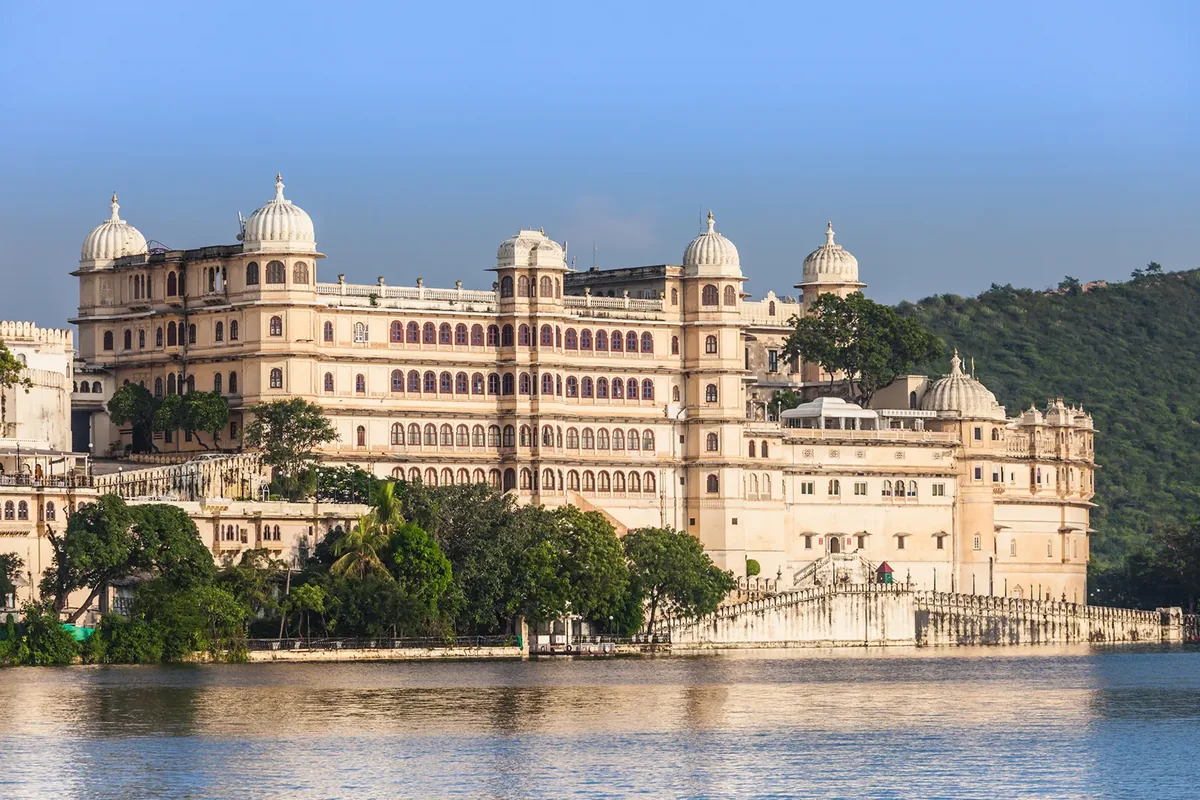
Started in 1559 and expanded by twenty-two different kings, this vertical fortress of glass and granite never lost its architectural soul despite four hundred years of construction.
About City Palace
Udaipur was chosen as a capital for its natural defenses, the surrounding mountains and the man-made lake offered protection that the plains of Chittorgarh lacked. The palace was not just a residence but a military stronghold, with walls designed to withstand cannon fire and secret exits leading to the hills. Throughout the British Raj, the Maharanas maintained their status as the highest-ranking princes in Rajasthan, hosting grand durbars in the Manak Mahal. After India's independence, the royal family converted much of the palace into a world-class museum to preserve the Mewar legacy, though they still reside in a private wing of the complex today.
What City Palace is
Udaipur’s City Palace rises from the eastern banks of Lake Pichola like a series of ivory-colored granite waves. This is the largest palace complex in Rajasthan, a dizzying vertical maze of courtyards, pavilions, and hanging gardens that seem to defy gravity. On all sides, The air is often cooled by the lake breeze, carrying the faint, metallic scent of the water and the dry aroma of sun-baked stone. Inside, the palace is a masterclass in Mewari opulence, where walls are encrusted with glass mosaics, colored mirrors, and intricate miniatures. You navigate a landscape of narrow, winding passages designed to confuse invaders, leading suddenly into vast, sun-drenched squares where the Maharana once held court under the watchful gaze of the Sun God.
“Udaipur’s City Palace rises from the eastern banks of Lake Pichola like a series of ivory-colored granite waves.”
City Palace, India
of this palace, 1559
Maharana Udai Singh II began the construction of this palace in 1559 after moving his capital from the besieged fort of Chittorgarh. Strategically perched on a ridge, the palace was expanded by twenty-two successive rulers over the next four centuries. Each Maharana added his own wing or courtyard, yet the entire complex maintains a surprising visual harmony. The Mewar dynasty claims descent from the sun, a lineage reflected in the giant gold sun emblems that decorate the palace gates. Unlike many other Indian kingdoms that allied with the Mughals, the Maharanas of Udaipur remained fiercely independent for centuries, and this palace was the unyielding bastion of their sovereignty and pride.
Walking through the Tripoliya Gate,
Walking through the Tripoliya Gate, The immense scale of the facade, characterized by hundreds of balconies and towers. The smooth, cool texture of the white marble floors and notice the brilliant blue tiles of the Mor Chowk, where three peacocks are rendered in a collection of five thousand glass pieces. You navigate steep, narrow staircases that open into the Zenana Mahal, the former women's quarters, now filled with royal carriages and costumes. The smell of ancient wood and a trace of oil paint in the galleries of Mewar miniatures. The view from the upper balconies is the highlight; the entire city of Udaipur and its floating Lake Palace are spread out below you like a detailed watercolor painting.
Udaipur is easily reached by air
Udaipur is easily reached by air from Delhi or Mumbai, or by the luxury trains that traverse the Rajasthani desert. The palace is the central landmark of the old city, and most visitors arrive by rickshaw or on foot through the busy Jagdish Temple street. The complex is divided into several museum sections and two heritage hotels; a separate ticket is required for the main museum. Arriving in the late afternoon allows you to see the sun dip behind the Aravalli hills from the palace heights, turning the white granite into a soft, glowing rose gold before the city lights begin to flicker across the surface of Lake Pichola.
“Udaipur is easily reached by air from Delhi or Mumbai, or by the luxury trains that traverse the Rajasthani desert.”
The Experience
The soundscape of the City Palace is a mix of echoing footsteps on stone and the distant calls of street vendors in the bazaar below. The standout is the play of light through colored glass windows, casting red and green patterns on the white floors. There is a weight of history in the Armory, where the sheer size and variety of Rajput weapons speak to a past of constant conflict. The most serene moment is found in the Badi Mahal, a garden built at the highest point of the palace, where full-grown trees grow out of the stone floor because the courtyard is actually resting on top of a natural hill.
Why It Matters
The City Palace is the definitive symbol of Rajput resilience and artistic patronage. It houses one of the best collections of royal artifacts in India and remains a living proof of the Mewar dynasty’s continuity. Architecturally, it is a unique synthesis of Rajasthani, Mughal, and even European influences, blended into a style that is uniquely 'Udaipuri.'
Why Visit
The view alone, but stay for the detail. While other Rajasthani palaces feel like empty museums, the City Palace feels like the royal family just stepped out for a moment. It offers a density of art and architecture that makes it the most rewarding cultural stop in the entire state.
Insider Tips
- 1
Hire a private guide at the entrance to navigate the confusing layout and hear the specific family legends of each courtyard.
- 2
The Crystal Gallery in the Fateh Prakash Palace wing requires an extra ticket but houses a bizarre and beautiful collection of furniture made entirely of crystal.
- 3
Visit the Vintage Car Museum nearby to see the royal family’s collection, including the Rolls Royce used in the James Bond film Octopussy.
- 4
Wear comfortable shoes with good grip; the narrow staircases are steep and the stone can be slippery in humid weather.