In this small pocket of Kerala, you can walk from a 16th-century Portuguese church to a Jewish synagogue with Chinese tiles, all while watching the sun set behind ancient Chinese fishing nets.
About Fort Kochi
Fort Kochi’s importance began after a massive flood in 1341 created a natural harbor, leading to the decline of the ancient port of Muziris. It became the hub of the spice trade, attracting traders from as far away as the court of Kublai Khan and the palaces of Europe. The town’s layout remains largely as the Dutch left it in the 17th century, with its grid of streets and open parade grounds. After India's independence, the fort lost its strategic military importance but gained status as a cultural sanctuary, preserving a polyglot heritage that is unique in the subcontinent. It is now a place where history is not just preserved but lived in by a diverse community of artists and craftsmen.
What Fort Kochi actually is
Fort Kochi is a humid, sun-dappled scrap of history where the Arabian Sea meets a labyrinth of colonial backstreets. This is the oldest European settlement in India, a place where the architecture is a palimpsest of Portuguese, Dutch, and British influences. The air air here smells of fermenting fish, cloves, and the salty dampness of the harbor. You walk through streets lined with rain-washed yellow bungalows and massive rain trees whose branches form a permanent green canopy. The sound is a mix of the rhythmic creaking of the massive Chinese fishing nets and the tolling of bells from 16th-century churches. It is a place of slow, liquid time, where the modern world feels like a distant, irrelevant rumor.
“Fort Kochi is a humid, sun-dappled scrap of history where the Arabian Sea meets a labyrinth of colonial backstreets.”
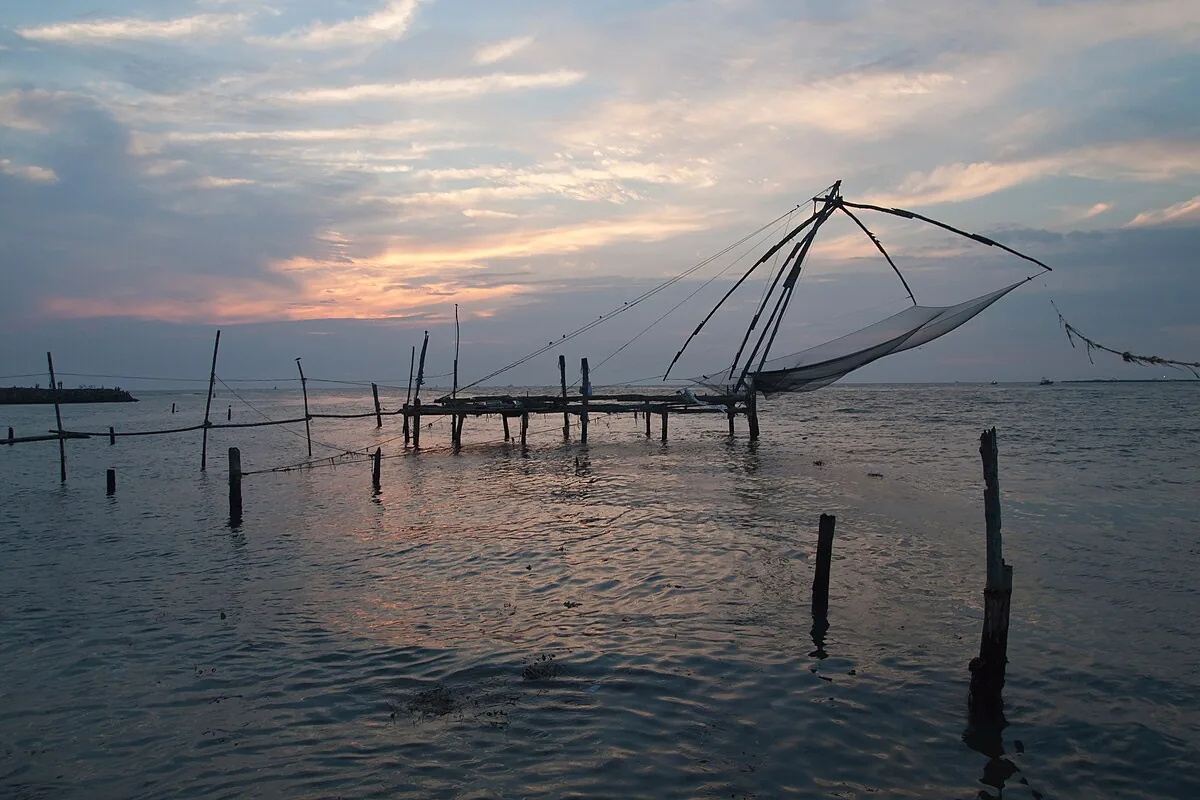
Fort Kochi, India
In 1503, the Raja of Kochi
In 1503, the Raja of Kochi granted the Portuguese permission to build Fort Emmanuel, making it the first European fort in India. For the next five centuries, the town became a prize in the global spice trade, changing hands between the Portuguese, the Dutch, and finally the British in 1795. This history is anchored by the St. Francis Church, where Vasco da Gama was originally buried, and the nearby 'Dutch' Palace, which was actually built by the Portuguese and renovated by the Dutch as a gift for the Raja. The town’s unique Jewish quarter, or Jew Town, dates back to the 12th century, with its synagogue paved in hand-painted Chinese tiles, representing the deep cosmopolitan roots of this Malabar coast outpost.
Walking along the waterfront at sunset,
Walking along the waterfront at sunset, The cool spray of the Arabian Sea and watch the massive cantilevered Chinese fishing nets being lowered into the water like giant wooden spiders. You come across a texture of the crumbling laterite walls and notice the vibrant street art that now decorates the colonial facades. The space in the spice markets is a sensory explosion, sacks of ginger, cardamom, and black pepper piled high in dark, cool godowns. The soft light filtering through the stained glass of the Santa Cruz Basilica and the sound of the evening prayer from the nearby mosques. The experience is defined by the ferry rides; for a few rupees, you can cross the harbor, feeling the wind in your hair as the colonial skyline of the fort recedes. Fort Kochi is part of the larger city of Kochi, which is a major international gateway with its own airport and railway stations. The best way to reach the fort from the mainland is via the public ferry from Ernakulam, a twenty-minute journey that avoids the city’s traffic. The fort itself is a walking town, though bicycles and rickshaws are readily available. Staying in a converted heritage hotel, many of which are centuries-old houses, allows you to experience the town’s quietest hours before the day-trippers arrive. The town is most alive during the Kochi-Muziris Biennale, a massive contemporary art festival that transforms the old warehouses into cutting-edge galleries.
The Experience
Inside Fort Kochi has a heavy, nostalgic quality that slows your heart rate. First, the smell of freshly grilled fish at the seaside stalls, where you can buy the catch of the day and have it cooked on the spot. A remnant of the vibration of the Kathakali drums from a nearby theater, a sound that has signaled the start of performances for centuries. The most evocative moment is found in the quiet backstreets behind the harbor, where the only sound is the rustle of the sea breeze through the coconut palms and the occasional creak of an old wooden gate. It is a town that encourages you to linger over a cup of tea and watch the ships move slowly toward the horizon.
Why It Matters
Fort Kochi is the primary archive of India’s colonial maritime history and a model of multicultural coexistence. It houses some of the oldest European monuments in Asia and remains a critical center for traditional arts like Kathakali and Kalaripayattu. Culturally, it has reinvented itself as the art capital of India, bridging the gap between ancient spice routes and modern creative expression.
Why Visit
Visit Fort Kochi for the vibe, a word that is overused but perfectly fits this place. It is the antithesis of the loud, hurried Indian metropolis. You come here for the history, but you stay because it is one of the few places in India where you can truly walk for hours, losing yourself in a dream of old maps and salt-stained walls.
Insider Tips
- 1
Take the public ferry from Ernakulam Jetty instead of a taxi; it is faster, cheaper, and offers the best views of the harbor.
- 2
Visit the Jewish Synagogue early in the morning to see the sunlight hit the hand-painted floor tiles before the crowds arrive.
- 3
Check out a Kathakali performance at the Kerala Kathakali Centre, and arrive an hour early to watch the performers apply their elaborate makeup.
- 4
Buy spices from the government-authorized outlets in Jew Town to ensure you are getting the highest quality Malabar pepper.
- 5
The Kochi-Muziris Biennale runs every two years from December to March; if your visit coincides, allow at least two full days just for the art.