A century ago, not a single rhinoceros could be found in these marshes; today, you can witness over two thousand of these armor-plated survivors thriving in the tall grass.
About Kaziranga National Park
The park was officially opened to visitors in 1938, but the real transformation occurred in 1974 when it was designated a National Park. It survived decades of poaching threats and severe flooding that often reshapes the entire geography of the marshes. The Brahmaputra acts as both a provider and a destroyer, depositing fertile soil while occasionally washing away large sections of the habitat. This dynamic environment has forced the park management to develop one of the most rigorous anti-poaching and flood-rescue systems in the world, involving forest guards who live in remote camps for months at a time.
Kaziranga National Park in short
Tall elephant grass swallows everything in Kaziranga, creating a shimmering wall of green that hides prehistoric giants. The Brahmaputra River defines the northern boundary of this flood-prone sanctuary, regularly spilling its silt-rich waters to nourish the sprawling marshlands. Here, It smells of wet earth and wild ginger, often thick with a morning mist that clings to the tops of the tropical moist broadleaf forests. Moving through a landscape that feels unchanged since the Pleistocene, where the silence is only broken by the sharp alarm call of a hog deer or the heavy, rhythmic splashing of a water buffalo in a hidden bhil. The sun sets behind the Karbi Anglong hills, casting long shadows over the tall reeds that house two-thirds of the world’s remaining great one-horned rhinoceros population.
“Tall elephant grass swallows everything in Kaziranga, creating a shimmering wall of green that hides prehistoric giants.”
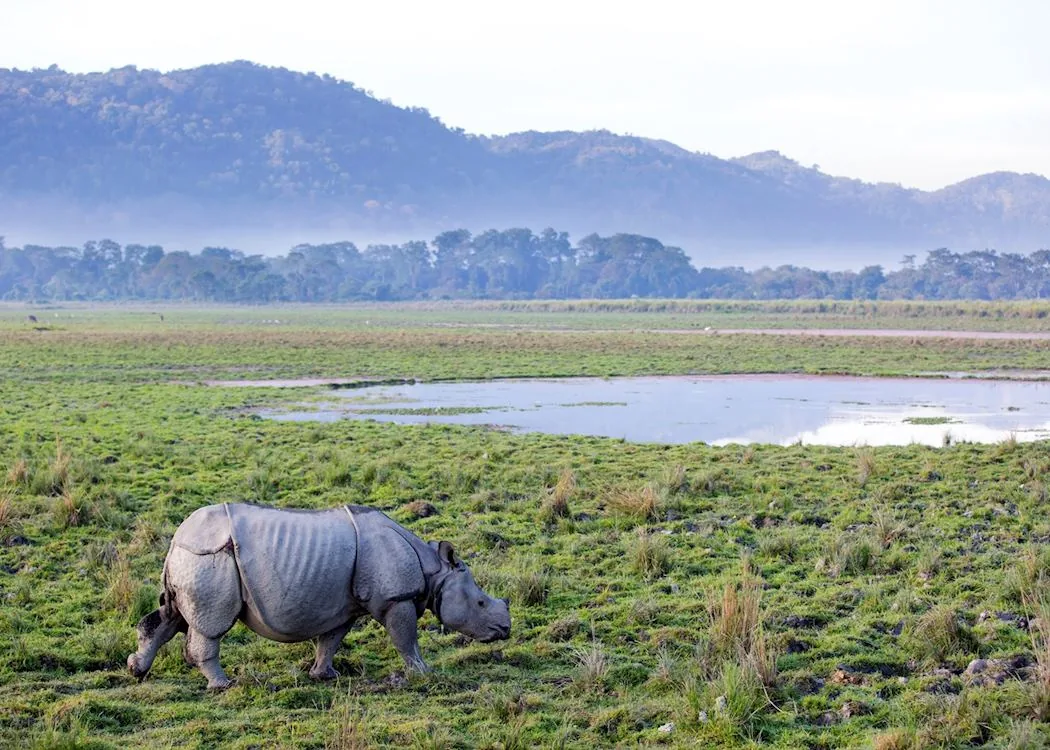
Kaziranga National Park, India
Sitting atop a jeep at daybreak,
Sitting atop a jeep at daybreak, The bite of the Assamese winter air as the vehicle rumbles into the Kohora range. The mist gradually thins to reveal the massive, armor-plated silhouette of a rhino grazing just yards from the track. The deep folds in its grey skin, looking like hammered metal encrusted with mud. The birdlife is staggering; The sudden rush of air as a Great Indian Hornbill takes flight, its heavy wings sounding like a steam engine. In the afternoon, the light turns a golden amber, illuminating the swampy lakes where pelicans and storks stand as motionless as statues. The humidity remains high even in winter, a constant reminder that you are deep within the Brahmaputra valley. Jorhat and Guwahati serve as the primary gateways, both connected to major Indian cities by air and rail. From Guwahati, a five-hour drive through the tea estates of Upper Assam brings you to the park’s main gate. People typically choose to stay in one of the lodges scattered around the Kohora or Bagori ranges. Access to the interior is strictly controlled via pre-booked safaris, and while jeep tours cover more ground, the early morning elephant rides offer a quiet, elevated perspective that allows you to drift almost unnoticed through the towering grass where the rhinos sleep.
visited this region, 1904
Mary Curzon, the wife of the Viceroy of India, visited this region in 1904 specifically to see a rhinoceros. After failing to spot a single animal, she persuaded her husband to take urgent measures to protect the species from extinction. Kaziranga was subsequently declared a Proposed Reserve Forest in 1905, marking the birth of one of Asia’s most successful conservation stories. Over the decades, the park grew in size and status, eventually earning UNESCO recognition in 1985. The local Karbi and Mising tribes have lived on the fringes of these swamps for generations, their lives dictated by the same seasonal floods that force the wildlife to migrate toward the safety of the southern highlands every monsoon.
The Experience
The soundscape of Kaziranga is dominated by the low hum of insects and the distant, guttural grunts of buffalo. You discover a vibration of the jeep's engine dying down as the driver spots a tiger's pugmark in the damp sand. The sharp, pungent scent of rhino dung, which these animals use as territorial markers in the dense brush. What sticks with you is the stillness of the Donga view point at noon, where the water is so flat it perfectly mirrors the blue Himalayan sky, and the only movement is the slow, prehistoric drift of a monitor lizard across a log.
Why It Matters
Kaziranga is a global conservation icon, representing the recovery of a species that was on the brink of vanishing forever. It is one of the few places in the world where the 'Big Five', rhino, tiger, elephant, buffalo, and swamp deer, can be seen in a single day. Ecologically, it serves as one of the last undisturbed habitats in the Indo-Malayan region.
Why Visit
Visit Kaziranga because it offers a raw, unmanicured wilderness that makes other parks look like landscaped gardens. It is the only place where you can look into the eye of a prehistoric beast from just a few meters away. You come here to witness the sheer power of nature in a landscape that refuses to be tamed by human intervention.
Insider Tips
- 1
Book a safari in the Agaratoli range for the best birdwatching, as it remains far quieter than the tourist-heavy central ranges.
- 2
Wear layers of neutral-colored clothing; the morning temperature in the open jeep can be near freezing even when the afternoons are hot.
- 3
Ask your driver to stop near the 'Hollock Gibbon' habitats in the woodland patches for a chance to see India’s only ape.
- 4
Bring high-quality binoculars; the vastness of the marshlands means many of the most dramatic predator-prey sightings happen at a distance.
- 5
Support the local Mising weavers by visiting the handloom cooperatives in the peripheral villages during your midday break.